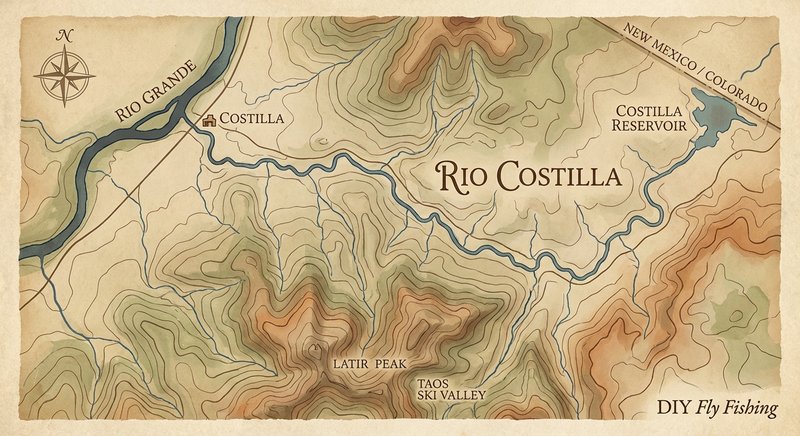
Rio Costilla
Fly fishing in New Mexico · Intermediate · Best seasons: Summer, Fall
Target Species
Cutthroat Trout, Rainbow Trout
About This Water
High elevation stream with native Rio Grande cutthroat trout. Beautiful northern New Mexico scenery.
Fishing Recommendations
The Rio Costilla is a crown jewel of New Mexico fly fishing. Tucked away in the Sangre de Cristo Mountains near the Colorado border, it offers a quintessential high-country meadow fishing experience. Whether you are fishing the private RCCLA (Rio Costilla Cooperative Livestock Association) acreage or the legendary Valle Vidal unit of the Carson National Forest, this is a destination every serious trout angler should visit.
🎣 Location Overview
The Rio Costilla is a relatively small, meandering meadow stream set at approximately 8,000 to 9,000 feet in elevation. It is famous for its "S-curves"—tight, serpentine bends that create deep undercut banks and perfect holding water.
What makes this water special is the scenery and the purity of the experience. You are fishing in wide-open alpine valleys surrounded by peaks, with elk and bison often visible in the distance. The water is crystal clear and generally shallow, making it a "sight-fishing" paradise. It is divided into two main sections:
- The Rio Costilla Park (RCCLA): Private land open to the public for a fee. It features the Latir Lakes and several miles of the river below the Costilla Dam.
- The Valle Vidal: A 100,000-acre paradise of public land. The Comanche Creek (a major tributary) and the Rio Costilla here are world-renowned for native trout restoration.
🐟 Target Species & Behavior
The Rio Costilla is one of the premier locations to catch the Rio Grande Cutthroat Trout, New Mexico’s state fish. You will also find Rainbow Trout, particularly in the lower reaches and stocked areas of the Park.
- Rio Grande Cutthroats: These fish are opportunistic but wary. They thrive in the cold, oxygenated water of the high meadows. They are famously surface-oriented; if there is a bug on the water, they will look up.
- Behavior: Because the water is clear and the banks are flat, these fish are "spooky." They hold tightly against undercut banks and in the shadows of the "foam lines" on the bends.
- Feeding: In mid-summer, they become "terrestrial junkies," waiting for grasshoppers, ants, and beetles to blow off the meadow grasses into the water.
📅 Best Times to Fish
- Optimal Months: July through September is the prime window.
- Note: The Valle Vidal section typically does not open until July 1st to protect the Rio Grande Cutthroat spawning season.
- Summer: This is the season of the "Hopper-Dropper." The fishing is consistent from late morning through the evening.
- Fall: September and early October offer breathtaking scenery as the aspens turn gold. The fish become more aggressive as they prepare for winter, and the crowds thin out.
- Best Time of Day: Unlike lower elevation rivers, you don't need to be there at dawn. The high-altitude water is cold; the fishing usually turns on around 10:00 AM once the sun hits the water and wakes up the insects.
🪰 Recommended Flies & Techniques
Presentation on the Costilla is more important than the specific fly, but you want to match the "meadow buffet."
Top Fly Patterns
- Dry Flies:
- Terrestrials: Amy’s Ant (size 12-14), Chubby Chernobyl (tan or orange, size 12), and Joe’s Hopper.
- Attractors: Royal Wulff, Stimulators (yellow/orange), and Parachute Adams (size 16-20).
- Midges/Mayflies: Blue Winged Olive (BWO) patterns for cloudy days.
- Nymphs:
- Pheasant Tail (bead-head, size 16-18), Gold-ribbed Hare’s Ear, and Zebra Midges (black or red, size 18-22).
Techniques
- The Dry-Dropper: This is the gold standard here. Use a buoyant foam hopper as your indicator and hang a small Pheasant Tail or Zebra Midge 18–24 inches below it.
- Stealth Approach: This is critical. Because there are no trees to hide behind in the meadows, you must stay low. Experienced anglers often fish from their knees to avoid casting a shadow over the water.
- The "Reach Cast": Since the current varies significantly between the middle of the stream and the undercut banks, a reach cast will help you get a drag-free drift.
💡 Pro Tips & Local Knowledge
- The "Vidal" Secret: If the main Rio Costilla is crowded, hike up Comanche Creek. It is smaller water, but it is packed with hungry, native Rio Grande Cutthroats that rarely see a fly.
- Watch the Wind: The meadows get windy in the afternoon. Instead of fighting it, use it. The wind blows grasshoppers into the water; a "splat" delivery with a hopper pattern can actually trigger a strike.
- Manage Your Shadow: Always fish with the sun in your face when possible. If your shadow hits the pool before your fly does, the fish will vanish into the undercuts.
- Check the Flow: The Rio Costilla is a "tailwater" below the Costilla Reservoir. Flows can change based on irrigation needs. Always check the USGS gauges before driving up.
⚠️ Important Information
- Access & Permits:
- RCCLA (The Park): You must purchase a daily fishing permit at the gatehouse or the park office in Costilla, NM.
- Valle Vidal: Requires a standard New Mexico Habitat Stamp and a valid NM Fishing License.
- Regulations: The Valle Vidal is largely Catch and Release for Cutthroat trout. Always use barbless hooks to ensure the survival of these native gems.
- Safety: This is remote country. There is zero cell service. Bring a spare tire, plenty of water, and bear spray—this is prime Black Bear and Mountain Lion habitat.
- Wading: The bottom is often silty or grassy. You don't need heavy waders in mid-summer; "wet wading" with quick-dry pants and wading boots is often more comfortable.
The Rio Costilla isn't just a fishing trip; it's an immersion into one of the last truly wild places in the Southwest. Treat the native Cutthroats with respect, and they will give you a day of fishing you’ll never forget.
Bug Hatches & Matching Flies
| Hatch | Type | Peak months | Time of day | Hook sizes | Matching flies |
|---|---|---|---|---|---|
| Blue Winged Olive Baetis | mayfly | May, September, October | Late Morning/Afternoon | #18-22 | RS2 #20-22, Parachute Adams #18-22, BWO CDC Emerger #18-20 |
| Pale Morning Dun Ephemerella | mayfly | June, July, August | Late Morning/Early Afternoon | #14-18 | PMD Sparkle Dun #16-18, Pheasant Tail Nymph #14-18, Quill Gordon #14-16 |
| Grasshoppers Orthoptera | terrestrial | July, August, September | Late Morning/Afternoon | #8-12 | Amy's Ant #10-12, Charlie Boy Hopper #8-12, Parachute Hopper #10-14 |
| Spotted Sedge / Tan Caddis Hydropsyche | caddis | June, July, August | Evening | #14-18 | Elk Hair Caddis #14-18, LaFontaine's Deep Sparkle Pupa #14-16, Caddis Variant #14-18 |
| Golden Stonefly Hesperoperla pacifica | stonefly | June, July | Morning/Afternoon | #8-12 | 20 Incher Stone #8-12, Pat's Rubber Leg #8-12, Golden Stimulator #10-14 |
| Tricos Tricorythodes | mayfly | August, September | Early Morning | #20-24 | Trico Spinner #20-24, Sunken Trico Spinner #22-24 |
| Carpenter Ants and Beetles Formicidae / Coleoptera | terrestrial | June, July, August | All Day | #12-18 | Cinnamon Ant #14-18, Black Foam Beetle #12-16 |
| Common Midge Chironomidae | midge | May, June, July, August, September, October | Morning | #18-24 | Zebra Midge #18-22, Griffith's Gnat #18-22, Top Secret Midge #20-22 |