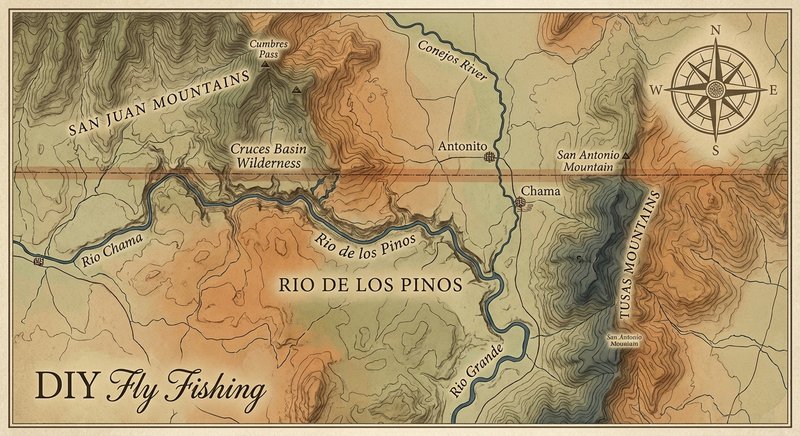
Rio de los Pinos
Fly fishing in New Mexico · Intermediate · Best seasons: Summer, Fall
Target Species
Brown Trout, Rainbow Trout
About This Water
Remote northern stream with excellent wild trout fishing. Less pressured than popular waters.
Fishing Recommendations
The Rio de los Pinos is one of Northern New Mexico’s best-kept secrets. Tucked away near the Colorado border, north of Tres Piedras and west of Antonito, this river offers a quintessential "high country" fly fishing experience. It lacks the crowds of the nearby San Juan or even the Conejos, providing a rugged, intimate setting for anglers who value solitude and wild fish.
🎣 Location Overview
The Rio de los Pinos (River of the Pines) is a medium-to-small freestone stream that meanders through a mix of high-alpine meadows, steep rocky canyons, and dense coniferous forests.
What makes it special is its diversity of water. In the lower sections (near the Los Pinos State Wildlife Area), you’ll find classic meadow oxbows with deep undercut banks. As you move upstream toward the Cruces Basin Wilderness, the river transforms into a high-gradient canyon with classic pocket water, plunge pools, and boulder gardens. It is a river that rewards the "blue-lining" enthusiast—the further you are willing to hike, the better the fishing becomes.
🐟 Target Species & Behavior
The river is home to a healthy population of Brown Trout and Rainbow Trout.
- Brown Trout: These are the stars of the Rio de los Pinos. While many are in the 8–12 inch range, the deep undercut banks and canyon pools hold "surprises" in the 16–18 inch class. They are notoriously "spooky" in the clear meadow sections and require a stealthy approach.
- Rainbow Trout: Found primarily in the faster riffles and well-oxygenated pocket water. Many are wild or long-term holdovers, displaying vibrant colors and high energy.
- Behavior: In the summer, these fish are opportunistic feeders, looking upward for terrestrials. In the fall, the Brown trout become highly aggressive as they prepare for the spawn, often moving out of deep holes into the tail-outs of pools.
📅 Best Times to Fish
Summer (Late June – August)
This is the prime window for dry fly enthusiasts. Once the spring runoff subsides (usually by mid-June), the water clears and the insect life explodes.
- Time of Day: Early morning for nymphing; 10:00 AM – 4:00 PM for hatches and terrestrials.
- Conditions: Watch for the "Monsoon" rains in July and August. Afternoon thunderstorms can cause temporary "blow-outs," but the river clears quickly.
Fall (September – October)
Many guides consider this the best time of year. The cottonwoods turn gold, the air is crisp, and the Brown trout are at their most aggressive.
- Time of Day: "Banker’s hours"—the water needs to warm up slightly, so 11:00 AM to 5:00 PM is peak.
- Conditions: Low, crystal-clear water. Long leaders and stealth are mandatory.
🪰 Recommended Flies & Techniques
Dry-Dropper (The Go-To Method)
Because the water is often shallow or pocketed, a dry-dropper rig is the most effective way to cover water without spooking fish with a heavy indicator.
- Top Dry Flies:
- Terrestrials: Amy’s Ant (Size 12), Hippie Stomper (Size 14), and Dave’s Hopper (Size 10-12).
- Attractors: Royal Wulff, Stimulators (Orange or Yellow, Size 14), and Parachute Adams.
- Top Nymphs:
- Bead-head Pheasant Tails (Size 16-18), Copper Johns (Red or Blue, Size 16), and Perdigons (for fast canyon water).
Streamer Fishing
In the fall, or in the deep canyon pools, don't be afraid to throw meat.
- Patterns: Wooly Buggers (Olive or Black, Size 8-10) or small Sparkle Minnows.
- Technique: "Pound the banks" in the meadow sections or swing through the tail-outs of the larger pools.
💡 Pro Tips & Local Knowledge
- The "Crawl" Approach: In the meadow sections, the fish can see you from a distance. If you see a rising fish near an undercut bank, literally crawl to the bank on your knees. If your shadow hits the water, the pool is "done" for 30 minutes.
- Fish the "Wrong" Side: Most anglers stand on the easy bank and cast to the far side. If you can safely cross, fish the bank everyone else is standing on; the fish often tuck right under the feet of unaware anglers.
- The Cumbres & Toltec Railroad: The historic steam train runs right along sections of this river. It’s a spectacular sight, but be aware that the whistle and vibration can occasionally "put down" the fish in the immediate vicinity for a few minutes.
- Pocket Water Speed: In the canyon sections, don't linger too long in one spot. Two or three drifts in a pocket are enough. If there's a hungry trout there, they will hit it almost instantly.
⚠️ Important Information
- Access: The Los Pinos State Wildlife Area (SWA) provides excellent public access. Access is also available via Forest Road 284. Be mindful of private property fences, particularly near the San Miguel area.
- Regulations: New Mexico fishing licenses are required. Check the current NM Department of Game and Fish (NMDGF) "Trout Water" classifications, as some sections may have specific bag limits or tackle restrictions (barbless hooks are always a good idea here).
- The "Border" Issue: The river meanders back and forth across the NM/CO border in certain reaches. Ensure you know where you are, or better yet, carry a license for both states if you plan on trekking deep into the backcountry.
- Safety: This is remote country. Cell service is non-existent. Ensure you have a spare tire (the roads are rocky), plenty of water, and bear spray, as both Black Bears and Mountain Lions frequent the Cruces Basin.
Bug Hatches & Matching Flies
| Hatch | Type | Peak months | Time of day | Hook sizes | Matching flies |
|---|---|---|---|---|---|
| Blue Winged Olive Baetis tricaudatus | mayfly | March, April, September, October | Late Morning/Afternoon | #18-22 | RS2 #18-22, Parachute Adams #18-22, Pheasant Tail Nymph #18-20 |
| Pale Morning Dun Ephemerella excrucians | mayfly | June, July | Morning/Midday | #16-18 | PMD Sparkle Dun #16-18, Frenchie #16-18, Barr's PMD Emerger #16-18 |
| Green Drake Drunella doddsii | mayfly | June, July | Afternoon | #10-12 | Hair Wing Green Drake #10-12, 20 Incher Stone #10-12, Quigley Cripple #10-12 |
| Mother's Day Caddis Brachycentrus occidentalis | caddis | May | All Day | #14-16 | Peacock Caddis #14-16, Guide's Choice Hare's Ear #14-16, LaFontaine's Deep Sparkle Pupa #14-16 |
| Golden Stonefly Hesperoperla pacifica | stonefly | June, July | Morning/Evening | #8-12 | Pats Rubber Legs #8-12, Chubby Chernobyl (Gold) #8-12, Golden Stimulator #10-14 |
| Spotted Sedge Hydropsyche | caddis | July, August, September | Evening | #14-18 | Elk Hair Caddis (Tan) #14-18, Holy Grail #16-18, Caddis Larva #14-16 |
| Terrestrials (Grasshoppers) Orthoptera | terrestrial | August, September | Midday/Afternoon | #8-12 | Morrish Hopper #8-12, Dave's Hopper #10-12, Amy's Ant #10-14 |
| Western Black Midge Chironomidae | midge | January, February, March, December | Midday | #20-24 | Zebra Midge #20-22, Griffith's Gnat #20-22, Top Secret Midge #20-24 |