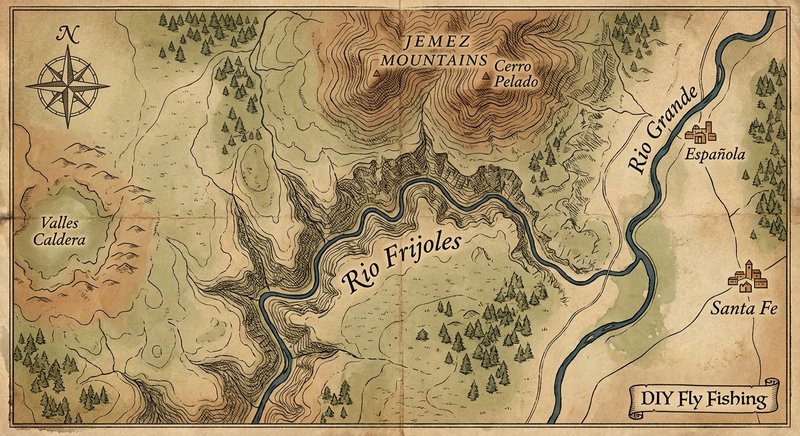
Rio Frijoles
Fly fishing in New Mexico · Intermediate · Best seasons: Summer, Fall
Target Species
Rainbow Trout, Brown Trout
About This Water
Stream in Bandelier National Monument. Small wild trout in historic setting.
Fishing Recommendations
As an expert guide who has spent years exploring the high-desert drainages of the Southwest, I can tell you that Rio Frijoles is one of New Mexico's most enchanting, yet fragile, hidden gems. Located primarily within Bandelier National Monument, this is not a river for the trophy hunter; it is a sanctuary for the "blue-liner"—the angler who prizes solitude, wild scenery, and technical small-water stalking.
Here is your comprehensive guide to fly fishing the Rio Frijoles.
🎣 Location Overview
The Rio Frijoles (River of Beans) is a small, spring-fed stream that has carved a breathtaking canyon through the volcanic tuff of the Pajarito Plateau. What makes this water special is the juxtaposition of world-class archaeology and wild trout. As you hike into the canyon, you pass ancient Ancestral Puebloan cliff dwellings before reaching the riparian ribbon of water.
The water is characterized by its intimacy. It is a "pocket water" stream, featuring tight bends, undercut banks, and small plunge pools. Following the 2011 Las Conchas fire and subsequent flooding, the stream has undergone significant changes, but it remains a resilient ecosystem where wild trout thrive in a high-desert environment.
🐟 Target Species & Behavior
The Rio Frijoles holds Wild Brown Trout and Rainbow Trout.
- Behavior: These fish are extremely "spooky." Because the water is often crystal clear and the stream is narrow, the trout have evolved a high sensitivity to shadows and vibrations on the bank.
- Holding Patterns: Look for fish in the deeper "buckets" at the base of small waterfalls and tucked tightly under the overhanging grass of the banks.
- Feeding: They are opportunistic feeders. Due to the limited nutrient load in high-elevation desert streams, they can’t afford to be too picky, but your presentation must be flawless.
📅 Best Times to Fish
Optimal Seasons
- Summer (Late June – August): This is the prime window for terrestrial fishing. However, you must be wary of the "Monsoon Season" (July/August). Afternoon thunderstorms can cause rapid, dangerous flash floods in the canyon.
- Fall (September – October): My personal favorite time. The cottonwoods turn gold, the air is crisp, and the Brown Trout become more aggressive as they prepare for the spawn. Water levels are usually stable.
Best Times of Day
- Early Morning: Before the sun hits the canyon floor. The fish are more comfortable moving out of cover.
- Late Afternoon/Dusk: As shadows stretch across the water, the evening rise can be prolific.
🪰 Recommended Flies & Techniques
Because the stream is small and often brushy, gear down to a 2-weight or 3-weight rod (7’ to 8’ length is ideal).
Top Fly Patterns
- Dry Flies: Parachute Adams (#16–20), Elk Hair Caddis (#14–18), and the Royal Wulff (#16).
- Terrestrials: Dave’s Hopper (#12), Black Ants (#16–18), and Foam Beetles. In the summer, a beetle dropped near an undercut bank is deadly.
- Nymphs: Bead-head Pheasant Tails (#18–20), Copper Johns (#18), and Zebra Midges (#20).
- Streamers: Very small Wooly Buggers (#10–12) in olive or black, but only in the deeper pools.
Effective Techniques
- The Dry-Dropper: This is the "bread and butter" of the Rio Frijoles. Use a buoyant dry (like a Stimulator) with a small nymph tied 12–18 inches below it.
- Stealth Approach: Crawl if you have to. If you can see the fish, they have likely already seen you. Always fish upstream to stay behind the fish’s field of vision.
- Bow-and-Arrow Cast: You will encounter tight brush. Mastery of the bow-and-arrow cast is essential to get your fly into the tightest "lion holes."
💡 Pro Tips & Local Knowledge
- Go High or Go Low: Most casual anglers stay near the Bandelier Visitor Center. To find the best fishing, hike several miles upstream toward the Upper Frijoles or downstream toward the Rio Grande. The further you hike, the more the fish population improves.
- Manage Your Shadow: The canyon walls can create stark shadows. Try to keep your shadow off the water at all times.
- The "One-Cast" Rule: In these small pools, you often only get one chance. Make sure your first cast counts; the splash of a second or third cast will usually send the trout scurrying under a rock for an hour.
⚠️ Important Information
Access & Permits
- National Monument Entry: You must pay the Bandelier National Monument entry fee or use an Interagency (America the Beautiful) Pass.
- Fishing License: A valid New Mexico State Fishing License is required. If you are not a resident, you can purchase a 1-day or 5-day license online via the NM Department of Game and Fish.
- Backcountry Permits: If you plan on hiking deep and camping, a free backcountry permit from the Visitor Center is required.
Regulations
- Tackle: Generally, New Mexico mountain streams favor "Barbless Hooks." Even where not strictly required by law, using barbless hooks is highly recommended to protect the fragile wild trout population here.
- Check Current Closures: Parts of the canyon can occasionally close due to fire danger or flood recovery. Always check the Bandelier National Monument website before heading out.
Special Considerations
- Flash Floods: This cannot be overstated. If you see clouds building over the Jemez Mountains or hear a distant roar, exit the canyon floor immediately.
- Wildlife: This is Black Bear and Mountain Lion country. Carry bear spray and be aware of your surroundings.
Bug Hatches & Matching Flies
| Hatch | Type | Peak months | Time of day | Hook sizes | Matching flies |
|---|---|---|---|---|---|
| Blue-Winged Olive (BWO) Baetis | mayfly | March, April, September, October | Late Morning/Afternoon | #18-22 | Parachute Adams #18-22, RS2 #20-22, Pheasant Tail #18-20 |
| Pale Morning Dun (PMD) Ephemerella excrucians | mayfly | June, July | Morning/Mid-day | #16-18 | PMD Sparkle Dun #16-18, Military Mayfly #16-18, Quigley Cripple #16 |
| Spotted Sedge Hydropsyche | caddis | May, June, July, August | Evening | #14-18 | Elk Hair Caddis #14-18, LaFontaine's Deep Sparkle Pupa #14-16, Peeking Caddis #14-16 |
| Yellow Sally Isoperla | stonefly | June, July | Afternoon/Evening | #14-16 | Yellow Sally Stimulator #14-16, Iron Sally #14-16 |
| Golden Stonefly Hesperoperla pacifica | stonefly | May, June | Morning/Evening | #8-12 | Golden Stimulator #10-12, Pats Rubber Legs #8-12 |
| Midges Chironomidae | midge | January, February, March, December | All Day | #20-24 | Zebra Midge #20-22, Griffith's Gnat #20-24, Morgan's Midge #20-22 |
| Trico Tricorythodes | mayfly | August, September | Early Morning | #20-24 | Trico Spinner #22-24, Drowned Trico #22-24 |
| Terrestrials (Ants and Beetles) Formicidae / Coleoptera | terrestrial | July, August, September | Mid-day/Afternoon | #12-18 | Cinnamon Ant #16-18, Foam Beetle #14-16, Parachute Hopper #12-14 |