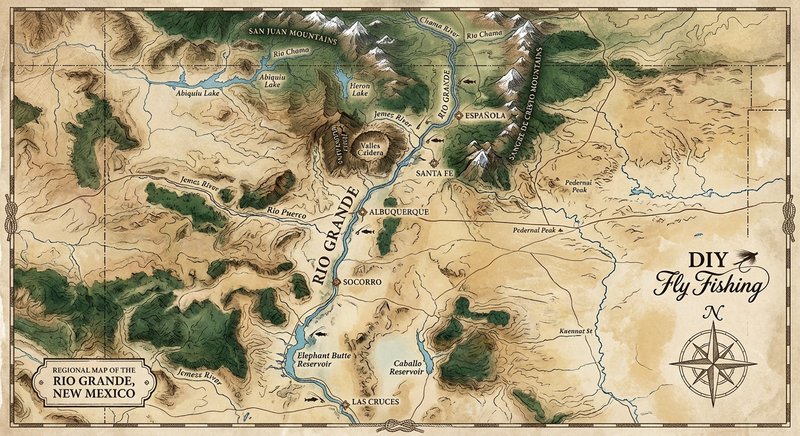
Rio Grande
Fly fishing in New Mexico · Intermediate · Best seasons: Spring, Summer, Fall
Target Species
Brown Trout, Rainbow Trout
About This Water
The Wild and Scenic section offers excellent fishing in dramatic canyon scenery. Brown and rainbow trout.
Fishing Recommendations
The Rio Grande in Northern New Mexico is not your typical meandering trout stream. It is a rugged, powerful, and majestic river carved into an 800-foot deep volcanic basalt chasm known as the Rio Grande Gorge. Fishing here is as much about the breathtaking scenery and the physical challenge as it is about the fish.
Here is your comprehensive guide to fly fishing the "Big River."
🎣 Location Overview
The crown jewel of this fishery is the Rio Grande del Norte National Monument, specifically the stretch from the Colorado border down through the "Taos Box." This is a "Wild and Scenic" designated river.
The water character is primarily high-desert pocket water, deep pools, and massive boulder gardens. The riverbed is composed of dark basalt rock, which keeps the water temps slightly higher and provides incredible structure for insects and fish. It is a "freestone-style" river, meaning its flow is largely dictated by snowmelt from the San Juan and Sangre de Cristo mountains. Anglers love it because it offers a true wilderness experience—once you hike down into the gorge, you are in a different world.
🐟 Target Species & Behavior
- Brown Trout: The kings of the Rio. The river is famous for its wild, buttery-yellow Brown Trout. They are opportunistic and highly aggressive. They hold tight to the "dark side" of boulders and under the shadows of the canyon walls.
- Rainbow Trout: Often found in the faster, more oxygenated "white water" riffles. While there are wild rainbows, many in the lower stretches (Orilla Verde) are holdovers from state stockings.
- Rio Grande Cutthroat: Rare in the main stem, but occasionally found near the confluence of tributaries like the Red River.
Behavior Note: Because the Rio is a high-volume river, fish are "structure-oriented." They won't sit in the middle of a heavy current; they look for soft pockets behind bus-sized boulders or "seams" where fast and slow water meet.
📅 Best Times to Fish
Spring (March – Early May)
- The Window: This is the time for the legendary Mother’s Day Caddis Hatch. In late April/early May, the river can be covered in millions of caddisflies.
- Condition: You must time this before the "run-off" (snowmelt) turns the river to chocolate milk.
Summer (Late June – August)
- The Window: Once the run-off subsides (usually late June), the fishing gets world-class.
- Condition: July and August are prime for Stoneflies and Terrestrials. Afternoon monsoons can cloud the water, so fish early.
Fall (September – November)
- The Window: Arguably the best time. The water is low, clear, and cold.
- Condition: Large Brown Trout become extremely aggressive as they prepare to spawn. The crowds vanish, and the cottonwoods turn gold.
🪰 Recommended Flies & Techniques
Top Fly Patterns
- Nymphs: Pat’s Rubber Legs (Size 6-10 in Brown/Orange), Prince Nymphs, Pheasant Tails, and heavy Cased Caddis imitations.
- Dry Flies: Elk Hair Caddis (Size 14-16), Stimulators (Orange/Yellow), and the "Chubby Chernobyl" (Size 8-12) for a hopper-dropper rig.
- Streamers: The Rio is "big fly" territory. Use Sparkle Minnows, Woolly Buggers (Olive/Black), or Near Nuff Crawfish.
Effective Techniques
- High-Sticking / Euro Nymphing: Because the currents are complex and multi-directional, long rods and tight-line techniques are very effective for keeping your line out of the "confused" surface water.
- Hopper-Dropper: In the summer, a large foam hopper with a weighted nymph 3 feet below is the standard "searching" rig.
- Streamer Stripping: Cast quartering downstream into deep holes and strip fast. The Rio Browns love to chase.
💡 Pro Tips & Local Knowledge
- The "Shadow" Rule: The canyon is deep. Fish will often feed aggressively in the shadows cast by the canyon walls. Once the sun hits the water directly, the bite often slows down.
- Follow the Gauge: Check the USGS gauge at "Rio Grande near Taos." If the flow is over 800-1,000 CFS, wading is dangerous. The "sweet spot" for most anglers is 300–600 CFS.
- Key Spots:
- La Junta: Where the Red River meets the Rio. It requires a steep hike but offers incredible fishing.
- Wild Rivers Recreation Area: Numerous trails (Big Arsenic, Little Arsenic) lead to the river.
- Orilla Verde (Pilar): Easier access, great for drift boats or older anglers who want to avoid the steep canyon hikes.
⚠️ Important Information
- Physical Fitness: To fish the best parts of the Rio, you must hike down (and eventually back up) 800 vertical feet. It is strenuous. Carry plenty of water—the high desert sun is punishing.
- Wildlife: This is rattlesnake country. Watch your step on the basalt rocks, especially in the spring and summer.
- Regulations:
- A New Mexico Fishing License and a Habitat Management & Access Validation are required.
- Check specific "Special Trout Water" designations; some areas are catch-and-release or restricted to artificial lures and flies with barbless hooks.
- Safety: The Rio Grande is a powerful river with "heavy" water. A wading staff is not optional; it is a necessity. Don't underestimate the current.
Bug Hatches & Matching Flies
| Hatch | Type | Peak months | Time of day | Hook sizes | Matching flies |
|---|---|---|---|---|---|
| Blue Winged Olives Baetis spp. | mayfly | March, April, October, November | Mid-day | #18-22 | RS2 #20-22, BWO Parachute #18-20, Pheasant Tail #18-22 |
| Salmonfly Pteronarcys californica | stonefly | May, June | All Day | #4-8 | Pats Rubber Legs #6-8, Chubby Chernobyl #6-10, Sofa Pillow #6-8 |
| Mother's Day Caddis Brachycentrus | caddis | April, May | Late Afternoon/Evening | #14-16 | Peacock Caddis #14-16, LaFontaine Sparkle Pupa #14-16, Graphic Caddis #14-16 |
| Golden Stonefly Hesperoperla pacifica | stonefly | June, July | Morning/Evening | #8-12 | Golden Rogue Stone #8-10, 20-Incher Stone #10-12 |
| Pale Morning Dun Ephemerella excrucians | mayfly | June, July | Morning | #14-18 | PMD Sparkle Dun #16-18, Frenchie #14-16 |
| Midges Chironomidae | midge | January, February, March, December | Morning/Mid-day | #18-24 | Zebra Midge #18-22, Griffith's Gnat #20-22, Mercury Midge #20-24 |
| Spotted Sedge Hydropsyche | caddis | July, August, September | Evening | #14-18 | Elk Hair Caddis #14-18, Holy Grail Caddis #14-16 |
| Grasshoppers Acrididae | terrestrial | August, September | Late Morning/Afternoon | #6-12 | Amy's Ant #10-12, Dave's Hopper #8-12, Morrish Hopper #8-10 |
| Tricos Tricorythodes | mayfly | August, September | Early Morning | #20-24 | Trico Spinner #22-24, Sunray Trico #20-22 |