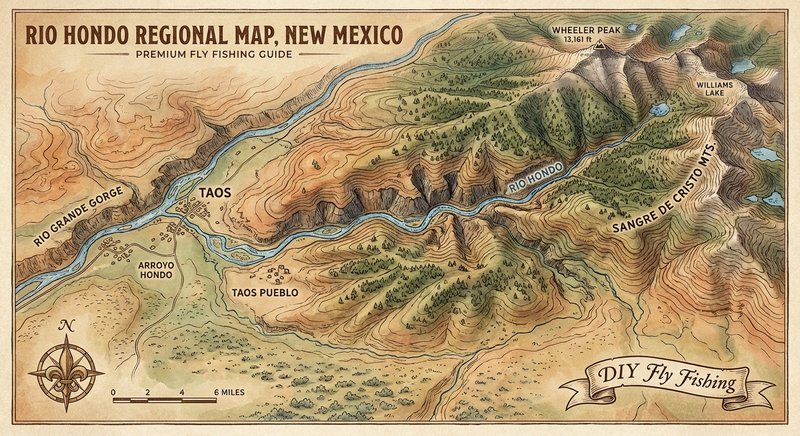
Rio Hondo
Fly fishing in New Mexico · Intermediate · Best seasons: Summer, Fall
Target Species
Rainbow Trout, Brown Trout, Cutthroat Trout
About This Water
Mountain stream near Taos Ski Valley. Small wild trout in beautiful alpine setting.
Fishing Recommendations
The Rio Hondo is one of Northern New Mexico’s most enchanting and technical small-stream fisheries. Tucked away in the Sangre de Cristo Mountains near Taos, this tributary of the Rio Grande offers a quintessential high-alpine angling experience.
As your guide, here is the breakdown of how to find success on these waters.
🎣 Location Overview
The Rio Hondo is a high-gradient, freestone stream that tumbles from the peaks of the Wheeler Peak Wilderness, through the Taos Ski Valley, and down into the deep basalt canyons where it meets the Rio Grande.
What makes it special is the variety of water packed into a short distance. In the upper reaches, you have classic "pocket water" and plunge pools amidst spruce and aspen forests. As it flows toward the village of Arroyo Hondo, it slows slightly, creating technical runs and undercut banks. Anglers love it for the solitude, the stunning mountain scenery, and the chance to catch a "New Mexico Slam" (Brown, Rainbow, and Cutthroat) in a single afternoon.
🐟 Target Species & Behavior
- Rio Grande Cutthroat: Found primarily in the higher elevations (above the Ski Valley and in side tributaries like Italianos or Yerba canyons). They are opportunistic but wary; they hold in the soft water at the edges of fast current.
- Brown Trout: The dominant species in the middle and lower stretches. They are wild, aggressive, and highly structure-oriented. Look for them in the "kitchen"—the foam lines and the dark shadows under overhanging willows.
- Rainbow Trout: Found throughout the system, particularly near the campgrounds and bridges where some supplemental stocking occurs. They tend to hold in the swifter, highly oxygenated riffles.
Behavior Note: These are high-altitude fish with a short growing season. They aren't usually picky about specific hatches, but they are extremely sensitive to vibration and shadows. If they see you, the fishing is over for that pool.
📅 Best Times to Fish
Optimal Seasons
- Summer (Late June – August): This is the prime window. Once the spring runoff subsides (usually by mid-June), the dry fly fishing is world-class.
- Fall (September – October): My personal favorite time. The Brown Trout become aggressive as they prepare to spawn, the aspens turn gold, and the water is crystal clear.
Best Times of Day
- Summer: 9:00 AM to 11:00 AM (nymphing) and 4:00 PM to sunset (the "Magic Hour" for dry flies).
- Fall: Midday is best. Wait for the sun to hit the water and warm the bugs; 11:00 AM to 3:00 PM is the sweet spot.
🪰 Recommended Flies & Techniques
The Rio Hondo is small, so leave the 6-weight at home. A 7.5-foot to 8.5-foot 3-weight or 4-weight rod is the perfect tool for the job.
Top Fly Patterns
- Dry Flies:
- Parachute Adams (Size 14-18) – The gold standard.
- Elk Hair Caddis (Size 14-16) – Great for the choppy pocket water.
- Stimulators (Orange or Yellow, Size 12-14) – Mimics the large stoneflies and grasshoppers.
- Hi-Vis Ant or Beetle (Size 16) – Deadly in August.
- Nymphs:
- Bead-head Pheasant Tail (Size 16-18).
- Prince Nymph (Size 14-16) – The "attractor" nymph that always seems to work here.
- Pats Rubber Legs (Size 10-12) – For the deeper pools near the Rio Grande confluence.
Techniques
- Dry-Dropper: This is the most effective way to fish the Hondo. Use a buoyant Stimulator or Royal Wulff as your "indicator" and hang a small Pheasant Tail 18 inches below it.
- Dapping/Short Leashes: In the tight, willow-choked sections, you won't be making 40-foot casts. It’s about flicking the fly into the pocket behind a rock.
- Upstream Stealth: Always fish moving upstream so you stay behind the fish’s field of vision.
💡 Pro Tips & Local Knowledge
- The "Pocket" Rule: In the Rio Hondo, 90% of the fish are in 10% of the water. Don't waste time on long, shallow flats. Focus on the "buckets"—the deeper, darker water behind large boulders.
- Shadow Management: The canyon is narrow. Pay attention to where your shadow falls. If your shadow hits a pool before your fly does, the fish will bolt.
- The Confluence: For a chance at a "trophy" (a 16"+ Brown), hike down to where the Hondo meets the Rio Grande. The larger fish from the main river often move into the Hondo to feed or find cooler water.
- Attractor Patterns: These fish don't see a lot of pressure compared to the San Juan River. Flashy, "buggy" flies like a Royal Wulff often out-produce hyper-realistic imitations.
⚠️ Important Information
Access
- National Forest: Most of the upper Hondo is within the Carson National Forest along NM Highway 150. There are numerous pull-outs between the town of Valdez and the Taos Ski Valley.
- Private Property: Be careful near the villages of Valdez and Arroyo Hondo. Much of the valley floor is private "Acequia" land. If it isn't marked as National Forest, look for "Posted" signs.
Regulations & Permits
- License: A valid New Mexico Fishing License is required for everyone 12 and older.
- Stamps: You must have the Habitat Management & Access Validation and the Habitat Stamp (standard with most NM licenses now).
- Limits: While state limits apply, I strongly recommend Catch and Release on the Rio Hondo to preserve the wild trout populations in this fragile ecosystem.
Special Considerations
- Altitude: You will be fishing between 7,000 and 10,000 feet. Hydrate aggressively and wear sunscreen.
- Wildlife: This is Black Bear and Mountain Lion country. While encounters are rare, keep your snacks sealed and be aware of your surroundings.
Bug Hatches & Matching Flies
| Hatch | Type | Peak months | Time of day | Hook sizes | Matching flies |
|---|---|---|---|---|---|
| Blue Winged Olive Baetis spp. | mayfly | March, April, October, November | Midday | #18-22 | Parachute Adams #18-22, RS2 #20-22, Pheasant Tail #18-20 |
| Mother's Day Caddis Brachycentrus occidentalis | caddis | May | Afternoon/Evening | #14-16 | Elk Hair Caddis #14-16, Peacock Caddis #16, LaFontaine's Deep Sparkle Pupa #14-16 |
| Pale Morning Dun Ephemerella excrucians | mayfly | June, July, August | Late Morning/Early Afternoon | #16-18 | PMD Sparkle Dun #16-18, Quigley Cripple #16-18, Military Mayfly #16-18 |
| Golden Stonefly Hesperoperla pacifica | stonefly | June, July | Morning/Evening | #8-12 | Stimulator (Yellow/Orange) #8-12, Pat's Rubber Leg #8-12, Golden Stone Nymph #10-12 |
| Yellow Sally Isoperla spp. | stonefly | June, July, August | Late Afternoon/Evening | #14-16 | Yellow Sally Dry #14-16, Little Yellow Sloan #14-16, PMX Yellow #14 |
| Grasshoppers Orthoptera | terrestrial | July, August, September | All Day/Windy Afternoons | #10-14 | Dave's Hopper #10-14, Amy's Ant #12-14, Fat Albert #10-12 |
| Midges Chironomidae | midge | January, February, March, December | Midday | #20-24 | Griffith's Gnat #20-22, Zebra Midge #20-24, Top Secret Midge #22-24 |
| Trico Tricorythodes | mayfly | August, September | Early Morning | #20-24 | Trico Spinner #20-24, Drowned Trico #22, WD-40 #20-22 |