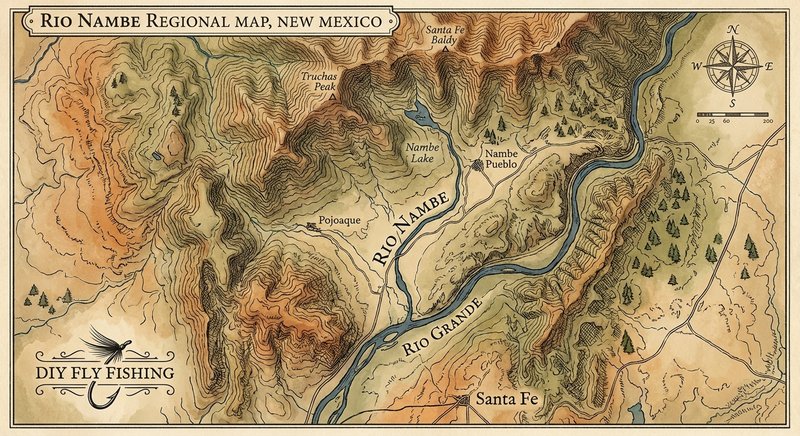
Rio Nambe
Fly fishing in New Mexico · Intermediate · Best seasons: Summer, Fall
Target Species
Brown Trout, Rainbow Trout
About This Water
Mountain stream near Santa Fe with wild trout. Beautiful canyon scenery.
Fishing Recommendations
As an expert guide who has spent years navigating the high-desert streams and alpine canyons of the Sangre de Cristo Mountains, I can tell you that Rio Nambe is one of New Mexico’s hidden gems. It is a technical, intimate, and stunningly beautiful fishery that rewards the adventurous angler who doesn't mind a bit of hiking and precise casting.
Here is your comprehensive guide to fly fishing the Rio Nambe.
🎣 Location Overview
Rio Nambe is a small, high-gradient mountain stream located north of Santa Fe. What makes it special is the dramatic transition it undergoes—from high alpine tundra and pine forests down into rugged, red-rock canyons.
The water is crystalline, cold, and fast-moving. This is "pocket water" at its finest. Because it is smaller than the nearby Rio Grande or Pecos, it doesn't see the same level of heavy pressure, offering a more solitary experience. Anglers love it for the "wild" feel; you aren't just fishing here, you are stalking fish in a landscape that feels largely untouched.
🐟 Target Species & Behavior
- Brown Trout: These are the "kings" of the lower and middle stretches. They are wild, wary, and highly opportunistic. They tend to hold in deep undercut banks and behind large granite boulders.
- Rainbow Trout: Found throughout, but more common near the stocked areas of the Nambe Falls Recreation Area. Wild rainbows are found higher up and are known for their aggressive strikes on dry flies.
Behavior: Because the Rio Nambe is nutrient-poor compared to larger rivers, the fish are opportunistic. However, they are incredibly "spooky." The water is clear, and the fish have excellent vision. If they see your silhouette or a sloppy line slap, the pool is "done" for the next hour.
📅 Best Times to Fish
Optimal Seasons
- Summer (Late June – August): This is prime time. As the spring runoff subsides, the water clears and the insect activity peaks. Terrestrials (grasshoppers and ants) become a major food source.
- Fall (September – October): My personal favorite. The Brown Trout become aggressive as they prepare for the spawn, and the changing colors of the aspens make the canyon spectacular. The water levels are usually stable and low.
Best Times of Day
- Summer: Early morning (6 AM – 10 AM) before the sun hits the water directly, and late evening (6 PM – Dusk) for the caddis hatches.
- Fall: Mid-day is best. The water needs to warm up a few degrees to get the bugs moving and the fish metabolism spiking.
🪰 Recommended Flies & Techniques
Top Fly Patterns
- Dry Flies:
- Stimulators (Orange or Yellow, size 12-16) – Great for imitating stoneflies or large hoppers.
- Parachute Adams (size 16-20) – The gold standard for any NM mountain stream.
- Elk Hair Caddis (Tan, size 14-18) – Essential for evening rises.
- Nymphs:
- Bead-head Pheasant Tail (size 16-20) – Mimics the natural mayfly nymphs found under the rocks.
- Prince Nymph (size 14-18) – Excellent "attractor" pattern in faster riffles.
- Terrestrials:
- Dave’s Hopper or Amy’s Ant (size 12-14) – Crucial for late summer.
Effective Techniques
- Dry-Dropper Rig: This is the most effective way to fish Rio Nambe. Use a buoyant dry fly (like a Stimulator) and hang a small nymph (like a Pheasant Tail) about 18–24 inches below it. This allows you to cover two parts of the water column without the splash of a plastic indicator.
- Dapping: In the tight, brushy sections, you won't be able to cast. Simply extend your rod over the water and drop the fly into the pockets.
💡 Pro Tips & Local Knowledge
- Stay Low and Move Slow: Because the water is clear and the stream is narrow, I recommend wearing earthy tones (camo or olive) and literally crawling to the edge of the pools. If you can see the fish, they have likely already seen you.
- The "Pocket Water" Secret: Don't waste too much time in the long, flat "glides." The biggest fish often sit in the tiny, oxygenated bubbles right behind a rock the size of a toaster. Give those pockets three good drifts and move on.
- Short Rods are King: Leave your 9-foot 5-weight at home. A 7.5-foot to 8-foot 3-weight or 4-weight is the perfect tool for these tight quarters.
- Fish Upstream: Always move upstream as you fish. Trout face into the current; if you approach from behind them, you have a much better chance of staying undetected.
⚠️ Important Information
Access & Permits
Rio Nambe flows through Nambe Pueblo lands. This is private tribal land and requires a specific Nambe Pueblo Fishing Permit, which is separate from a New Mexico state license.
- Where to buy: Permits can usually be purchased at the Nambe Falls Recreation Area entrance station.
- Rules: Always check the current Pueblo regulations, as they can change seasonally. Some areas are "Catch and Release" only, and others allow for harvesting.
Regulations
- Barbless Hooks: Even if not strictly required by the Pueblo, I highly recommend using barbless hooks to protect the wild trout populations.
- Wading: The stream is small enough that you rarely need to be in the water. Stay on the banks to avoid spooking fish and damaging the fragile stream bed.
Safety Considerations
- Flash Floods: During the "Monsoon" season (July/August), keep an eye on the sky. Heavy rain in the mountains can cause the Rio Nambe to rise several feet in minutes. If the water turns muddy or you hear a roar, get to high ground immediately.
- Wildlife: This is Black Bear and Mountain Lion country. Carry bear spray and stay alert, especially if you are hiking deep into the canyon alone.
Bug Hatches & Matching Flies
| Hatch | Type | Peak months | Time of day | Hook sizes | Matching flies |
|---|---|---|---|---|---|
| Blue Winged Olive Baetis spp. | mayfly | March, April, September, October | Late Morning/Afternoon | #18-22 | BWO Sparkle Dun #18-20, RS2 #20-22, Pheasant Tail #18-22 |
| American Grannom Brachycentrus occidentalis | caddis | April, May | Midday/Evening | #14-16 | Elk Hair Caddis #14-16, Peacock Caddis #16, Deep Sparkle Pupa #14-16 |
| Western March Brown Rhithrogena morrisoni | mayfly | April, May | Midday | #12-14 | March Brown Para-Wulff #12-14, Gold Ribbed Hare's Ear #12-14 |
| Golden Stonefly Hesperoperla pacifica | stonefly | June, July | All Day | #8-12 | Chubby Chernobyl (Gold) #8-12, Pat's Rubber Leg #8-12 |
| Yellow Sally Isoperla spp. | stonefly | June, July | Late Afternoon/Evening | #14-16 | Yellow Sally Foam Dry #14-16, Iron Lotus #16 |
| Pale Morning Dun Ephemerella excrucians | mayfly | June, July, August | Morning | #14-18 | PMD Parachute #16-18, Military Mayfly #16-18 |
| Spotted Sedge Hydropsyche spp. | caddis | July, August | Evening | #14-18 | Puterbaugh Caddis #16, LaFontaine's Emerger #14-18 |
| Terrestrials (Grasshoppers/Ants) Orthoptera/Formicidae | terrestrial | July, August, September | All Day | #10-18 | Amy's Ant #12-14, Dave's Hopper #10-12, Parachute Ant #16-18 |
| Midges Chironomidae | midge | January, February, March, December | Midday | #20-24 | Griffith's Gnat #20-22, Zebra Midge #20-24 |