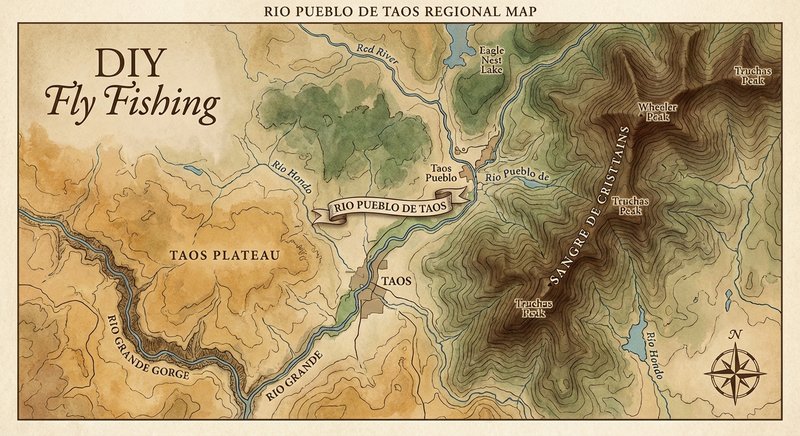
Rio Pueblo de Taos
Fly fishing in New Mexico · Intermediate · Best seasons: Spring, Summer, Fall
Target Species
Brown Trout, Rainbow Trout
About This Water
Scenic stream flowing through Taos with wild brown and rainbow trout. Good public access.
Fishing Recommendations
Welcome to one of the most rugged and rewarding fisheries in the Land of Enchantment. The Rio Pueblo de Taos is a fascinating river that undergoes a dramatic transformation as it flows from the high peaks of the Sangre de Cristo Mountains, through the town of Taos, and ultimately carves a deep path into the basalt walls of the Rio Grande Gorge.
As your guide, I’m here to help you navigate this technical but highly productive water.
🎣 Location Overview
The Rio Pueblo de Taos (often just called "the Pueblo") is a classic mountain freestone stream that offers two very different experiences.
The Upper Section, above the town of Taos, is a small, high-gradient mountain stream characterized by plunge pools and tight brush. However, the Lower Section—where the river enters the Rio Grande del Norte National Monument—is what draws serious anglers. Here, the river tumbles through a steep, rocky canyon before joining the Rio Grande at the "Confluence."
What makes it special is the sheer diversity of water: you’ll find everything from fast-moving pocket water and deep slots to glassy tail-outs. It is a "pocket water" specialist's dream, requiring stealth, accurate casting, and a bit of a hike.
🐟 Target Species & Behavior
- Brown Trout: The dominant species, especially in the lower canyon. These fish are wild, buttery-gold, and incredibly territorial. They hold in the "slack" water behind large basalt boulders and deep in the undercut banks.
- Rainbow Trout: Found more frequently in the upper reaches or near the confluence. They tend to hold in the faster riffles and the heads of pools where the oxygen levels are highest.
- Behavior: These fish are opportunistic but wary. Because the water is often clear, they have a high "spook factor." They feed heavily on nymphs year-round but will look to the surface the moment a hatch begins. In the fall, the Browns become aggressive as they prepare for the spawn.
📅 Best Times to Fish
- Spring (Late March – May): This is "Pre-Runoff" season. Before the snow melts, you can have incredible days with Blue Winged Olives (BWOs). Once runoff hits (usually late May), the river becomes high and turbid.
- Summer (Late June – August): The prime window. As the water drops and clears, the dry fly fishing becomes world-class. July is famous for the Caddis hatches and the appearance of terrestrial insects.
- Fall (September – early November): My personal favorite time. The crowds thin, the cottonwoods turn gold, and the Brown Trout become aggressive. Look for the "Caddis blizzard" in late afternoon.
- Best Time of Day: In the heat of summer, fish early (dawn to 11 AM) and late (the "Golden Hour" before sunset). In Spring and Fall, the 10 AM to 3 PM window is usually the most productive as the water warms up.
🪰 Recommended Flies & Techniques
Top Fly Patterns
- Dries:
- Chubby Chernobyl (Size 10-14) in Tan or Orange (Great for a dropper rig).
- Elk Hair Caddis (Size 14-18) in Tan or Olive.
- Parachute Adams (Size 16-20) for technical sips.
- Stimulators (Size 12-16) to mimic stoneflies.
- Nymphs:
- Pat’s Rubber Legs (Size 8-12) in Coffee/Black.
- Pheasant Tail Nymph (Size 16-20) – a local staple.
- Caddis Pupa (Size 14-16) in bright green.
- Perdigons (Size 16-18) in Silver or Purple (to get deep fast in the pockets).
- Streamers:
- Woolly Bugger (Size 8-12) in Olive or Black.
- Near Nuff Sculpin to imitate the bottom-dwellers.
Techniques
- Dry-Dropper: This is the "bread and butter" on the Pueblo. Use a high-floating dry (like a Chubby) and hang a weighted nymph 18–24 inches below it.
- High-Sticking/Euro Nymphing: Because the river is so rocky, traditional indicator nymphing often leads to snags. "High-sticking" your nymphs through the deep slots allows for a natural drift.
- The "Twitch": When fishing a Caddis dry, don't be afraid to give it a tiny skate or twitch. The Browns here love a moving target.
💡 Pro Tips & Local Knowledge
- The Confluence Hike: For the best fishing, park at the confluence trailhead (off NM-68). It’s a steep hike down into the gorge, but the water where the Pueblo meets the Rio Grande is legendary.
- Stealth is Key: The basalt rocks are dark, and the fish can see your silhouette against the bright New Mexico sky. Wear drab clothing (earth tones) and stay low when approaching a pool.
- Short Casts: You rarely need to cast more than 20–30 feet. Focus on "picking apart" the pockets. Every boulder has a fish behind it, in front of it, and to the side of it.
- Watch the Water Temp: In mid-summer, the lower reaches can get warm. If the water hits 68°F, stop fishing to protect the trout. Head further upstream to cooler mountain water.
⚠️ Important Information
- Access: Much of the river near the town of Taos passes through Taos Pueblo Land. This is private tribal land and is off-limits to fishing without specific tribal permission/permits, which are often not available to the public. Stick to the sections within the Rio Grande del Norte National Monument or the National Forest sections upstream.
- Permits: A valid New Mexico Fishing License is required. If you are on Forest Service land, you’ll also need a Habitat Management & Access Validation (HMAV).
- Safety: The canyon is rugged. Cell service is non-existent once you drop into the gorge. Watch for rattlesnakes in the summer and be mindful of "monsoon" rains—flash floods can turn the Pueblo chocolate brown in minutes.
- Regulations: Check the current NM Department of Game and Fish "Ribbon Press" for any specific seasonal closures or bag limits. Most local guides practice 100% Catch and Release here to preserve the wild populations.
Tight lines, and enjoy the magic of Northern New Mexico!
Bug Hatches & Matching Flies
| Hatch | Type | Peak months | Time of day | Hook sizes | Matching flies |
|---|---|---|---|---|---|
| Midges Chironomidae | midge | January, February, March, December | Late Morning/Early Afternoon | #18-24 | Zebra Midge #18-22, Griffith's Gnat #20-22, Morgan's Midge #20-24 |
| Blue Winged Olive Baetis spp. | mayfly | March, April, September, October | Late Morning/Afternoon | #16-22 | RS2 #18-22, Parachute Adams #16-20, Pheasant Tail #16-20 |
| Mother's Day Caddis Brachycentrus occidentalis | caddis | May | Afternoon/Evening | #14-16 | Peacock Caddis #14-16, Holy Grail #14-16, Deep Sparkle Pupa #14-16 |
| Golden Stonefly Hesperoperla pacifica | stonefly | June, July | Morning/Evening | #8-12 | Pats Rubber Legs #8-12, Chubby Chernobyl #10-12, Golden Stimulator #10-14 |
| Yellow Sally Isoperla spp. | stonefly | June, July, August | Afternoon/Evening | #14-16 | Yellow Sally Stimulator #14-16, Iron Lotus #16, Puterbaugh Caddis (Yellow) #14-16 |
| Spotted Sedge Hydropsyche spp. | caddis | July, August | Evening | #14-18 | Elk Hair Caddis (Tan) #14-18, LaFontaine Sparkle Pupa #16-18, X-Caddis #14-16 |
| Trico Tricorythodes spp. | mayfly | August, September | Early Morning | #20-24 | Trico Spinner #20-24, Sunken Trico Spinner #20-22, Drowned Trico #20-24 |
| Grasshoppers Acrididae | terrestrial | August, September | Late Morning/Afternoon | #8-14 | Amy's Ant #10-14, Joe's Hopper #10-12, Parachute Hopper #12-14 |
| Red Quill Rhithrogena spp. | mayfly | June, July | Late Afternoon | #12-14 | Red Quill #12-14, Hare's Ear #12-14, Quill Gordon #14 |
| Craneflies Tipulidae | terrestrial | July, August | Morning/Evening | #8-12 | Cranefly Larva #8-10, Daddy Long Legs #10-12 |