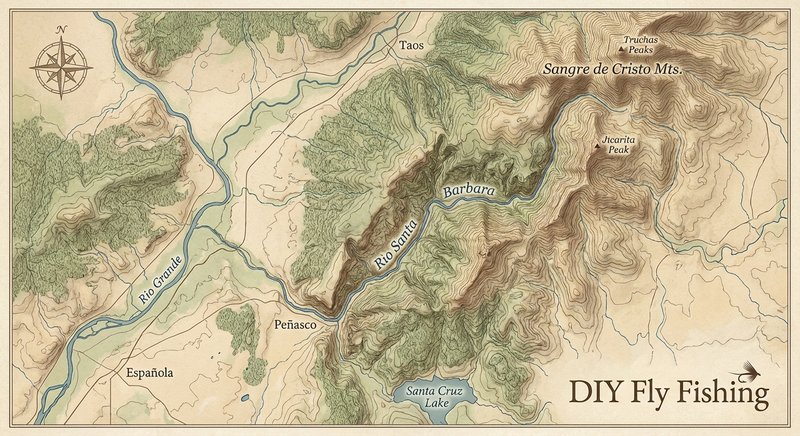
Rio Santa Barbara
Fly fishing in New Mexico · Intermediate · Best seasons: Summer, Fall
Target Species
Brown Trout, Rainbow Trout, Cutthroat Trout
About This Water
Beautiful wilderness stream with wild trout. Popular backpacking destination.
Fishing Recommendations
The Rio Santa Barbara is one of Northern New Mexico’s most pristine and rewarding small-stream fisheries. Tucked away in the Sangre de Cristo Mountains within the Carson National Forest and the Pecos Wilderness, it offers a true "Blue Ribbon" experience for anglers who value solitude, high-alpine scenery, and wild trout.
As a guide, I consider this water a quintessential high-country freestone stream. It is a place of tight casts, cold water, and stunningly beautiful fish.
🎣 Location Overview
The Rio Santa Barbara is located near the village of Peñasco, NM. It is formed by three main branches: the West, Middle, and East Forks, which converge near the Santa Barbara Campground.
What makes this water special is its transition from a meadow-style stream near the trailhead to a rugged, high-gradient canyon stream as you hike deeper into the wilderness. The water is crystal clear and flows over a bed of granite cobble and volcanic rock. It is one of the premier strongholds for the Rio Grande Cutthroat Trout, New Mexico’s state fish. Anglers love it because it rewards the "hike-to-fish" mentality—the further you walk, the more the crowds disappear and the more eager the fish become.
🐟 Target Species & Behavior
- Rio Grande Cutthroat Trout: These are the crown jewels of the drainage. They primarily hold in the upper reaches and the higher-altitude forks. They are opportunistic feeders but very "spooky" in the clear, thin water.
- Brown Trout: Dominant in the lower sections and around the campground area. They are wild, aggressive, and tend to hold in deeper undercut banks and the shadows of large boulders.
- Rainbow Trout: Found mostly in the lower main stem, including some holdovers from historical stocking near the bridge and campground.
Behavior: Because the growing season is short at 9,000+ feet, these fish are generally hungry. They hold in "classic" spots: the bubble line at the head of a pool, behind large mid-stream rocks, and in the deep "buckets" at the tail-ends of riffles.
📅 Best Times to Fish
- Summer (Late June – August): This is the prime window. Once the spring runoff subsides (usually by mid-June), the dry fly action explodes. July is spectacular for caddis and stonefly hatches.
- Fall (September – October): My personal favorite. The Aspen trees turn gold, the water levels drop and clear further, and the Brown Trout become aggressive as they prepare for the spawn. The Rio Grande Cutthroats take on their most brilliant orange and red hues.
- Best Time of Day: High-altitude water stays cold. You don’t need to be on the water at dawn. 10:00 AM to 4:00 PM is the "Golden Window" when the sun hits the water and activates insect life.
🪰 Recommended Flies & Techniques
Top Fly Patterns
- Dry Flies:
- Elk Hair Caddis (Size 14-16) – Tan or Olive.
- Royal Wulff or Humpy (Size 14-16) – High visibility is key in the pocket water.
- Parachute Adams (Size 16-18) – The ultimate searcher pattern.
- Amy’s Ant or Fat Angie (Size 12-14) – Excellent during the summer terrestrial season.
- Nymphs:
- Bead-head Pheasant Tail (Size 16-18).
- Copper John (Red or Copper, Size 16).
- Hare’s Ear (Size 14-16).
- Streamers:
- Small Wooly Buggers (Black or Olive, Size 10) – Great for tempting larger Browns in deep holes during the fall.
Effective Techniques
- Dry-Dropper Rig: This is the most effective way to fish the Santa Barbara. Use a buoyant dry fly (like a Stimulator) with 18-24 inches of 5X tippet to a small weighted nymph.
- Short Line Nymphing: In the higher gradient sections, "high-sticking" or Euro-style nymphing through the pockets is deadly.
- The Stealth Approach: Because the water is so clear, stay low. Approach pools from downstream and avoid casting your shadow over the water.
💡 Pro Tips & Local Knowledge
- Go Higher: The West Fork is the most popular trail. If you want better fishing and native Cutthroats, hike at least 2–3 miles past the trailhead. The "Middle Fork" is less traveled and offers incredible solitude for those willing to bushwhack.
- The "One Cast" Rule: In these small pools, you often only get one chance. If you slap the water or drag your line across the pool, the fish will dive for cover. Make your first cast count.
- Observe the Banks: In late summer (August), grasshoppers are abundant in the meadow sections. Use a "splat" delivery with a hopper pattern right against the bank.
- Gear: A 3-weight or 4-weight rod (7'6" to 8'6") is perfect. Anything heavier is overkill and makes delicate presentations difficult.
⚠️ Important Information
- Access: The main access point is the Santa Barbara Campground at the end of NM Highway 73. There is a large parking area for hikers and anglers.
- Regulations:
- A valid New Mexico Fishing License and Habitat Management & Access Validation (HMAV) are required.
- While certain sections allow for harvest, I strongly recommend Catch and Release, especially for the native Rio Grande Cutthroats, to preserve this fragile ecosystem.
- Check the NMDGF Proclamation for current bag limits.
- Special Considerations:
- Wilderness Ethics: This is a "Pack it in, Pack it out" area.
- Wildlife: This is Black Bear and Mountain Lion country. Carry bear spray if you are hiking deep into the forks.
- Weather: Afternoon thunderstorms are common in the summer. High ridges can be dangerous during lightning; get off the water if you hear thunder.
- Cell Service: Expect zero cell service once you leave Peñasco. Tell someone where you are going.
Bug Hatches & Matching Flies
| Hatch | Type | Peak months | Time of day | Hook sizes | Matching flies |
|---|---|---|---|---|---|
| Blue Winged Olive Baetis spp. | mayfly | April, May, September, October | Late Morning/Afternoon | #18-22 | RS2 #20-22, Parachute Adams #18-22, BWO Limp Critter #20 |
| Golden Stonefly Hesperoperla pacifica | stonefly | June, July | Morning/Evening | #8-12 | Pat's Rubber Legs #8-12, Rogue Foam Stone #10-12, Golden 20-Incher #10-14 |
| Pale Morning Dun Ephemerella dorothea | mayfly | July, August | Late Morning | #16-18 | PMD Sparkle Dun #16-18, Pheasant Tail #16-18, Mercer's Poxyback PMD #16 |
| Yellow Sally Isoperla spp. | stonefly | July, August | Afternoon/Evening | #14-16 | Yellow Sally Foam Dry #14-16, Iron Sally #14-16 |
| Grannom Caddis Brachycentrus occidentalis | caddis | May, June | Morning/Evening | #14-16 | Elk Hair Caddis (Olive) #14-16, LaFontaine's Deep Sparkle Pupa #14-16, Peacock Caddis #16 |
| Western Green Drake Drunella grandis | mayfly | July | Afternoon | #10-12 | Green Drake Hairwing #10-12, Hare's Ear Nymph #10-12, Green Drake Cripple #12 |
| Grasshoppers Melanoplus spp. | terrestrial | August, September | Late Morning/Afternoon | #10-14 | Dave's Hopper #12, Amy's Ant #10-14, Parachute Hopper #12-14 |
| Cinnamon Caddis Hydropsyche spp. | caddis | July, August, September | Evening | #14-18 | Godzilla Caddis #16, Tan Elk Hair Caddis #14-18, Holy Grail Caddis Pupa #16 |
| Midges Chironomidae | midge | March, April, October, November | All Day | #20-24 | Zebra Midge #20-22, Griffith's Gnat #20-24, Top Secret Midge #22 |