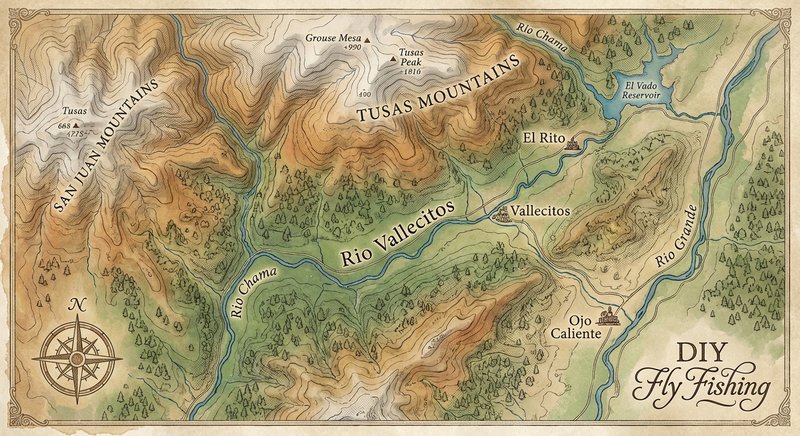
Rio Vallecitos
Fly fishing in New Mexico · Beginner · Best seasons: Summer, Fall
Target Species
Brown Trout, Rainbow Trout
About This Water
Meadow stream with wild trout. Beautiful high country fishing.
Fishing Recommendations
Welcome to the Rio Vallecitos, one of Northern New Mexico’s best-kept secrets. Located within the Carson National Forest, this is a gem for anglers who prefer solitude, stunning scenery, and technical small-stream fly fishing.
As your guide, here is everything you need to know to find success on these high-desert waters.
🎣 Location Overview
The Rio Vallecitos is a classic high-elevation freestone stream. It originates in the Tusas Mountains and winds its way through a mix of tight, boulder-strewn canyons and expansive, lush alpine meadows.
What makes it special is its intimacy. This is not a river for long, hero casts; it’s a river for "mountain stalking." The water is crystal clear and cold, flowing through ponderosa pines and granite outcrops. Anglers love it because it offers a true "wild" experience—you are far more likely to see a black bear or an elk than another fisherman. It’s a place where the scenery matches the quality of the fishing.
🐟 Target Species & Behavior
The Rio Vallecitos is primarily a Brown Trout fishery, though you will find Rainbows scattered throughout, particularly near bridge crossings or deeper canyon pools.
- Brown Trout: The majority are wild. They are incredibly spooky and have a PhD in detecting shadows on the water. They hold tight to undercut banks, submerged logs, and the "dark water" behind boulders.
- Rainbow Trout: Found more frequently in the riffles and faster pocket water. They tend to be more opportunistic feeders than the browns.
- Feeding Behavior: These fish are opportunistic but wary. In the summer, they look up for terrestrials and caddis. In the fall, the larger Browns become aggressive and territorial as they prepare for the spawn.
📅 Best Times to Fish
While the river can be fished from late spring through early winter, the windows you requested are truly the "sweet spots."
Summer (Late June – August)
- Conditions: Once the spring runoff subsides (usually by mid-June), the river settles into a perfect flow.
- Prime Window: Early morning (6 AM – 10 AM) and late evening "power hours" are best. During the heat of the day, fish move into the deepest oxygenated pockets.
- The Monsoon Factor: Be aware of July/August afternoon thunderstorms. They can cause flash floods or turn the water "chocolate milk" quickly.
Fall (September – October)
- Conditions: This is the "Golden Season." The aspens turn, the air gets crisp, and the water temperatures drop into the ideal 50–55°F range.
- Prime Window: 10 AM – 4 PM. As the morning frost melts, the insects become active.
- Behavior: This is your best chance at a trophy Brown. They lose their wariness and strike aggressively at streamers and large dries.
🪰 Recommended Flies & Techniques
Top Fly Patterns
- Dries:
- Stimulators (Size 12-16) in Orange or Yellow (mimics hoppers and stoneflies).
- Elk Hair Caddis (Size 14-18) in Tan or Olive.
- Parachute Adams (Size 16-20) – the ultimate "find out" fly.
- Terrestrials (Summer Essential):
- Dave’s Hopper or Amy’s Ant (Size 12).
- Black Beetles or Cinnamon Ants (Size 16-18).
- Nymphs:
- Bead-head Pheasant Tail (Size 16-20).
- Copper John (Red or Copper, Size 16).
- Pat’s Rubber Legs (Size 10-12) for higher water.
- Streamers (Fall):
- Woolly Buggers (Black or Olive, Size 8-10).
Techniques & Presentation
- The Dry-Dropper: This is the most effective method on the Vallecitos. Hang a small Pheasant Tail about 18–24 inches below a buoyant Stimulator or Hopper.
- High-Sticking: In the canyon sections, use a short line to "dap" your flies into small pockets behind rocks. If your fly line hits the water, you’ve likely spooked the fish.
- The Stealth Approach: Wade upstream. If you walk downstream, the silt and vibrations you kick up will alert every fish for 50 yards.
💡 Pro Tips & Local Knowledge
- The "Meadow Stealth": In the open meadow sections, stay 5-10 feet back from the bank. The fish hold right under the grass overhangs. If you stand on the edge, they will feel the vibration of your footsteps and vanish.
- Focus on the Confluences: Where small tributary creeks enter the main stem, the water is often cooler and more oxygenated—prime real estate for the biggest fish in the system.
- The "Tusas" Reach: Explore the upper reaches near the village of Cañon Plaza. The water is smaller, but the fish are less pressured.
- Gear: A 7.5ft to 8.5ft 3-weight or 4-weight rod is ideal. A 9ft rod is often too cumbersome in the brushy canyon sections. Use a 5X or 6X fluorocarbon tippet.
⚠️ Important Information
- Access: Much of the river is accessible via Forest Road 106 and Forest Road 111. While much of the river is on National Forest land, there are patches of private property near the towns of Vallecitos and La Madera. Always look for "Posted" signs and respect private land.
- Regulations: You need a valid New Mexico Fishing License plus a Habitat Management & Access Validation (HMAV) and a Habitat Stamp (for USFS land). Check the current NM Department of Game and Fish "Ribiac" (Rules and Info) for any seasonal closures.
- Safety: This is remote country. Cell service is non-existent. Carry a spare tire, plenty of water, and bear spray. Tell someone where you are going.
- Catch & Release: While not all sections are "fly only," please practice catch and release for wild Browns to preserve this fragile high-desert ecosystem.
Tight lines, and enjoy the silence of the Vallecitos!