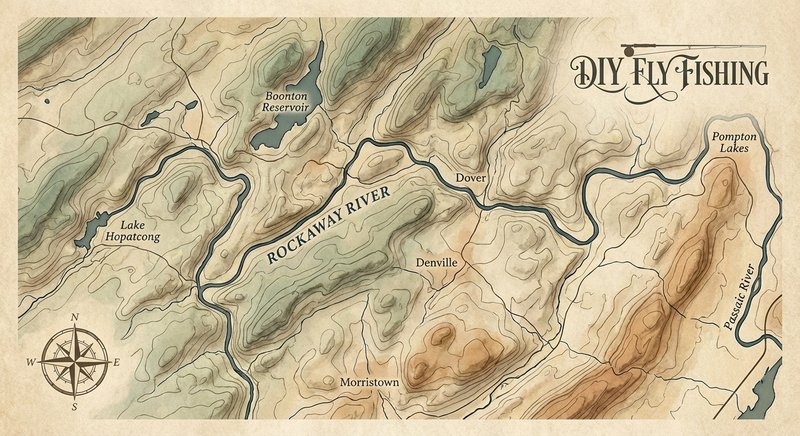
Rockaway River
Fly fishing in New Jersey · beginner · Best seasons: spring, summer
Target Species
Brown Trout, Rainbow Trout
About This Water
Morris County urban trout fishery with surprising quality. Multiple parks provide access to stocked sections.
Fishing Recommendations
As an expert guide who has spent years navigating the technical waters of the Mid-Atlantic, I can tell you that the Rockaway River in Morris County, New Jersey, is one of the state's most underrated gems. While many anglers rush to the Musconetcong or the South Branch of the Raritan, the Rockaway offers a diverse range of water—from plunging pocket water to long, glassy pools—that rewards the observant fly fisher.
Here is your comprehensive guide to mastering the Rockaway River.
🎣 Location Overview
The Rockaway River is a 35-mile-long tributary of the Passaic River. For the fly fisherman, the "trophy" water lies in the upper and middle sections, particularly from the Berkshire Valley Management Area down through Wharton, Dover, and Denville.
What makes the Rockaway special is its resilience and variety. It transitions from a mountainous, freestone-style stream in its upper reaches to a more suburban, Meadowlands-adjacent river as it flows east. Anglers love it because it offers a "wilderness" feel in the middle of one of the most densely populated counties in the U.S. The river features excellent structure—boulder gardens, undercut banks, and deep "blue" holes—that provide perfect habitat for trout.
🐟 Target Species & Behavior
The Rockaway is primarily a stocked fishery, but it has a surprising capacity to hold fish year-round.
- Rainbow Trout: These are the most common. They tend to hold in the faster, highly oxygenated "white water" or at the very head of pools. They are aggressive and often the first to rise during a hatch.
- Brown Trout: While many are stocked, the Rockaway is famous for its "holdover" browns. These fish have survived multiple seasons, grown large, and become incredibly wary. Look for them in deeper, slower water, under fallen logs, or tucked tightly against undercut banks. They are most active during low-light periods (dawn/dusk).
- Wild Fish: You will occasionally find wild Brook Trout in the small feeder streams and the uppermost reaches, though these are rare and should be handled with extreme care.
📅 Best Times to Fish
Spring (April – June): The Prime Window
This is the gold standard for the Rockaway.
- Conditions: Water levels are usually high and cool.
- Timing: Mid-day is best in early April; move toward late afternoon/evening as June approaches.
- The "Magic" Window: Late May brings the most consistent hatches, and the fish are fully acclimated to the river.
Summer (July – August): The Tactical Season
The Rockaway can get warm in the summer.
- Conditions: Low water and rising temperatures. Check water temps! If the water is over 68°F, stop fishing to protect the trout.
- Timing: "First Light" (5:00 AM – 8:00 AM) or "Last Light" (sunset).
- Strategy: Focus on the Berkshire Valley section where the canopy is thicker and the water stays cooler.
🪰 Recommended Flies & Techniques
Dry Flies (Match the Hatch)
- Early Spring: Blue Winged Olives (#18-22), Quill Gordons (#12-14), and Hendricksons (#12-14).
- Late Spring/June: Light Cahills (#14-16) and the famous Sulphurs (#14-18). The Sulphur hatch on the Rockaway can be spectacular in the evening.
- Summer: Elk Hair Caddis (#14-16) and terrestrials like Black Ants and Foam Beetles (#14-18).
Nymphing (The Meat and Potatoes)
Since the Rockaway has significant depth in the pools, nymphing is the most productive method.
- Patterns: Pheasant Tail (#14-18), Gold-Ribbed Hare’s Ear (#12-16), and Zebra Midges (#18-22) for tailing fish.
- Pro Choice: Use a "Perdigon" style nymph in the faster runs to get deep quickly.
Streamers (For the Big Browns)
- Patterns: Wooly Buggers (Olive or Black, #6-10) and Mickey Finns.
- Technique: Swing streamers through deep holes or "strip" them erratically near submerged wood.
💡 Pro Tips & Local Knowledge
- The "Gorge" Mentality: In the section through Wharton, the river drops over rocks creating "pocket water." Don't just fish the big pools. Cast into the tiny pockets of calm water behind boulders—trout often wait there to ambush food.
- Stealth is Key: Because the Rockaway is relatively narrow in many spots, your shadow can spook an entire pool. Wear earthy tones (olive/tan) and wade upstream slowly.
- The Bridge Factor: Many of the best fish hold directly under the various road bridges. These areas provide shade and overhead cover. Don't be afraid to drift a nymph right into the shadows under a bridge.
- The Split Rock Influence: The discharge from Split Rock Reservoir affects the upper sections. Keep an eye on local rain levels; the Rockaway can blow out (become muddy) quickly, but it also clears faster than the larger NJ rivers.
⚠️ Important Information
- Regulations: The Rockaway is subject to New Jersey Division of Fish and Wildlife regulations. It is a "Stocked Trout Water." Be aware of the pre-season closure dates in early April.
- Permits: A valid NJ Fishing License and a Trout Stamp are mandatory for anyone 16 or older.
- Access:
- Berkshire Valley Wildlife Management Area: Great for a "wilder" experience.
- Grace Lord Park (Boonton): Beautiful scenery but can be crowded.
- The "Tourne" County Park: Excellent access points and well-maintained trails along the river.
- Wading Safety: The rocks in the Rockaway are notoriously slippery. Studded wading boots and a wading staff are highly recommended, especially in the swifter sections near Dover.
Tight lines, and remember to "keep 'em wet" if you're practicing catch and release!
Bug Hatches & Matching Flies
| Hatch | Type | Peak months | Time of day | Hook sizes | Matching flies |
|---|---|---|---|---|---|
| Blue Winged Olive Baetis | mayfly | March, April, September, October | Late Morning/Afternoon | #18-22 | BWO Sparkle Dun #18-22, Pheasant Tail #18-20, RS2 #20-22 |
| Hendrickson Ephemerella subvaria | mayfly | April | Afternoon | #12-14 | Red Quill #12-14, Hendrickson Emerger #12-14, Hare's Ear Nymph #12-14 |
| Grannom Caddis Brachycentrus | caddis | April, May | All Day/Evening | #14-16 | Grannom Pupa #14-16, Elk Hair Caddis (Olive) #14-16, Peacock Caddis #16 |
| Sulphur Ephemerella invaria/dorothea | mayfly | May, June | Evening | #14-18 | Sulphur Parachute #14-18, Sulphur Emerger #16-18, Pheasant Tail (Flashback) #14-18 |
| March Brown Maccaffertium vicarium | mayfly | May | Afternoon | #10-12 | March Brown Dry #10-12, Gold Ribbed Hare's Ear #10-12 |
| Light Cahill Stenacron interpunctatum | mayfly | June, July | Evening | #12-14 | Light Cahill #12-14, Cream Variety Nymph #14 |
| Isonychia (Slate Drake) Isonychia bicolor | mayfly | June, September | Late Afternoon/Evening | #10-12 | Isonychia Parachute #10-12, Zug Bug #10-12, Prince Nymph #10-14 |
| Trico Tricorythodes | mayfly | July, August, September | Early Morning | #22-26 | Trico Spinner #22-24, Black Zebra Midge #20-24 |
| Terrestrials Formicidae/Coleoptera | terrestrial | July, August, September | All Day | #12-18 | Black Foam Ant #14-18, Crowe Beetle #12-16, Dave's Hopper #10-12 |