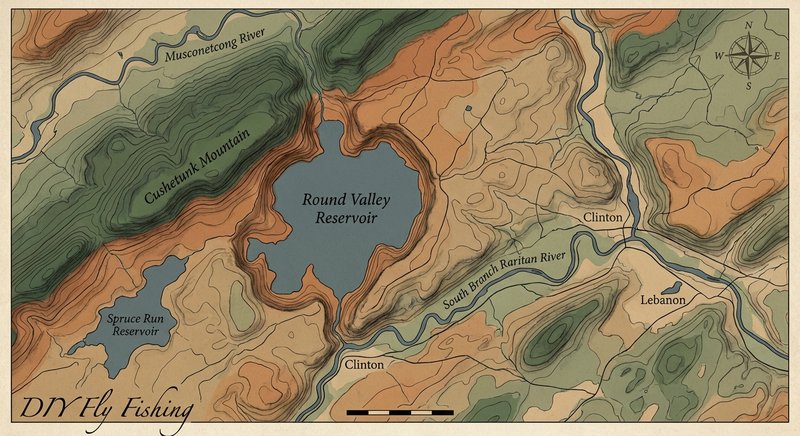
Round Valley Reservoir
Fly fishing in New Jersey · advanced · Best seasons: spring, fall, winter
Target Species
Lake Trout, Brown Trout, Rainbow Trout
About This Water
Deep, clear reservoir with trophy lake trout and brown trout. New Jersey's premier stillwater trout fishery.
Fishing Recommendations
Welcome to Round Valley Reservoir, often referred to by local anglers as the "Bermuda Triangle of New Jersey." As your guide, I’m going to be straight with you: this is one of the most challenging fly-fishing destinations in the Northeast, but it offers the rarest of rewards—trophy-sized, wild-reproduced Lake Trout and holdover Rainbows and Browns in a setting that looks more like the Pacific Northwest than Central Jersey.
Here is your comprehensive guide to tackling "The Valley."
🎣 Location Overview
Round Valley Reservoir is a 2,350-acre man-made impoundment in Clinton, NJ. It is unique because it is an oligotrophic lake—deep (reaching 180 feet), nutrient-poor, and incredibly clear. The water is often a striking turquoise blue, offering visibility up to 20 or 30 feet.
What makes it special is the "two-story" fishery. Because the water is so deep and well-oxygenated, it supports cold-water salmonids year-round. It is one of the few places south of Maine where Lake Trout reproduce naturally. For the fly angler, the challenge is the sheer volume of water and the steep drop-offs, but when the thermal layers are right, these fish move within reach of a well-cast fly.
🐟 Target Species & Behavior
- Lake Trout (Lakers): The stars of the show. They are "bottom dwellers" by nature but move into the 10–30 foot range during spring and fall. They are aggressive predators that primary hunt Alewives (the main forage in the lake).
- Brown Trout: Known for hanging near the rocky shorelines and submerged structures. They are wary and often require the most finesse.
- Rainbow Trout: Often found "cruising" the upper water column. They are more likely to be found near the dams or the aerators where oxygen levels are highest.
- Behavior: These fish are extremely light-sensitive due to the water clarity. They follow the Alewife schools. If you find the bait on your electronics, the trout are nearby.
📅 Best Times to Fish
Because Round Valley is so deep, the "window" for fly fishing is dictated by water temperature.
- Spring (April – Early June): Prime Time. As the ice melts and the water warms slightly, the trout move into the shallows (5–20 feet) to feed. This is the best time for shore-based fly anglers.
- Fall (October – November): As the lake "turns over" and the surface cools, Lake Trout move toward the rocky shorelines and dams to spawn. They become aggressive and territorial.
- Winter: If the reservoir hasn't frozen over, fishing can be productive, but you’ll need to fish deep and slow.
- Optimal Window: The first two hours of daylight and the last hour of "magic hour" before dark. On overcast, drizzly days, the fish will stay shallower longer.
🪰 Recommended Flies & Techniques
Top Fly Patterns
Since the primary forage is the Alewife, your fly box should be dominated by white, silver, and translucent patterns.
- Game Changers (3-5 inch): White or Pearl. The movement mimics a wounded Alewife perfectly.
- Clouser Minnows: Chartreuse/White or Blue/White. The weighted eyes help get the fly down quickly in the water column.
- Zonkers: White or Silver/Grey.
- Bunny Leeches: White or Olive (for Browns).
- EP Fiber Minnows: 4-inch patterns with a bit of flash.
Techniques & Presentation
- The "Countdown" Method: You must use a sinking line (Type 5 or 7) or a heavy 250–400 grain sink tip. Cast out, count to 20 or 30 seconds to let the fly reach the 15–25 foot zone, and then begin your retrieve.
- The Strip-Strip-Pause: Alewives are fast swimmers. Use a vigorous strip to get their attention, but the "pause" is usually when the Laker will hammer the fly.
- Shoreline Prowling: In the spring, walk the perimeter and look for "drop-offs" where the turquoise water turns dark blue. Cast parallel to the drop-off.
💡 Pro Tips & Local Knowledge
- The Stealth Factor: Because the water is so clear, these fish can see you from a mile away. Use a Fluorocarbon leader (8lb–12lb). Do not use nylon mono; it's too visible. Long leaders (9ft+) are essential.
- The Wind is Your Friend: A "Round Valley Chop" on the water breaks up the surface and makes the fish less spooky. If it’s dead calm, your chances decrease significantly.
- The Dam Areas: The two main dams (North and South) have steep rip-rap banks. Trout love to cruise these rocks looking for bait tucked in the crevices.
- The "Blue Hole" Mystery: If you are in a boat or float tube, look for the "scum lines" or foam lines on the surface. These usually indicate where two currents or temperatures are meeting—trout use these as hunting lanes.
⚠️ Important Information
- Access: The main entrance is off Route 22 in Clinton. There is a boat ramp and a "Wilderness Area" that requires a hike-in.
- Vessel Restrictions: Motors are limited to 10 horsepower or less. This makes it a haven for kayak anglers and float tubers, but be careful—the wind can whip up dangerous waves very quickly.
- Regulations: Round Valley has specific regulations that differ from the rest of NJ.
- Lake Trout: There is usually a minimum size and a specific creel limit (check the current NJ Fish & Wildlife Digest as these change).
- Trout Stamp: A New Jersey fishing license and a Trout Stamp are required.
- Safety: Always wear a PFD. The water stays frigid well into the summer, and hypothermia is a real risk if you capsize.
Guide’s Final Word: Don't get discouraged if you get "skunked" your first three times out. Round Valley demands patience. But when you hook into an 8-pound wild Lake Trout on a 7-weight fly rod in crystal clear water, you’ll understand why we keep coming back.
Bug Hatches & Matching Flies
| Hatch | Type | Peak months | Time of day | Hook sizes | Matching flies |
|---|---|---|---|---|---|
| Chironomids (Midges) Chironomidae | midge | March, April, September, October | All Day | #18-24 | Zebra Midge #18-22, Griffith's Gnat #20-24, Palomino Midge #20-22 |
| Blue-Winged Olive Baetis | mayfly | April, May, September, October | Afternoon | #18-22 | RS2 #20-22, Parachute BWO #18-22, Pheasant Tail Nymph #18-20 |
| Hendrickson Ephemerella subvaria | mayfly | April, May | Afternoon | #12-14 | Red Quill #12-14, Hendrickson Emerger #12-14, Gold Ribbed Hare's Ear #12-14 |
| Grannom Caddis Brachycentrus | caddis | April, May | Morning/Evening | #14-16 | Elk Hair Caddis (Olive) #14-16, LaFontaine's Deep Sparkle Pupa #14-16, Peacock Caddis #16 |
| Damselfly Enallagma | terrestrial | June, July | Morning/Afternoon | #10-14 | Marabou Damselfly Nymph #10-12, Adult Damselfly #12-14 |
| Terrestrial Ants and Beetles Formicidae / Coleoptera | terrestrial | July, August, September | All Day | #12-20 | Chernobyl Ant #12-16, Black Foam Ant #16-20, Crowe Beetle #14-18 |
| Trico Tricorythodes | mayfly | July, August, September | Early Morning | #20-24 | Trico Spinner #22-24, Sunken Trico Spinner #22-24 |
| March Brown Maccaffertium vicarium | mayfly | May, June | Afternoon/Evening | #10-14 | March Brown American #10-12, March Brown Emerger #12-14 |