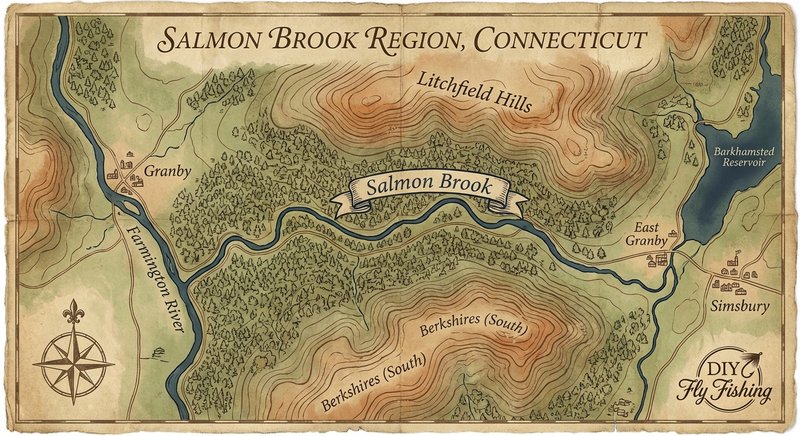
Salmon Brook
Fly fishing in Connecticut · Intermediate · Best seasons: Spring, Summer, Fall
Target Species
Brown Trout, Brook Trout
About This Water
Hartford County stream with wild trout. Granby area fishing.
Fishing Recommendations
Salmon Brook, located primarily in Granby, Connecticut, is one of the state's most cherished "small water" gems. As a major tributary to the Farmington River, it offers a more intimate, rugged, and technical experience than the tailrace conditions of the main stem Farmington. For the angler who prefers stalking wild fish in pocket water over long-distance casting, Salmon Brook is a sanctuary.
🎣 Location Overview
Salmon Brook is divided into two primary forks: the East Branch and the West Branch.
- The West Branch is the crown jewel for fly anglers. It is characterized by high gradients, tumbled boulders, deep plunges, and classic New England pocket water. It feels much more like a mountain stream in Vermont than a Connecticut brook.
- The East Branch is slightly lower gradient, featuring more gravel runs and traditional pool-and-riffle sequences.
What makes this water special is its resilience. While many Connecticut streams warm up significantly in the summer, the cold-water springs and heavy canopy cover of the Salmon Brook watershed—particularly the West Branch—keep water temperatures hospitable for trout year-round. It is a designated Class 1 Wild Trout Management Area (WTMA) in certain stretches, meaning you are fishing for fish born and bred in this gravel.
🐟 Target Species & Behavior
- Brown Trout: You will find both wild and holdover Browns. The wild fish are buttery-yellow with brilliant red spots. They are wary and often hold in the "cushion" just in front of boulders or tucked deep under undercut banks.
- Brook Trout: The West Branch and its tiny feeders are home to vibrant native Brookies. They are opportunistic but easily spooked. Look for them in the coldest, most oxygenated water—right at the base of small waterfalls and in the swiftest riffles.
- Behavior: These fish are highly attuned to overhead predators. Unlike the "educated" fish of the Farmington that see a thousand flies a day, Salmon Brook fish are more concerned with stealth. If they see you, the fishing in that pool is over for the next hour.
📅 Best Times to Fish
- Spring (April – June): This is the prime window. The Hendrickson hatch in late April and the subsequent Caddis hatches in May bring the larger wild Browns to the surface. Water levels are usually perfect during this time.
- Summer (July – August): While other rivers "shut off," Salmon Brook remains a viable option. Focus on the early mornings (6:00 AM – 10:00 AM). Terrestrial fishing (ants and beetles) is the name of the game here.
- Fall (September – October): A spectacular time to be on the water. The Brook Trout begin to don their spawning colors, and the Brown Trout become aggressive before their late-fall spawn. The "Blue Winged Olive" (BWO) hatches on drizzly October afternoons can be legendary.
🪰 Recommended Flies & Techniques
Top Fly Patterns
- Dries:
- Early Season: Hendrickson (Light and Dark) #12-14, Quill Gordon #14.
- Summer: Elk Hair Caddis (Tan/Olive) #14-18, Stimulators #12.
- Terrestrials: Black Ants #16-22 (essential), Cinnamon Ants, and Foam Beetles.
- Nymphs:
- Pheasant Tail #16-20, Prince Nymph #14-16, and Zebra Midges.
- Local Secret: Small stonefly nymphs in golden or black (#12-14).
- Streamers:
- Small Woolly Buggers (Olive or Black) #10-12. Fish these "low and slow" through the deeper plunge pools.
Techniques
- The "Bow and Arrow" Cast: The brush is thick here. Often, you won't have room for a backcast. Mastering the bow-and-arrow cast is mandatory for reaching the best pockets.
- High-Sticking/Euro Nymphing: Because the water is so broken and turbulent, traditional indicator nymphing often creates too much drag. Using a long rod to "high-stick" nymphs through pockets is incredibly effective.
- Dry-Dropper: This is the most efficient way to cover Salmon Brook. Hang a small Pheasant Tail 18 inches below a buoyant Elk Hair Caddis.
💡 Pro Tips & Local Knowledge
- Stealth is Paramount: Wear drab colors (greens and browns). Avoid "lining" the fish; stay low and cast from a kneeling position if you have to.
- Focus on the West Branch: For the best wild trout experience, focus on the stretches along Route 20 and Simsbury Road. Look for the areas where the gorge tightens up.
- The "One-Cast" Rule: In these small pools, your first cast is your best chance. Don't "warm up" with short casts; analyze the water, pick the prime lie, and make your first presentation count.
- Check the Tributaries: If the main stem of the brook is running high after a rain, the tiny unnamed feeders often clear up faster and can hold surprisingly large Brookies.
⚠️ Important Information
- Access: Much of the West Branch flows through the McLean Game Refuge. This is a beautiful, protected area. Park only in designated lots; the wardens are strict. Respect all "No Trespassing" signs on private residential stretches.
- Regulations:
- Salmon Brook features Class 1 Wild Trout Management Areas. In these sections, it is generally Catch and Release Only and restricted to Barbless Single Hook lures or flies.
- Always check the current CT DEEP Fishing Guide for updated seasonal closures and specific boundary lines.
- Gear Recommendation: A 7.5ft to 8.5ft 3-weight or 4-weight rod is perfect. A 9ft rod is often too long for the overhanging canopy. Use 5X or 6X fluorocarbon tippet for nymphing, as the water is exceptionally clear.
Guide’s Final Thought: Salmon Brook is not about catching 20-inch fish; it’s about the beauty of the pursuit and the purity of the strain. Treat these wild fish with care, keep them in the water, and they’ll be there for the next generation of New England anglers.
Bug Hatches & Matching Flies
| Hatch | Type | Peak months | Time of day | Hook sizes | Matching flies |
|---|---|---|---|---|---|
| Hendrickson Ephemerella subvaria | mayfly | April, May | Afternoon | #12-14 | Red Quill #12-14, Hendrickson Emerger #12-14, Pheasant Tail #12-14 |
| Blue Winged Olive Baetis spp. | mayfly | April, May, September, October | Midday | #18-22 | RS2 #20-22, BWO Parachute #18-22, WD-40 #20-22 |
| Grannom Caddis Brachycentrus | caddis | April, May | All day | #14-16 | Apple Green Grannom #14-16, Peacock Caddis Larva #14-16, Holy Grail #14-16 |
| Sulfur Ephemerella invaria/dorothea | mayfly | May, June | Evening | #14-18 | Sulfur Parachute #14-18, Sulfur Cripple #14-18, Frenchie #16-18 |
| Light Cahill Stenacron interpunctatum | mayfly | June, July | Evening | #12-14 | Light Cahill Dry #12-14, Gold Ribbed Hare's Ear #12-14 |
| Slate Drake Isonychia bicolor | mayfly | June, September | Late Afternoon | #10-12 | Iso Parachute #10-12, Zug Bug #10-12, Isonychia Wet #12 |
| Tan Caddis Hydropsyche | caddis | June, July, August | Evening | #14-18 | Elk Hair Caddis (Tan) #14-18, LaFontaine's Sparkle Pupa #14-16, Pupa-Tan #14-18 |
| Trico Tricorythodes | mayfly | July, August, September | Morning | #22-26 | Trico Spinner #22-24, Zebra Midge #22-24 |
| Terrestrials (Ants/Beetles) Formicidae / Coleoptera | terrestrial | July, August, September | All day | #14-20 | Cinnamon Ant #16-18, Black Foam Beetle #14-16, Crowe Beetle #16-20 |
| Winter Stonefly Allocapnia | stonefly | February, March | Midday | #16-20 | Early Brown Stone #16-18, Copper John (Black) #16-20 |