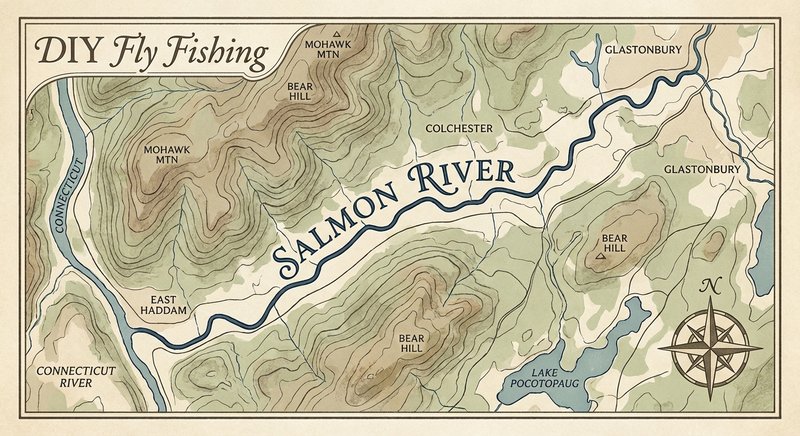
Salmon River
Fly fishing in Connecticut · Intermediate · Best seasons: Spring, Fall
Target Species
Atlantic Salmon, Sea-Run Brown Trout, Brown Trout
About This Water
Eastern Connecticut stream with Atlantic salmon restoration. Sea-run brown trout in fall.
Fishing Recommendations
The Salmon River in Connecticut is one of the most storied and unique fly fishing destinations in southern New England. While it doesn't hold a massive natural run of Atlantic Salmon today, it serves as a critical focal point for Connecticut’s "Broodstock" program, offering anglers a rare opportunity to tangle with powerful, multi-pound fish in a relatively intimate river setting.
Here is your guide to mastering the Salmon River.
🎣 Location Overview
Located in the central-eastern part of the state near East Haddam and Colchester, the Salmon River flows through the scenic Salmon River State Forest. What makes this river special is its accessibility and its diversity. It transitions from classic, rocky freestone runs and pocket water in its upper reaches to slower, deeper tidal-influenced pools as it nears the Connecticut River.
Anglers love it because it offers a "big fish" experience in a manageable environment. The river is heavily stocked with trout, but the primary draw is the Broodstock Atlantic Salmon program, where large fish (often 5–15 lbs) are released into specific stretches, creating an exciting challenge for fly rod enthusiasts.
🐟 Target Species & Behavior
Broodstock Atlantic Salmon
These are retired hatchery breeders. Unlike wild salmon, they aren't migrating to spawn, but they retain their aggressive, territorial instincts.
- Holding: They love the "heads" of deep pools where oxygen is high or the very "tail-outs" before a riffle. They will also tuck behind large boulders to break the current.
- Behavior: They are notorious for being "moody." One hour they ignore everything; the next, they will crush a swung fly.
Brown Trout (Resident & Stocked)
The river has a robust stocking program. You'll find standard "stockies" and some holdover Brown Trout that have become wary and selective.
- Behavior: They hold in traditional seams, undercut banks, and in the slower bubbles behind rocks.
Sea-Run Brown Trout
A "unicorn" species in CT. These fish migrate to the salt and return to the Salmon River.
- Behavior: They are extremely shy and often move under the cover of low light or high water. They are silver-bright and exceptionally strong.
📅 Best Times to Fish
Spring (April – June)
- The Draw: Massive trout stockings and the emergence of insect life.
- Conditions: High water is common in April; June offers the best dry fly action as the water warms and stabilizes.
Fall (October – December)
- The Draw: This is Prime Time for Atlantic Salmon. The CT DEEP usually stocks the salmon starting in October.
- Conditions: Crisp mornings and falling leaves. The salmon are most active when water temperatures drop into the 50s and 40s.
Prime Windows
- Low Light: Early morning and the "blue hour" at dusk are best for Sea-Run Browns and wary Salmon.
- Post-Rain: A slight rise in water level (and a bit of stain) often "wakes up" the Salmon and encourages them to strike.
🪰 Recommended Flies & Techniques
For Atlantic Salmon
- Technique: The Traditional Swing. Cast 45 degrees downstream, let the fly swing through the current, and "hang" it at the end.
- Patterns:
- Classic: Green Butt Night Heron, Blue Charm, Black Bear Green Butt (Size 4-8).
- Modern: Mickey Finn, Egg Leach, and Woolly Buggers in hot orange, purple, or chartreuse.
For Brown Trout
- Nymphing: This is the most consistent producer. Use a "Tandem Rig" with a heavy attractor nymph (Stonefly) followed by a small dropper.
- Patterns: Pheasant Tails (14-18), Zebra Midges, and Prince Nymphs.
- Dry Fly: During the Mayfly hatches (Hendricksons in Spring, Tan Caddis in Summer), use Parachute Adams or Elk Hair Caddis.
Presentation Tip
For Salmon, swing speed is key. If the water is cold, use a sink tip to get the fly deeper and slow the swing. If the fish are active, a floating line with a long leader is often more effective to avoid spooking them in the clear pools.
💡 Pro Tips & Local Knowledge
- The "Salmon River Fly Only" Area: Focus your efforts on the designated Trophy Trout/Fly Fishing Only section near the Comstock Covered Bridge. This area is well-managed and holds fish longer due to the regulations.
- The Stealth Factor: Because the river is easily accessible, fish see a lot of pressure. Approach pools quietly. Long, fine leaders (9ft-12ft) are often necessary when the water is low and clear.
- Vary Your Retrieve: If the "swing" isn't working for Salmon, try a "strip-and-pause" retrieve with a streamer. Sometimes the erratic movement triggers a predatory strike from a bored broodstock fish.
- The Covered Bridge: The area around the Comstock Covered Bridge is iconic but crowded. For more solitude, hike a half-mile upstream or downstream away from the parking lots to find "unpressured" pockets.
⚠️ Important Information
Access
- Main Access: Route 16 in Colchester/East Haddam provides several pull-offs.
- Day Pond State Park: Another good entry point for the upper reaches.
Regulations & Permits
- Fishing License: You must have a valid Connecticut Fishing License.
- Trout & Salmon Stamp: A Trout & Salmon Stamp is mandatory if you are fishing the Salmon River or any designated trout waters.
- Salmon Specifics: There are very specific harvest rules for Broodstock Salmon (usually Catch & Release early in the season, moving to a one-fish limit later). Always check the current CT DEEP Fishing Guide before heading out.
Special Considerations
- Gear: For Trout, a 4wt or 5wt rod is perfect. If you are targeting the Atlantic Salmon, jump up to a 7wt or 8wt rod. These fish are powerful, and a 5wt will likely snap if you hook a 12-pounder in fast current.
- Wading: Most of the river is easily wadeable, but be careful of "slick" rocks in the faster runs. Felt soles or studs are recommended.
Bug Hatches & Matching Flies
| Hatch | Type | Peak months | Time of day | Hook sizes | Matching flies |
|---|---|---|---|---|---|
| Hendrickson Ephemerella subvaria | mayfly | April, May | Afternoon | #12-14 | Red Quill #12-14, Hendrickson Emerger #14, Pheasant Tail #12-14 |
| Blue-Winged Olive (BWO) Baetis / Pseudocloeon | mayfly | April, May, September, October | Late Morning/Afternoon | #18-24 | RS2 #20-22, BWO Parachute #18-22, WD-40 #20-24 |
| Grannom Caddis Brachycentrus | caddis | April, May | Morning/Evening | #14-16 | Peacock Caddis #14-16, LaFontaine's Deep Sparkle Pupa #14-16, Elk Hair Caddis (Olive) #14-16 |
| March Brown Maccaffertium vicarium | mayfly | May, June | Afternoon | #10-14 | March Brown American #10-12, Hare's Ear Nymph #10-14, March Brown Wet Fly #12 |
| Light Cahill Stenonema / Stenacron | mayfly | June, July | Evening | #12-16 | Light Cahill Dry #12-16, Cream Usual #14-16, Gold Ribbed Hare's Ear #14-16 |
| Tan Caddis Hydropsyche | caddis | May, June, July, August | Evening | #14-18 | Elk Hair Caddis (Tan) #14-18, Pulsating Caddis Pupa #16, Frenchie #14-18 |
| Yellow Sally Isoperla | stonefly | June, July | Afternoon/Evening | #14-16 | Yellow Sally Dry #14-16, Little Yellow Stone Nymph #14-16, Stimulator (Yellow) #14-16 |
| Early Black Stonefly Allocapnia | stonefly | February, March | Mid-day | #16-20 | Black Stone Nymph #16-18, Griffith's Gnat #18-20, Zebra Midge (Black) #18-20 |
| Terrestrials (Ants/Beetles) Formicidae / Coleoptera | terrestrial | July, August, September | All Day | #12-18 | Black Foam Ant #14-18, Cinnamon Ant #16-18, Coffee's Sparkle Beetle #14-16 |
| Common Midge Chironomidae | midge | January, February, March, December | Mid-day | #20-28 | Zebra Midge (Red/Black) #20-22, Morgan's Midge #22-24, Top Secret Midge #20-24 |