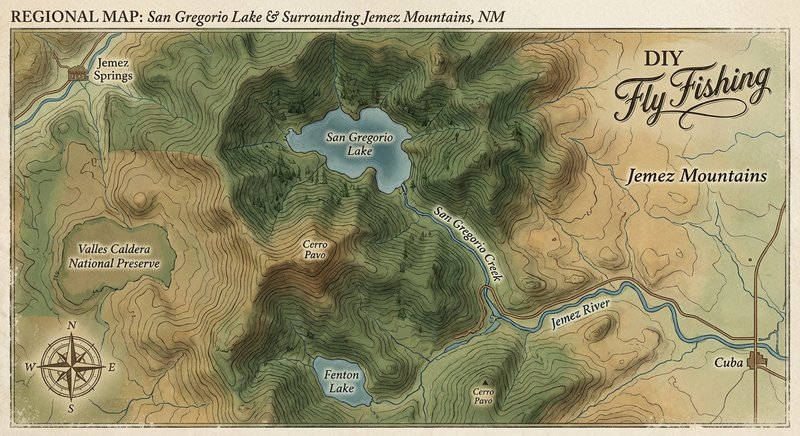
San Gregorio Lake
Fly fishing in New Mexico · Advanced · Best seasons: Summer, Fall
Target Species
Cutthroat Trout, Rainbow Trout
About This Water
Backcountry lake in the Pecos Wilderness. Excellent cutthroat and rainbow fishing.
Fishing Recommendations
Nestled in the heart of the San Pedro Parks Wilderness in the Santa Fe National Forest, San Gregorio Lake is a high-altitude (approx. 9,400 ft) alpine gem. As your guide, I can tell you that this isn't just a fishing trip; it’s a wilderness experience. Because it requires a hike to access, the pressure is lower than roadside waters, offering a serene environment characterized by lush meadows, spruce-fir forests, and crystal-clear water.
🎣 Location Overview
San Gregorio is a relatively small, high-mountain reservoir that feels more like a natural alpine lake. What makes it special is its "meadow-lake" character. The perimeter is mostly open grass and wetlands, allowing for excellent back-casting room—a rarity in many mountain lakes. The water is clear and relatively shallow near the banks, dropping off into deeper channels toward the center. Anglers love it because it offers a true "backcountry" feel without requiring a grueling 10-mile trek.
🐟 Target Species & Behavior
- Rio Grande Cutthroat Trout: This is the prize of New Mexico. These native fish are beautiful, with vivid orange slashes and spotting concentrated toward the tail. They are opportunistic feeders but can be extremely "shy" in the clear, still water.
- Rainbow Trout: Often stocked to supplement the wild population. They tend to be a bit more aggressive than the Cutthroats and will often cruise the shoreline in schools.
Behavior: During the summer, fish cruise the drop-off shelves where the shallow meadow flats meet the deeper water. They feed heavily on midge pupae in the mornings and transition to terrestrial insects (ants, beetles, grasshoppers) blown in from the surrounding meadows by afternoon winds.
📅 Best Times to Fish
- Optimal Months: Late June through September.
- Summer: The peak of the terrestrial season.
- Fall: September is magical; the air turns crisp, the elk start bugling in the surrounding forest, and the trout feed aggressively to bulk up for the long high-altitude winter.
- Best Time of Day:
- Early Morning (Dawn to 10:00 AM): For still-water midge hatches and glass-calm surfaces.
- Late Afternoon (4:00 PM to Dusk): This is the prime window for dry fly action as the wind dies down and the evening "rise" begins.
- Conditions: A slight "riffle" on the water is your best friend. It breaks up the surface, making the trout less likely to see you or be spooked by your fly line.
🪰 Recommended Flies & Techniques
Top Fly Patterns
- Dry Flies:
- Parachute Adams (Size 16–20) – The gold standard for matching midges and small mayflies.
- Royal Wulff (Size 14–16) – High visibility; great for prospecting.
- Amy’s Ant or Foam Beetles (Size 12–16) – Essential for summer afternoons.
- Nymphs:
- Pheasant Tail (Size 16–18) – Mimics the small mayfly nymphs present in the weeds.
- Zebra Midge (Size 18–22) – Red or Black; effective under a small indicator or as a dropper.
- Streamers:
- Woolly Bugger (Size 10–12) – Olive or Thin Mint. Slowly stripped along the bottom to mimic damselfly larvae or small leeches.
Effective Techniques
- The Dry-Dropper: This is the most effective way to fish San Gregorio. Use a buoyant dry fly (like a Stimulator) and hang a small Zebra Midge or Pheasant Tail 18–24 inches below it.
- The "Still-Water Strip": If using a streamer, use a very slow, rhythmic "inch-worm" retrieve. Alpine trout often prefer a slow crawl over a fast dart.
- Stealth: Because the water is clear, keep a low profile. If you can see the fish, they have likely already seen you. Long leaders (9ft–12ft) ending in 5X or 6X fluorocarbon tippet are mandatory.
💡 Pro Tips & Local Knowledge
- The "Dam" Area vs. The Inlets: Most people fish near the dam because it’s where the trail hits. For the big Cutthroats, hike around to the far side where small feeder trickles enter the lake. These areas bring in fresh oxygen and nutrients.
- Float Tubes: If you have a lightweight backpackable float tube (like a Belly Boat), bring it! Being able to reach the center of the lake allows you to fish the deep channels that shore anglers can't reach.
- The Afternoon Wind: Don't get frustrated when the wind picks up at 2:00 PM. This is when the "Hopper" fishing gets good. Cast your terrestrial pattern right against the windward bank where insects are being blown into the water.
⚠️ Important Information
- Access: Take NM-126 from Cuba, NM. Look for the San Pedro Parks/Vacas Trailhead sign. It is an easy-to-moderate 1-mile hike from the parking lot to the lake.
- Regulations:
- A valid New Mexico Fishing License and a Habitat Management Access Validation are required.
- Check current NM Department of Game and Fish (NMDGF) regulations for bag limits; however, Catch and Release is strongly encouraged for the native Rio Grande Cutthroats to preserve the fishery.
- Wilderness Ethics: This is a "Leave No Trace" area. No motorized vehicles or bicycles are allowed past the trailhead.
- Safety: You are in bear and mountain lion country. Also, afternoon thunderstorms are frequent and dangerous at this elevation—if you hear thunder, get off the water immediately.
Bug Hatches & Matching Flies
| Hatch | Type | Peak months | Time of day | Hook sizes | Matching flies |
|---|---|---|---|---|---|
| Chironomids Chironomidae | midge | May, June, September | All day | #18-24 | Zebra Midge #18-22, Griffith's Gnat #20-24, Ice Cream Cone #18-20 |
| Callibaetis Callibaetis spp. | mayfly | June, July, August | Morning/Afternoon | #14-16 | Adams #14-16, Pheasant Tail #14-18, Callibaetis Spinner #14-16 |
| Damselfly Enallagma spp. | other | July, August | Morning/Afternoon | #10-14 | Marabou Damsel #10-12, Adult Damsel #12-14 |
| Scud Gammarus lacustris | other | May, June, October | All day | #14-18 | Ray Charles #14-18, Flashback Scud #14-16 |
| Cinnamon Caddis Hesperophylax spp. | caddis | July, August | Evening | #14-16 | Elk Hair Caddis #14-16, LaFontaine's Emerger #14-16 |
| Black Carpenter Ants Camponotus spp. | terrestrial | June, July | Afternoon | #12-16 | Chernobyl Ant #12-14, Black Foam Ant #14-16 |
| Water Boatmen Corixidae | other | September, October | Afternoon | #14-18 | Water Boatman #14-18, Prince Nymph #14-18 |
| Green Drake Drunella grandis | mayfly | July | Afternoon | #10-12 | Green Drake Hairwing #10-12, Hares Ear Nymph #10-12 |