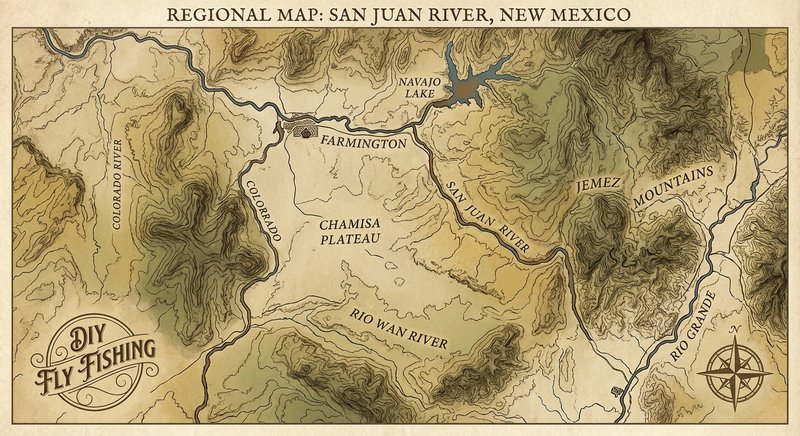
San Juan River
Fly fishing in New Mexico · Beginner · Best seasons: Spring, Summer, Fall, Winter
Target Species
Rainbow Trout, Brown Trout
About This Water
Famous tailwater below Navajo Dam with some of the highest trout densities in the country. Year-round fishing for large rainbows.
Fishing Recommendations
Welcome to the "San Juan Shuffle." As an expert guide, I can tell you that the San Juan River in northwest New Mexico is arguably the most consistent trophy trout fishery in North America. Because it is a tailwater flowing from the bottom of the Navajo Dam, the water temperature remains a constant 42–48°F year-round, creating a "biological factory" for midges and mayflies.
Here is your comprehensive guide to mastering the San Juan.
🎣 Location Overview
The San Juan River is a desert oasis. Located below Navajo Dam, the first 3.75 miles are designated as "Quality Waters." This stretch is world-famous for its incredible fish density—estimated at times to be over 15,000 fish per mile.
The river is characterized by wide, shallow flats, slow-moving "braids," and deep, swirling holes (like the legendary Texas Hole). The water is crystal clear, meaning the fish can see you as easily as you can see them. It is a technical fishery that rewards patience, light tippets, and perfect presentations.
🐟 Target Species & Behavior
- Rainbow Trout: These make up the vast majority of the population in the upper Quality Waters. They are exceptionally fat, hard-fighting, and "educated." They hold in the shallow riffles and current seams, often sitting in water much shallower than you’d expect.
- Brown Trout: While less numerous than Rainbows in the upper flats, the Browns here grow to massive proportions. They are more prevalent as you move downstream toward the "Lower Flats" and the bait-waters. They are predatory and often hold near undercut banks or deep structure.
Behavior: Because the food source (midges) is so small and constant, these fish don't have to move far to eat. They will often hold in a "feeding lane" and only move inches to the left or right. If your fly isn't in that specific 2-inch lane, they won't move for it.
📅 Best Times to Fish
The San Juan is a 365-day fishery, but each season offers a different experience:
- Spring (March – May): This is prime time for Blue-Winged Olive (BWO) hatches. If you love dry fly fishing, the cloudy days in April are magical.
- Summer (June – August): The water stays cold, making it a refuge from the desert heat. Expect crowds. Fishing is excellent, but you must be on the water early.
- Fall (September – November): My personal favorite. The crowds thin out, the Brown trout move into their pre-spawn aggression, and the BWO hatches return.
- Winter (December – February): The "secret" season. Midges hatch mid-day even in snow. You’ll have the Texas Hole almost to yourself, and the fish are just as active in the stable water temps.
Best Time of Day: Typically 9:00 AM to 3:00 PM when the sun hits the water and triggers insect activity.
🪰 Recommended Flies & Techniques
The San Juan is famous for "Micro-Fishing." If you aren't comfortable fishing size 22-26 flies, you will struggle here.
Top Fly Patterns
- Nymphs: RS2 (Grey or Olive, #20-24), Foam Wing Chocolate Emerger (#22-24), WD-40 (#20-24), Manhattan Midge (#22-26), and the classic San Juan Worm (Red or Orange) especially after a rain or flow increase.
- Larva: Red or White Larva (size 18-22) are essential for the "upper" river near the dam.
- Dry Flies: Griffith’s Gnat (#22), Morgan’s Midge (#24), and Parachute Adams (#22).
- Streamers: For the big Browns, use White or Olive Wooly Buggers or Bunny Leeches in the deeper holes.
Techniques
- The "San Juan Rig": Use a 9ft 6X tapered leader. Add 12-24 inches of 6X or 7X fluorocarbon tippet. Use a tiny "pob" (small plastic bubble) or yarn indicator. Weight is key—use small TM split shot to get those tiny midges down to the "eye level" of the fish.
- Sight Fishing: Do not just blind cast. Walk slowly, use polarized glasses, and spot a specific fish. Watch its mouth. When you see the white of its mouth open, set the hook gently.
💡 Pro Tips & Local Knowledge
- Master the 7X: You will hook 20-inch fish on 7X tippet. You cannot "horse" them. Learn to use the butt-section of your rod and side-pressure to tire the fish without snapping the light wire hooks.
- Avoid the "San Juan Shuffle": You may see people kicking the riverbed to dislodge bugs and attract fish. This is illegal and highly frowned upon by the local community. Don't be that person.
- The Texas Hole: It’s the most famous hole on the river. It holds the most fish, but also the most anglers. If it’s crowded, walk downstream to Baetis Bend or Lower Flats. The fishing is just as good and much more peaceful.
- Drag is the Enemy: Because the current is complex with many micro-eddies, a "drag-free drift" is harder than it looks. Use a reach cast or a pile cast to ensure your tiny midge isn't skating across the surface.
⚠️ Important Information
- Regulations: The "Quality Waters" (Navajo Dam to the Crusher Hole) is Catch and Release only. You must use barbless, single hooks.
- Permits: You need a New Mexico Fishing License PLUS a "Habitat Management Access Validation" and a "Habitat Stamp." These can be purchased online or at local shops in Abe’s or Navajo Dam.
- Wading Safety: The bottom is very slick "bowling ball" rocks covered in didymo (rock snot). Felt soles or studded boots are highly recommended. Be careful—the "Texas Hole" has some sudden drop-offs.
- Etiquette: This is a high-traffic river. If someone is in a "run," give them plenty of space (at least 50 yards). If you catch a fish, keep it in the water; the high desert air can dry out their slime coat quickly.
Guide’s Final Word: The San Juan rewards the technician. Shrink your flies, lighten your tippet, and stay patient. When you land a 22-inch Rainbow on a size 24 hook, you'll understand why we keep coming back.
Bug Hatches & Matching Flies
| Hatch | Type | Peak months | Time of day | Hook sizes | Matching flies |
|---|---|---|---|---|---|
| Midges Chironomidae | midge | January, February, March, April, May, June, July, August, September, October, November, December | All Day | #20-28 | Zebra Midge #20-24, RS2 #20-24, Griffith's Gnat #20-26 |
| Blue Winged Olive Baetis spp. | mayfly | March, April, September, October | Late Morning/Afternoon | #18-24 | JujuBaetis #20-24, RS2 (Grey or Olive) #20-24, Parachute Adams #20-24 |
| Pale Morning Dun Ephemerella excrucians | mayfly | June, July, August | Late Morning | #16-20 | PMD Emerger #16-18, Pheasant Tail #16-20, Sparkle Dun #16-18 |
| Spotted Sedge Hydropsyche spp. | caddis | May, June | Evening | #14-18 | Elk Hair Caddis #14-18, LaFontaine's Deep Sparkle Pupa #16-18, Puterbaugh Caddis #16-18 |
| San Juan Worm Oligochaeta | midge | May, June, July | All Day | #12-16 | San Juan Worm (Red/Orange) #12-16, Chamois Worm #14-16 |
| Sowbugs Isopoda | midge | March, April, May | All Day | #16-20 | Ray Charles #16-20, Scud/Sowbug (Grey) #16-20 |
| Terrestrials (Ants/Beetles) Formicidae/Coleoptera | terrestrial | July, August, September | Afternoon | #12-18 | Cinnamon Ant #14-18, Foam Beetle #12-16 |
| Cicada Magicicada spp. | terrestrial | June, July | Afternoon | #6-10 | Black Cicada #6-10 |