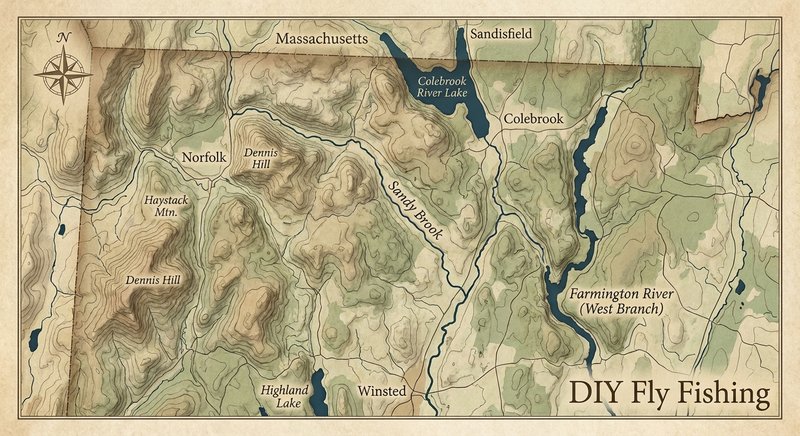
Sandy Brook
Fly fishing in Connecticut · Intermediate · Best seasons: Spring, Summer, Fall
Target Species
Brook Trout, Brown Trout
About This Water
Litchfield County stream with wild trout. Remote mountain brook.
Fishing Recommendations
As an expert guide with decades of experience on New England’s freestone streams, I can tell you that Sandy Brook in Litchfield County is one of Connecticut’s true hidden gems. It is a classic "pocket water" stream that offers a more intimate, wild experience than the nearby (and often crowded) Farmington River.
Here is your comprehensive guide to fly fishing Sandy Brook.
🎣 Location Overview
Sandy Brook is a high-gradient, freestone tributary of the Still River (which eventually feeds the Farmington). Located near the towns of Colebrook and Riverton, it flows through the Algonquin State Forest, providing a secluded, forest-canopy environment.
What makes it special is its rugged character. The stream is defined by large boulders, plunges, deep pools, and frantic riffles. Unlike the tailwater sections of the Farmington, Sandy Brook is a "wild" freestone; its flow and temperature are dictated by rainfall and snowmelt. Anglers love it because it requires "mountain-style" fishing—short casts, high-sticking, and stealthy approaches.
🐟 Target Species & Behavior
- Brown Trout: You will find both stocked and wild Brown Trout here. The wild fish are incredibly wary and often hold in the dark shadows beneath overhanging banks or behind large mid-stream boulders.
- Brook Trout: While there are some stocked Brookies, the upper reaches and smaller feeder tributaries contain beautiful, vibrant wild Brook Trout.
- Behavior: Because the water is clear and relatively shallow, these fish are "spooky." They are opportunistic feeders because the nutrient load in a high-gradient stream is lower than in a valley river. If you don't scare them with your shadow, they are usually willing to rise to a well-presented fly.
📅 Best Times to Fish
- Spring (Mid-April – June): This is the prime window. Water levels are usually ideal after the initial snowmelt. This coincides with the best hatches (Hendricksons and Quill Gordons).
- Summer (Early July – August): Focus on the early mornings and late evenings. Because it is heavily forested, the water stays cooler than many other CT streams, but you must monitor temperatures. If the water hits 70°F, give the fish a break.
- Fall (September – October): A spectacular time to be on the brook. The Brown Trout become aggressive as they prepare for the spawn. Low, clear water requires 6x or 7x tippet and very long leaders.
🪰 Recommended Flies & Techniques
Top Fly Patterns
- Dry Flies:
- Ausable Wulff (Size 12-16): High buoyancy for rough water.
- Elk Hair Caddis (Size 14-18): A staple for CT freestones.
- Stimulators (Size 10-14): Great as an attractor or a "hopper-dropper" lead fly.
- Nymphs:
- Pheasant Tail (Size 16-20): Mimics many of the natural mayfly nymphs.
- Prince Nymph (Size 12-16): The "attractor" nymph that stands out in bubbly pocket water.
- Zebra Midge (Size 18-22): Essential for low-water summer conditions.
- Streamers:
- Black or Olive Wooly Bugger (Size 8-12): Best fished through the deep pools after a rain.
Effective Techniques
- Tight-Line/Euro Nymphing: This is the most effective way to fish Sandy Brook. Because the currents are complex, an indicator often gets pulled in three directions. A tight-line setup allows you to feel the take in the deep pockets.
- Dry-Dropper: In the riffles, hang a small nymph (like a Copper John) 18 inches below a buoyant dry fly.
- The "Stealth" Approach: Wade upstream. Fishing from behind the fish is mandatory here. If you cast downstream, the fish will see you before you see them.
💡 Pro Tips & Local Knowledge
- The "Pocket Water" Secret: Most anglers fish the big, obvious pools. The pros fish the "pockets"—the tiny 2-foot circles of calm water behind rocks. A trout will sit there to conserve energy and wait for food to drift by.
- Gear Selection: Leave the 9-foot 5-weight at home. A 7'6" to 8'6" 3-weight or 4-weight is the perfect tool for this tight, brushy environment.
- Watch the Gauge: Sandy Brook can get very low in a dry summer. If the rocks are dry and the water is trickling, head over to the Farmington tailwater instead.
- The Route 8 Connection: Access near the confluence with the Still River can be excellent, but the further you hike into the Algonquin State Forest sections (off Sandy Brook Rd), the better the "wild" feel and the less pressure you'll encounter.
⚠️ Important Information
- Access: Much of the brook runs along Sandy Brook Road in Colebrook. There are several pull-offs within the State Forest. Be respectful of private property signs, as some stretches are privately owned.
- Regulations: Connecticut DEEP (Department of Energy and Environmental Protection) manages this water. It is generally open year-round, but specific sections may have different rules. Check the current CT Fishing Guide for the latest creel limits and tackle restrictions.
- Safety: The rocks in Sandy Brook are notoriously slippery and "roly-poly." Felt-soled boots or studs are highly recommended. Cell service is spotty at best in the gorge, so tell someone where you are going.
- Permits: A standard Connecticut Inland Fishing License is required for all anglers 16 and older. A "Trout & Salmon Stamp" is also required if you intend to keep trout or fish in designated Trout Management Areas.
Bug Hatches & Matching Flies
| Hatch | Type | Peak months | Time of day | Hook sizes | Matching flies |
|---|---|---|---|---|---|
| Blue Winged Olive Baetis / Pseudocloeon | mayfly | April, May, September, October | Midday/Afternoon | #18-24 | RS2 #20-22, Parachute BWO #18-22, Pheasant Tail #18-20 |
| Hendrickson Ephemerella subvaria | mayfly | April, May | Afternoon | #12-14 | Red Quill #12-14, Hendrickson Nymph #12-14, Snowshoe Rabbit Emerger #14 |
| Quill Gordon Epeorus pleuralis | mayfly | April | Midday | #12-14 | Quill Gordon #12-14, Hare's Ear #12-14 |
| March Brown Maccaffertium vicarium | mayfly | May, June | Afternoon/Evening | #10-12 | March Brown Dry #10-12, Gold Ribbed Hare's Ear #10-12 |
| Tan Caddis Hydropsyche / Cheumatopsyche | caddis | May, June, July | Evening | #14-18 | Elk Hair Caddis #14-16, LaFontaine's Deep Sparkle Pupa #14-16, Holy Grail #16 |
| Sulphur Ephemerella invaria / dorothea | mayfly | May, June | Evening | #14-18 | Sulphur Parachute #14-18, Sulphur Cripple #16-18 |
| Slate Drake Isonychia bicolor | mayfly | June, September | Afternoon/Evening | #10-14 | Iso Parachute #10-12, Isonychia Nymph #10-12 |
| Early Brown Stonefly Strophopteryx fasciata | stonefly | March, April | Midday | #12-16 | Early Brown Stone #14-16, Pats Rubber Legs #12-14 |
| Light Cahill Stenocron interpunctatum | mayfly | June, July | Evening/Night | #12-14 | Light Cahill #12-14, Cream Usual #14 |
| Ants and Beetles Formicidae / Coleoptera | terrestrial | July, August, September | All Day | #12-20 | Black Foam Ant #16-20, Cinnamon Ant #14-18, Coffee's Sparkle Beetle #14-16 |