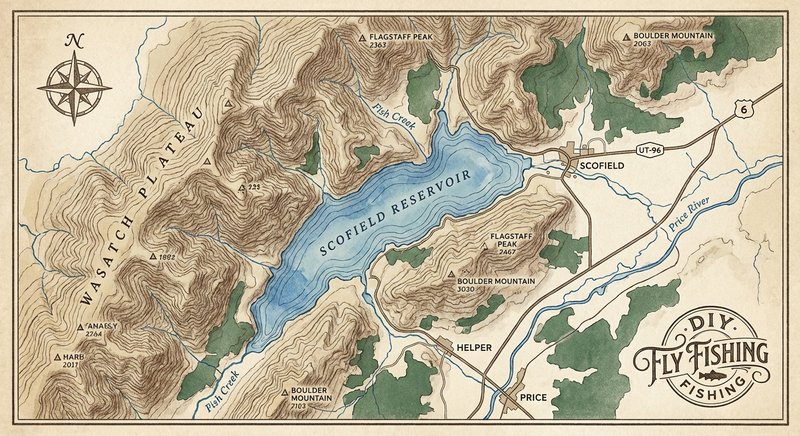
Scofield Reservoir
Fly fishing in Utah · Beginner · Best seasons: Summer, Fall, Winter
Target Species
Tiger Trout, Cutthroat Trout, Rainbow Trout
About This Water
High elevation reservoir with excellent tiger trout and cutthroat. Good ice fishing.
Fishing Recommendations
Scofield Reservoir is one of Utah’s premier stillwater destinations, located high in the Manti-La Sal National Forest at an elevation of 7,600 feet. Once known primarily as a "family" rainbow fishery, it has transitioned into a world-class trophy destination, particularly for those hunting massive Tiger Trout.
Here is your guide to mastering Scofield Reservoir.
🎣 Location Overview
Scofield is a classic mountain reservoir surrounded by rolling hills and sagebrush flats. What makes it special is its resilience and transformation. After a period of being overrun by invasive Utah Chub, the Utah Division of Wildlife Resources (DWR) stocked aggressive predatory species to balance the ecosystem.
The result? A high-protein environment where trout grow exceptionally large and exceptionally fast. The water is relatively clear but fertile, with expansive weed beds and rocky points that provide the perfect habitat for both predator and prey.
🐟 Target Species & Behavior
Tiger Trout (The Main Attraction)
Tigers are a sterile hybrid of a Brook Trout and a Brown Trout. They are highly aggressive, piscivorous (fish-eating), and fight with incredible strength.
- Behavior: They are ambush predators. They hang out near weed edges and rocky drop-offs, waiting to smash Utah Chub or smaller trout.
- Feeding: They prefer large meals. While they will take nymphs, they are most susceptible to streamer patterns that mimic baitfish.
Cutthroat Trout (Bear Lake Strain)
These fish are sleek, silver, and hard-fighting.
- Behavior: Often found cruising the upper 10 feet of the water column. They are more likely to be found near the inlets (Mud Creek and Scofield Creek) during the spring and fall.
Rainbow Trout
While less numerous than they once were, the rainbows here are healthy and provide great action for indicator fishers.
- Behavior: Generalist feeders that key in on midge hatches and scud populations in the weed beds.
📅 Best Times to Fish
Summer (June – August)
- Window: Early morning and late evening are critical. Once the sun hits the water, the fish move deeper to find cooler temperatures.
- Highlights: The Damselfly hatch in July is legendary. Look for trout "porpoising" near the weed beds as they hunt damselfly nymphs migrating to the shore.
Fall (September – November) - PRIME TIME
- Window: All day. As water temperatures drop, fish move into the shallows to gorge before winter.
- Highlights: This is when the biggest Tiger Trout are caught. They become extremely territorial and aggressive. Target rocky points and the mouths of the creeks.
Winter (December – March)
- Window: Mid-day when the sun is out.
- Highlights: Scofield is one of the best ice-fishing destinations in the West. For fly anglers, this means "vertical fly fishing" through the ice using small jigs or weighted nymphs (Scuds and San Juan Worms).
🪰 Recommended Flies & Techniques
Streamer Stripping (Best for Trophy Tigers)
This is the most exciting way to fish Scofield. Use a Type 3 or Type 5 sinking line to get the fly down.
- Patterns:
- Sex Dungeon (White or Olive): Mimics the Utah Chub.
- Sculpzilla: Great for bottom-dwelling movement.
- Balanced Leeches (Black/Blue or Maroon): Deadly when stripped slowly or fished under an indicator.
- Technique: Use an erratic "strip-strip-pause" retrieve. Most hits happen on the pause.
Indicator Nymphing
Ideal for Rainbows and Cutthroats, especially on windy days.
- Patterns:
- Ray Charles or Flashback Scuds (Orange or Olive): Scofield is loaded with freshwater shrimp (scuds).
- Zebra Midges (Size 16–20): Red or Black.
- Chironomids: Long leaders (12–15 ft) are often necessary to reach the zone.
The Damsel Dry/Nymph Combo
During July, fish a floating line with a damsel nymph dropped 2 feet behind a high-visibility dry fly.
💡 Pro Tips & Local Knowledge
- Match the Chub: The Utah Chub is the primary forage. Flies with a "silvery-purple" or "olive-gold" hue will consistently out-produce others.
- Focus on "The Points": If you are fishing from shore, look for rocky points that jut out into the lake. These create natural "ambush alleys" where Tigers trap schools of baitfish.
- The Wind is Your Friend: A "Scofield Chop" (light ripples) breaks up the surface and makes the fish less spooky. If the water is glass-calm, you must use longer, thinner leaders (4X or 5X).
- Inlet Focus: In the fall, Mud Creek (on the south end) is a magnet for fish. Even though the Tigers don't spawn, their instincts drive them toward moving water, making them highly concentrated.
⚠️ Important Information
Access
- Scofield State Park: Offers excellent boat ramps, docks, and camping (Madsen Bay or Mountain View areas).
- Walk-in Access: Much of the western shore is accessible via public land off Highway 96.
Regulations
- Limit: The limit is currently 2 trout (all species combined).
- Size Restriction: Only one trout may be over 22 inches. (Always check current Utah Fishing Proclamations as they can change annually).
- Gear: No specific "flies-only" restriction, but barbless hooks are recommended for easy release of these trophy fish.
Special Considerations
- Weather: Scofield is notorious for sudden mountain storms. If you are in a float tube or small boat and see dark clouds over the Skyline Drive mountains, head to shore immediately.
- Float Tubing: This is perhaps the best way to fish Scofield, as it allows you to silently hover just outside the weed lines where the big fish cruise.
Bug Hatches & Matching Flies
| Hatch | Type | Peak months | Time of day | Hook sizes | Matching flies |
|---|---|---|---|---|---|
| Chironomid Chironomidae | midge | April, May, June, September | All Day | #10-18 | Ice Cream Cone #12-16, Zebra Midge #14-18, Chrono-Pupae #12-16 |
| Callibaetis Callibaetis ferrugineus | mayfly | June, July, August | Late Morning/Afternoon | #12-16 | Parachute Adams #14-16, Callibaetis Nymph #12-16, Pheasant Tail #14-16 |
| Traveling Sedge Hesperophylax | caddis | July, August | Evening | #8-12 | Goddard Caddis #8-12, Mikulak Sedge #10-12, Elk Hair Caddis #12-14 |
| Carpenter Ants Camponotus | terrestrial | June, July | Afternoon | #10-14 | Chernobyl Ant #10-12, Black Foam Ant #12-14 |
| Grasshoppers Acrididae | terrestrial | August, September | Afternoon | #8-12 | Parachute Hopper #8-12, Morrish Hopper #10-12 |
| Bloodworm Chironomus plumosus | midge | May, June, October | All Day | #10-14 | San Juan Worm (Red) #12-14, Blood Midge #10-14 |
| Speckled Spinner Callibaetis | mayfly | July, August | Morning | #14-16 | Callibaetis Spinner #14-16, Rusty Spinner #16 |
| Cinnamon Caddis Hydropsyche | caddis | June, July | Evening | #14-18 | Cinnamon Ant #16, Elk Hair Caddis (Tan) #14-18 |