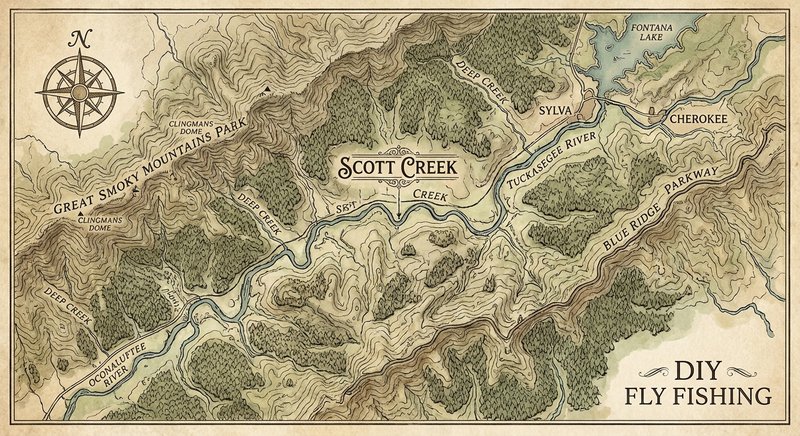
Scott Creek
Fly fishing in North Carolina · Beginner · Best seasons: Spring, Fall, Winter
Target Species
Brown Trout, Rainbow Trout
About This Water
Delayed harvest stream near Sylva. Easy access and good winter fishing.
Fishing Recommendations
Welcome to the mountains of Western North Carolina. As a guide in this region, I can tell you that Scott Creek is one of the most underrated gems in Jackson County. While many anglers rush past it to reach the famous "Tuckasegee River," Scott Creek offers a more intimate, classic freestone experience with exceptional access.
Here is your comprehensive guide to fly fishing Scott Creek.
🎣 Location Overview
Scott Creek is a medium-sized freestone stream that flows through the heart of Jackson County, passing through the towns of Sylva and Dillsboro before emptying into the Tuckasegee River.
What makes Scott Creek special is its dual personality. It features a Delayed Harvest (DH) section that is heavily stocked, making it an incredible destination for high numbers of fish and large "trophy" retirees from the hatchery. The water is characterized by classic Appalachian pocket water, long runs, and deep pools carved out by the creek's descent from the Balsam Mountains. Because it runs parallel to Highway 74/23, it is arguably one of the most accessible trout streams in the state, yet it retains a beautiful, rocky character.
🐟 Target Species & Behavior
The primary targets here are Rainbow Trout and Brown Trout.
- Rainbow Trout: These are the "acrobats" of Scott Creek. In the DH section, they tend to congregate in the faster oxygenated water at the heads of pools. They are aggressive feeders and will often move several feet to intercept a fly.
- Brown Trout: The Browns here like structure. Look for them tucked against undercut banks, behind large boulders, or in the deep, dark "guts" of the pools. Large holdover Browns can be found in the deeper holes near the bridges; these fish are wary and often require a stealthier approach or a well-placed streamer.
- Behavior: During the Delayed Harvest months (October–June), these fish are primarily subsurface feeders. However, once they acclimate to the stream, they become very "buggy" and will keyed in on the heavy hatches common to the region.
📅 Best Times to Fish
Optimal Seasons
- Spring (March – May): This is the "Golden Era" on Scott Creek. The water temperatures rise into the 50s, the insects are active, and the fish are incredibly hungry. This is your best chance for dry fly action.
- Fall (October – November): When the DH season begins in October, the creek is loaded with fresh fish. The cooling temperatures and the changing leaves make for a spectacular backdrop.
- Winter (December – February): Unlike higher elevation streams, Scott Creek remains fishable all winter. On sunny afternoons, midges and small winter stones will bring fish to the surface.
Best Times of Day
- Spring/Fall: 10:00 AM to 4:00 PM. You want to wait for the sun to warm the water slightly to trigger insect activity.
- Winter: 12:00 PM to 3:00 PM. The "warmest" part of the day is critical.
🪰 Recommended Flies & Techniques
Top Fly Patterns
- Nymphs:
- Sexy Walt’s Worm (Size 12-16) - A local staple.
- Pheasant Tail (Beadhead, Size 14-18) - Mimics the ubiquitous Mayfly nymphs.
- Squirmy Wormy/Egg Patterns - Especially effective right after a fresh stocking or high water.
- Dry Flies:
- Parachute Adams (Size 14-18) - The ultimate generalist.
- Yellow Stimulator (Size 12-14) - Great for the heavy Stonefly activity in late spring.
- Elk Hair Caddis (Size 14-16) - Perfect for the evening "skittering" bite.
- Streamers:
- Woolly Bugger (Black or Olive, Size 8-10) - Dead-drifted or swung through deep holes.
Techniques
- Tight-Line (Euro) Nymphing: Because Scott Creek has so much "pocket water" (small pockets of calm water behind rocks), a tight-line setup is incredibly effective. It allows you to probe the depths of small pockets without a strike indicator getting caught in conflicting currents.
- Indicator Nymphing: In the larger, slower pools near the Dillsboro end, a standard indicator rig with a two-fly setup (a heavy attractor nymph followed by a smaller natural) is the way to go.
- The "Dry-Dropper": In the late spring, use a buoyant dry fly (like a Stimulator) with a small pheasant tail dropped 18 inches below it.
💡 Pro Tips & Local Knowledge
- The "Town" Stretch: Don't be afraid to fish through the town of Sylva. There are some surprisingly deep holes behind the shops and restaurants that hold very large fish.
- Watch the Gauge: Scott Creek can get "flashy" (rise and muddy quickly) after a heavy rain. If it looks like chocolate milk, wait 24 hours. It clears faster than the larger Tuckasegee.
- Stealth Matters: Even though it's a stocked stream, the water is often crystal clear. Wear earthy tones and avoid "lining" the fish (casting your fly line directly over their heads).
- The Bridge Piles: Many anglers skip the areas directly under the highway bridges. These areas provide shade and overhead cover, making them prime real estate for the larger, "smarter" Brown trout.
⚠️ Important Information
Access
- Main Access: Parallel to US-74/23 and Business 23. There are numerous pull-offs along the road between Sylva and Ochre Hill.
- Public Parks: Poteet Park in Sylva offers excellent public access and easy wading for beginners.
Regulations & Permits
- License: You must have a North Carolina Fishing License with a Trout Privilege.
- Delayed Harvest (DH) Rules: From October 1 until the first Saturday in June, the section designated as DH is Catch and Release Only and Artificial Lures Only (no bait).
- Hatchery Supported: Check the NC Wildlife Resources Commission map, as some upper sections revert to Hatchery Supported rules (7-fish creel limit, bait allowed) year-round. Stick to the DH section for the best fly fishing experience.
Guide’s Final Word: Scott Creek is the perfect "quick hit" stream. Whether you have two hours or a whole day, its proximity to town and high fish density make it a rewarding stop for any angler visiting the North Carolina mountains. Tight lines!
Bug Hatches & Matching Flies
| Hatch | Type | Peak months | Time of day | Hook sizes | Matching flies |
|---|---|---|---|---|---|
| Quill Gordon Epeorus pleuralis | mayfly | March, April | Midday | #12-14 | Quill Gordon Dry #12-14, Quill Gordon Wet #12-14 |
| Blue-Winged Olive Baetis spp. | mayfly | March, April, October, November | Late Morning/Afternoon | #18-22 | RS2 #20-22, Parachute Adams #18-22 |
| March Brown Maccaffertium vicarium | mayfly | April, May | Afternoon | #10-14 | American March Brown #10-12, Hare's Ear Nymph #10-14 |
| Sulphur Ephemerella invaria/dorothea | mayfly | May, June | Evening | #14-18 | Sulphur Parachute #14-16, Pheasant Tail Nymph #14-18 |
| Golden Stonefly Acroneuria evoluta | stonefly | June, July | Morning/Evening | #6-10 | Pat's Rubber Legs #6-10, Golden Stimulator #8-12 |
| Cinnamon Caddis Hydropsyche spp. | caddis | May, June, July, August | Evening | #14-18 | Elk Hair Caddis (Tan) #14-16, Holy Grail #14-16 |
| Light Cahill Stenacron interpunctatum | mayfly | June, July, August | Late Evening/Dusk | #12-16 | Light Cahill Dry #12-14, Cream Variant #14-16 |
| Terrestrials Formicidae / Coleoptera | terrestrial | July, August, September | All Day | #12-18 | Chernobyl Ant #10-14, Black Foam Beetle #14-18 |
| Little Black Caddis Brachycentrus nigrisoma | caddis | April | Morning/Afternoon | #16-20 | Zebra Midge #18-20, Black Elk Hair Caddis #16-18 |