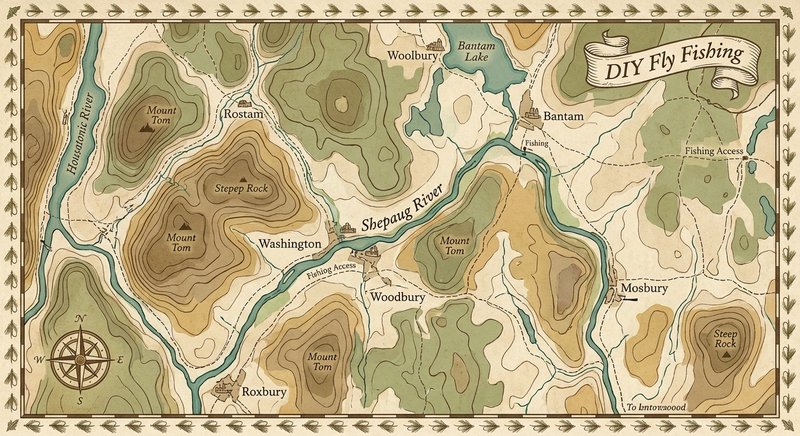
Shepaug River
Fly fishing in Connecticut · Intermediate · Best seasons: Spring, Summer, Fall
Target Species
Brown Trout, Rainbow Trout
About This Water
Litchfield County stream with brown trout. Scenic covered bridge area.
Fishing Recommendations
The Shepaug River is one of Connecticut’s "best-kept secrets." While most Litchfield County anglers flock to the famous Farmington or Housatonic Rivers, the Shepaug offers a more intimate, rugged, and solitary experience. It is a quintessential New England freestone stream, characterized by its steep hemlock-lined ravines, massive granite boulders, and clear, tumbling water.
Here is your comprehensive guide to fly fishing the Shepaug River.
🎣 Location Overview
The Shepaug River flows through the heart of Litchfield County, primarily through the towns of Washington and Roxbury. It is a major tributary of the Housatonic River, but it has a completely different character.
What makes the Shepaug special is its wildness. Much of the river flows through protected land trusts, such as the Steep Rock Preserve and Hidden Valley Preserve. This means you won’t find many houses or roads lining the banks; instead, you’ll find deep pools, technical pocket water, and long, glassy runs. It is a "hiker’s river"—the further you are willing to walk from the parking areas, the better the fishing usually gets.
🐟 Target Species & Behavior
The Shepaug is primarily a Stocked Trout fishery, though it does support a small number of holdover fish in its deeper, cooler sections.
- Brown Trout: These are the "smart" residents of the river. They tend to hold in the "darker" water—under overhanging banks, beneath submerged logs, or in the deep shadows of the boulders. They are more likely to move into shallow water during low-light hours or heavy hatches.
- Rainbow Trout: Found primarily in the faster, oxygenated water. They will sit right in the "bubble line" or at the very head of a riffle. They are generally more aggressive than the Browns and will chase streamers or flashy nymphs.
- Behavior: Because the Shepaug can get low and clear, the fish are remarkably spooky. Stealth is your best friend here. Long leaders and light footfalls are essential.
📅 Best Times to Fish
- Spring (Mid-April – June): This is the prime window. The CT DEEP stocks the river heavily in April. May brings the most consistent insect hatches, and water levels are usually perfect for both nymphing and dry fly fishing.
- Summer (July – August): The Shepaug is susceptible to low water and high temperatures. During a hot summer, fishing should be restricted to early morning (dawn until 10 AM). If the water temperature exceeds 68°F, give the trout a break and head elsewhere.
- Fall (September – October): A secondary peak. As the water cools, the fish become active again. This is a great time for "searching" with streamers or terrestrial patterns (ants/beetles).
🪰 Recommended Flies & Techniques
Nymphing (The Bread and Butter)
The Shepaug is full of "pocket water." High-sticking or European-style nymphing is incredibly effective here.
- Pheasant Tail (Size 14-18): Mimics almost everything.
- Hare’s Ear (Size 12-16): Great for the "buggy" look of the river's stoneflies.
- Zebra Midge (Size 18-22): Essential for the slower pools.
Dry Flies (The Match the Hatch)
- Hendrickson (April/May): The first major hatch of the year.
- Sulphurs (Late May/June): The most reliable evening hatch.
- Blue-Winged Olives (BWO): Essential for overcast or drizzly days.
- Elk Hair Caddis: A great "prospecting" fly in the riffles.
Streamers
- Woolly Buggers (Black or Olive): Swing these through deep holes or strip them through the tail-outs of pools.
- Muddler Minnows: Work great when skipped across the surface to mimic a sculpin or large moth.
💡 Pro Tips & Local Knowledge
- The Steep Rock Loop: Focus on the Steep Rock Preserve in Washington Depot. There is a tunnel (the Shepaug Tunnel) that you can hike through to reach more remote sections of the river. The water away from the main parking lot receives significantly less pressure.
- The "Boulder" Technique: Don't just fish the big pools. In the Shepaug, every large boulder creates a "pillow" of soft water in front of it and a "seam" behind it. A single well-placed cast next to a rock can often yield more fish than an hour spent in a crowded pool.
- Downsize Your Tippet: The water is often crystal clear. While you might get away with 4X on the Housatonic, you’ll often need to drop to 5X or even 6X on the Shepaug to avoid spooking the fish.
- Check the Gauge: The Shepaug is regulated by a dam, but it still behaves like a freestone. Check the USGS gauge (Shepaug River near Roxbury). If it’s below 50 CFS, it’s very low and technical. 80-150 CFS is the "sweet spot."
⚠️ Important Information
- Access: Much of the river is accessed through the Steep Rock Association lands. These are private preserves open to the public for hiking and fishing. Please respect their rules: carry out what you carry in and stay on the trails until you reach your fishing spot.
- Regulations: The Shepaug is subject to Connecticut's general trout regulations. However, be aware that CT has moved to a year-round trout season, though "Catch and Release" only applies during the early spring (check the current DEEP Angler's Guide for specific dates).
- Wading: The rocks in the Shepaug are notoriously slippery (covered in "didymo" or slick algae). Studded wading boots and a wading staff are highly recommended.
- Permits: You must have a valid Connecticut Fishing License and a Trout & Salmon Stamp.
The Shepaug isn't a river where you go to catch 50 fish a day; it’s a river where you go to enjoy the scenery, sharpen your technical skills, and find a bit of peace in the Litchfield hills. Tight lines!
Bug Hatches & Matching Flies
| Hatch | Type | Peak months | Time of day | Hook sizes | Matching flies |
|---|---|---|---|---|---|
| Blue-Winged Olive Baetis / Pseudocloeon | mayfly | April, May, September, October | Mid-day | #18-22 | RS2 #20-22, BWO Parachute #18-22, CDC Emerger #20-22 |
| Hendrickson Ephemerella subvaria | mayfly | April, May | Afternoon | #12-14 | Hendrickson Dark #12-14, Red Quill #14, Pheasant Tail #12-14 |
| Grannom Caddis Brachycentrus | caddis | April, May | Morning/Afternoon | #14-16 | Elk Hair Caddis (Olive) #14-16, LaFontaine's Deep Sparkle Pupa #14-16, Peacock Caddis #16 |
| Sulfur Ephemerella invaria / dorothea | mayfly | May, June | Evening | #14-18 | Sulfur Parachute #14-18, Sulfur Emerger #16-18, Pheasant Tail #16-18 |
| March Brown Maccaffertium vicarium | mayfly | May, June | Afternoon | #10-12 | March Brown American #10-12, Gold Ribbed Hare's Ear #10-12, March Brown Wet #12 |
| Light Cahill Stenacron / Stenonema | mayfly | June, July | Evening | #12-14 | Light Cahill #12-14, Cream Usual #14, Gold Ribbed Hare's Ear #14 |
| Isonychia (Slate Drake) Isonychia bicolor | mayfly | June, September | Afternoon/Evening | #10-12 | Iso Nymph #10-12, Slate Drake Parachute #10-12, Prince Nymph #10-14 |
| Trico Tricorythodes | mayfly | July, August, September | Morning | #22-26 | Trico Spinner #22-24, Trico Parachute #22-24, Zebra Midge #22 |
| Terrestrials Formicidae / Coleoptera | terrestrial | July, August, September | All Day | #12-18 | Cinnamon Ant #16-18, Black Foam Beetle #14-16, Dave's Hopper #12 |
| Winter Midge Chironomidae | midge | January, February, March | Mid-day | #20-24 | Griffith's Gnat #20-24, Zebra Midge #20-24, Top Secret Midge #22 |