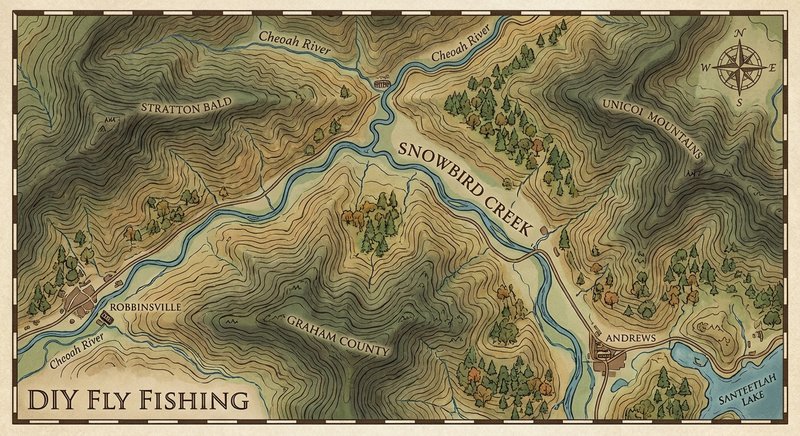
Snowbird Creek
Fly fishing in North Carolina · Intermediate · Best seasons: Spring, Summer, Fall
Target Species
Brown Trout, Rainbow Trout
About This Water
Remote stream in Nantahala National Forest. Wild trout in pristine setting.
Fishing Recommendations
Snowbird Creek, located in the remote reaches of Graham County near Robbinsville, North Carolina, is often whispered about in fly fishing circles as one of the "crown jewels" of the Nantahala National Forest. It offers a rare trifecta: easily accessible stocked water, productive "Delayed Harvest" stretches, and miles of rugged, backcountry wild trout water.
Here is your comprehensive guide to fly fishing Big Snowbird Creek.
🎣 Location Overview
Big Snowbird Creek is a quintessential Southern Appalachian freestone stream. It is characterized by its crystal-clear water, dramatic waterfalls, and a split personality that caters to every type of angler.
The creek is generally divided into three sections:
- The Lower Section: Hatchery-supported water that is wide, easy to wade, and heavily stocked.
- The Delayed Harvest (DH) Section: A popular stretch managed for high catch rates from fall through spring.
- The Upper Section (Wild Trout): Above the "Junction," the road ends and the wilderness begins. This is rugged, high-gradient water featuring three major waterfalls (Lower, Middle, and Upper Falls). This area is famous for its "wild" feel and the remnants of the old logging railroads.
What makes Snowbird special is its solitude. While the lower sections see pressure, a three-mile hike into the backcountry puts you in some of the most pristine trout water in the Eastern United States.
🐟 Target Species & Behavior
- Rainbow Trout: Found throughout the system. In the lower sections, these are often hard-fighting stockies. In the upper reaches, wild rainbows are colorful, opportunistic, and incredibly fast. They hold in the "pocket water" behind boulders and in the bubbly oxygenated water at the heads of pools.
- Brown Trout: Snowbird is known for holding some truly "profound" wild browns in its deeper, darker pools. These fish are wary. They tend to hide under undercut banks or beneath rhododendron overshoots during the day, coming out to feed aggressively during low-light conditions or after a rain.
- Brook Trout (Bonus): While you asked for Rainbows and Browns, it’s worth noting that above Upper Falls, you will find the "native" Southern Appalachian Brook Trout—the only trout native to these mountains.
📅 Best Times to Fish
Spring (March – May)
This is the gold standard for Snowbird. The Quill Gordon and March Brown hatches bring fish to the surface. Water levels are usually high but clear, and the fish are hungry after winter.
Summer (June – August)
While lower elevation streams get too warm, the Upper Wild Section of Snowbird remains cool due to the heavy canopy and high elevation. This is the time for Terrestrials (ants, beetles, and hoppers). Focus on the early morning and the "golden hour" before dusk.
Fall (September – November)
October brings the October Caddis hatch—a favorite for Big Snowbird browns. The spawning run for wild browns occurs in late fall; please watch your step to avoid stepping on "redds" (spawning beds) in the gravel.
🪰 Recommended Flies & Techniques
Top Fly Patterns
- Dry Flies:
- Yellow Stimulator (Size 12-16): The "go-to" attractor for the Smokies region.
- Parachute Adams (Size 14-18): Perfect for matching generic mayfly hatches.
- Elk Hair Caddis (Size 14-16): Tan or Olive.
- Chernobyl Ant: High-floating and great for "Dry-Dropper" rigs in the summer.
- Nymphs:
- Pheasant Tail (Size 14-18): Beaded and non-beaded.
- Pat’s Rubber Legs (Size 8-12): Mimics the large Golden Stoneflies found in Snowbird’s depths.
- Prince Nymph: Effective in the faster runs.
- Streamers:
- Woolly Buggers (Black or Olive): Essential for targeting big browns in the deep plunge pools below the waterfalls.
Techniques
- Dry-Dropper: This is the most effective way to cover Snowbird. Use a buoyant dry fly (like a Stimulator) with 18-24 inches of 5X tippet tied to a small Pheasant Tail nymph.
- High-Sticking/Euro Nymphing: In the high-gradient sections, use a tight-line approach to keep your flies in the small "buckets" behind rocks without your line getting caught in conflicting currents.
- Stealth: The water is exceptionally clear. Wear drab clothing (greens and browns) and "hunt" the fish. Kneel when approaching a pool to avoid being silhouetted against the sky.
💡 Pro Tips & Local Knowledge
- The "Junction" Rule: Most casual anglers stop at the end of the road. If you are willing to hike 2-3 miles past the gate at the end of Big Snowbird Road, the fishing pressure drops to almost zero.
- Watch the Waterfalls: The pools below Lower and Middle Falls are very deep. Don't just fish the edges; put a heavy streamer or a weighted nymph deep into the "foam line" where big browns wait for stunned baitfish or insects.
- Yellow is Key: For some reason, trout in the Nantahala Forest have a particular affinity for yellow. A Yellow Sallie or a Yellow Humpy will often outproduce more "realistic" patterns.
⚠️ Important Information
Access
- By Car: From Robbinsville, take NC-143 to Snowbird Road (SR 1127). Follow it until the pavement ends. The road continues as a gravel Forest Service road.
- Hiking: The Big Snowbird Trail (Trail #151) follows the creek for miles into the wilderness. It is relatively flat for the first few miles but gets rugged as you climb toward the falls.
Regulations
- NC Fishing License: A valid North Carolina fishing license with a Trout Privilege is required.
- Variable Regs: Pay close attention to signage. The lower section transitions from Hatchery Supported (closed in March) to Delayed Harvest (catch and release only with single-hook artificials from Oct 1 to the first Saturday in June), and eventually to Wild Trout Water (natural bait allowed on some sections, but check the NCWRC map for specific "Wild Trout/Natural Bait" vs "Wild Trout" boundaries).
Special Considerations
- Safety: This is "Grizzly" country... well, Black Bear country. While they generally avoid humans, keep your food sealed.
- Cell Service: There is zero cell service once you turn onto Snowbird Road. Download your maps for offline use or bring a physical map and a GPS/InReach device.
- Wading: The rocks in Snowbird are notoriously slick ("Snot-on-a-glass-doorknob" slick). Felt-soled boots or studs are highly recommended.
Bug Hatches & Matching Flies
| Hatch | Type | Peak months | Time of day | Hook sizes | Matching flies |
|---|---|---|---|---|---|
| Quill Gordon Epeorus pluristrigatus | mayfly | March, April | Midday | #12-14 | Quill Gordon Dry #12-14, Quill Gordon Wet #12-14 |
| Blue Quill Paraleptophlebia adoptiva | mayfly | March, April | Late Morning | #16-18 | Blue Quill Dry #16-18, Pheasant Tail Nymph #16-18 |
| March Brown Maccaffertium vicarium | mayfly | April, May | Afternoon | #10-14 | March Brown American #10-12, Hare's Ear Nymph #10-14 |
| Yellow Sally Isoperla spp. | stonefly | May, June, July | Late Afternoon/Evening | #14-16 | Yellow Sally Stone #14-16, Yellow Stimulator #14-16 |
| Light Cahill Stenacron interpunctatum | mayfly | June, July | Evening | #14-16 | Light Cahill Dry #14-16, Gold Ribbed Hare's Ear #14-16 |
| Green Sedge Rhyacophila | caddis | April, May, June | Morning/Evening | #12-16 | Green Weenie #12-16, Elk Hair Caddis (Olive) #14-16 |
| Blue Winged Olive Baetis spp. | mayfly | February, March, October, November | Midday | #18-22 | BWO Sparkle Dun #18-22, RS2 #20-22 |
| Golden Stonefly Acroneuria lycorias | stonefly | June, July | Morning/Evening | #6-10 | Pat's Rubber Legs (Golden) #8-10, Golden Stone #6-10 |
| Terrestrials (Ants/Beetles) Formicidae / Coleoptera | terrestrial | July, August, September | All Day | #12-18 | Black Foam Ant #14-18, Crowe Beetle #12-16 |