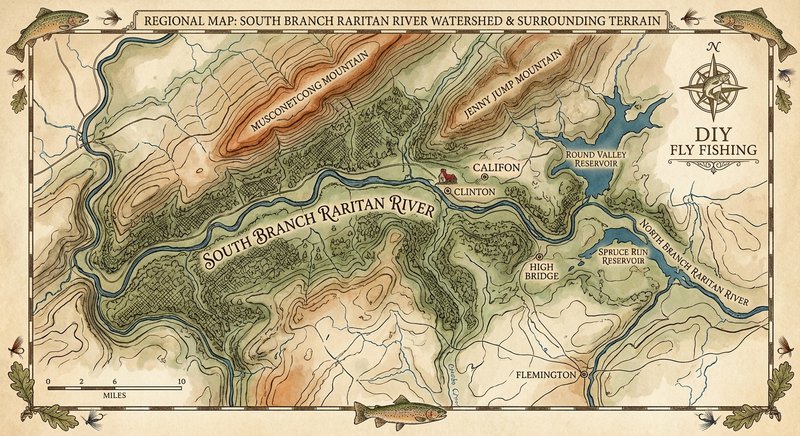
South Branch Raritan River
Fly fishing in New Jersey · intermediate · Best seasons: spring, fall
Target Species
Brown Trout, Rainbow Trout, Brook Trout
About This Water
Premier trout stream in Hunterdon County with excellent wild brown trout population. Ken Lockwood Gorge section offers scenic canyon fishing.
Fishing Recommendations
The South Branch of the Raritan River is widely considered the "crown jewel" of New Jersey fly fishing. Flowing through the picturesque hills of Hunterdon and Morris Counties, it offers a diverse range of water types—from the steep, rocky "Gorge" to meandering meadow streams. It is a river that rewards technical skill but remains accessible to the intermediate angler.
🎣 Location Overview
The South Branch is a classic Northeastern freestone-style river with some spring-fed characteristics. What makes it special is the Ken Lockwood Gorge (KLG), a 2.5-mile stretch of boulder-strewn, high-gradient water that is widely regarded as one of the most beautiful places to fish in the Mid-Atlantic.
The river transitions from a small, brushy stream in its headwaters near Budd Lake to a substantial river by the time it reaches the confluence with the North Branch. Anglers love the South Branch because it feels like a piece of the Catskills or Montana dropped right into the heart of the most densely populated state in the U.S.
🐟 Target Species & Behavior
- Brown Trout: The stars of the river. The South Branch has a healthy population of wild brown trout, especially in the upper reaches and the Gorge. They are wary and "educated," often tucked under undercut banks or behind large boulders.
- Rainbow Trout: Heavily stocked by the state, but many hold over year-round. They tend to sit in faster, oxygenated riffles and are generally more aggressive toward flies than the browns.
- Brook Trout: Found primarily in the headwaters and cold-water tributaries. They are small, vibrant, and opportunistic, usually found in the tightest, wood-filled pockets of the upper river.
Behavior Note: Because of the high fishing pressure, trout here can be "leader shy." A drag-free drift is absolutely mandatory to fooling the resident fish.
📅 Best Times to Fish
Optimal Seasons
- Spring (April – June): This is the "Golden Age" on the South Branch. Massive hatches and consistent water flows make this prime time.
- Fall (September – November): As water temperatures drop, the brown trout become aggressive ahead of the spawn. The foliage in the Gorge is world-class during this window.
Best Times of Day
- Spring: Mid-morning to late afternoon (10:00 AM – 4:00 PM) as the sun warms the water and triggers hatches.
- Late Spring/Summer: Early morning and "The Magic Hour" (sunset).
- Fall: Late morning through evening.
Prime Conditions
Look for a receding water level after a light rain. The "tea-colored" water provides enough cover for the fish to lose some of their wariness, making them more likely to hit a larger streamer or nymph.
🪰 Recommended Flies & Techniques
Top Fly Patterns
- Dry Flies:
- Hendrickson (April): Size 12-14.
- Sulphurs (May/June): Size 14-18 (The most famous hatch on the river).
- Blue-Winged Olives (BWO): Size 18-22 (Essential for cloudy days).
- Elk Hair Caddis: Size 14-16 (Tan or Olive).
- Nymphs:
- Pheasant Tail: Size 14-18 (Flashback versions work well).
- Zebra Midge: Size 18-22 (Red or Black – a must in the winter/early spring).
- Frenchie/Perdigons: Size 14-16 (Weight is key in the Gorge's deep pockets).
- Streamers:
- Woolly Bugger: Size 8-12 (Black or Olive).
- Black Ghost: Traditional streamers work surprisingly well in the slower pools.
Techniques
- European Nymphing: This is arguably the most effective way to fish the Ken Lockwood Gorge. Short-lining through the pocket water allows you to reach trout holding in deep slots behind boulders.
- Dry-Dropper: Excellent for the "Red Barn" or "Seven Bridges" stretches where the water is shallower and more uniform.
- Downstream Wet Fly Swing: An old-school technique that is still deadly on the South Branch during a caddis hatch.
💡 Pro Tips & Local Knowledge
- The "Gorge" Strategy: If the main KLG parking lots are full, don't squeeze in. Head to the Hoffman's Crossing area or the South Branch Wildlife Management Area. You'll find fewer people and equally productive water.
- Size Down your Tippet: These fish see a lot of flies. If you aren't getting hits during a hatch, drop down to 6X or 7X fluorocarbon. It makes a massive difference here.
- The "Sulphur" Blizzard: In late May, the Sulphur hatch can be so thick it's hard to see your fly. Use a "double dry" rig: a large, high-vis fly (like a Stimulator) with a tiny Sulphur parachute tied 18 inches behind it.
- Stealth Matters: The water in the South Branch is often crystal clear. Avoid wading deeply if you don't have to; many of the biggest browns are sitting only two feet from the bank.
⚠️ Important Information
- Regulations: The Ken Lockwood Gorge is a designated "Year-Round Catch and Release Only" area. Only artificial lures/flies may be used. Check the NJ Division of Fish & Wildlife for specific boundary markers and "Trout Conservation Area" rules.
- Permits: A valid New Jersey Fishing License and a Trout Stamp are required for all anglers age 16 and older.
- Access:
- Ken Lockwood Gorge: Accessible via Raritan River Rd (Califon) or High Bridge.
- Clinton: Excellent public access near the historic Red Mill.
- Califon Island Park: Great for families and easy wading.
- Wading Safety: The rocks in the Gorge are notoriously slippery. Felt soles or studs are highly recommended.
Guide's Final Word: The South Branch is a "technical" river. Don't be discouraged if you get skunked your first time out. Observe the water, watch for the subtle "sip" of a rising trout, and enjoy the scenery—there’s no finer place to be in New Jersey.
Bug Hatches & Matching Flies
| Hatch | Type | Peak months | Time of day | Hook sizes | Matching flies |
|---|---|---|---|---|---|
| Blue-Winged Olive Baetis / Pseudocloeon | mayfly | March, April, October, November | Afternoon | #18-24 | RS2 #18-22, Blue-Winged Olive Sparkle Dun #18-22, Pheasant Tail #18-20 |
| Hendrickson Ephemerella subvaria | mayfly | April, May | Afternoon | #12-14 | Red Quill #12-14, Hendrickson Emerger #12-14, Hare's Ear Nymph #12-14 |
| Sulfur Ephemerella invaria / dorothea | mayfly | May, June | Evening | #14-18 | Sulfur Parachute #14-18, CDC Sulfur Emerger #14-18, Pheasant Tail #14-18 |
| Tan Caddis Hydropsyche | caddis | April, May, June | Morning/Evening | #14-18 | Elk Hair Caddis #14-18, LaFontaine's Deep Sparkle Pupa #14-16, Holy Grail #14-16 |
| March Brown Maccaffertium vicarium | mayfly | May | Afternoon | #10-12 | March Brown American #10-12, Gold Ribbed Hare's Ear #10-12, March Brown Wet Fly #10-12 |
| Trico Tricorythodes | mayfly | July, August, September | Morning | #22-26 | Trico Spinner #22-26, Griffith's Gnat #22-24, Trico Drown Spinner #22-26 |
| Light Cahill Stenacron interpunctatum | mayfly | June, July | Evening | #12-14 | Light Cahill #12-14, Light Cahill Wet #14, Gold Ribbed Hare's Ear #14 |
| Zebra Midge Chironomidae | midge | January, February, March, December | Morning/Afternoon | #18-24 | Zebra Midge #18-22, Griffith's Gnat #20-24, Top Secret Midge #20-24 |