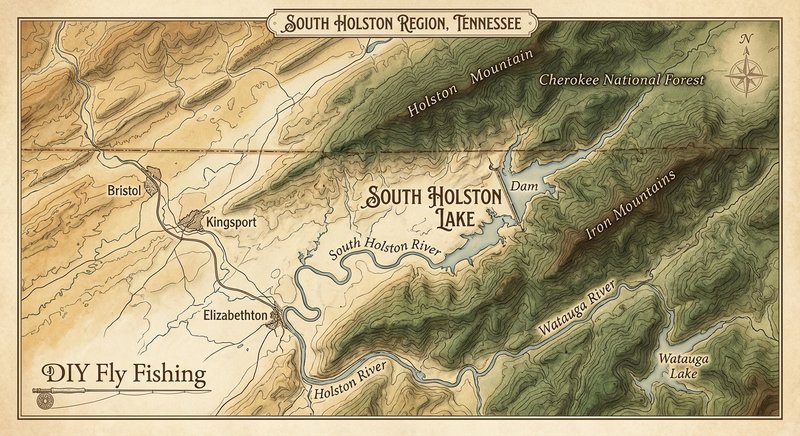
South Holston Lake
Fly fishing in Tennessee · Beginner · Best seasons: Spring, Summer, Fall
Target Species
Smallmouth Bass, Walleye, Rainbow Trout
About This Water
Clear reservoir above famous tailwater. Excellent smallmouth and walleye.
Fishing Recommendations
Welcome to one of the crown jewels of the Appalachian highlands. As a guide, I consider South Holston Lake to be a unique "tri-state" treasure (spanning Tennessee and Virginia) that offers a rare combination of deep-water reservoir tactics and cold-water species management.
Known for its incredible clarity and staggering depth (up to 245 feet), this is not your typical "lily pad and stump" bass pond. This is a high-mountain reservoir where the water stays cool and the fish stay strong.
🎣 Location Overview
South Holston Lake is an approximately 7,500-acre impoundment managed by the TVA. Nestled in the Cherokee National Forest, it is characterized by steep shale bluffs, long gravel points, and incredibly clear, emerald-tinted water.
What makes it special for the fly angler is the water quality. Because the lake is fed by the cold flows of the South Holston River and various mountain creeks, it supports a "two-story" fishery. You can target trophy Smallmouth Bass on the rocky shorelines while Rainbow Trout cruise the deeper channels or the oxygen-rich thermocline. It is a visual fishery—on calm days, you can often see fish tracking your fly from 15 feet down.
🐟 Target Species & Behavior
Smallmouth Bass ("The Bronze Backs")
- Behavior: These are "rock-oriented" fish. They move from deep winter haunts to shallow gravel points and shale shelves to spawn in the spring.
- Feeding: They primary forage on Gizzard Shad and Threadfin Shad, but they are also opportunistic crawfish hunters.
- Fly Target: Look for "transition zones" where a steep bluff turns into a flatter gravel point.
Walleye
- Behavior: Often called "Marble Eyes," these fish are light-sensitive. In South Holston, they migrate up the headwaters (toward the VA line) in early spring to spawn.
- Feeding: Primarily piscivorous (fish-eaters). They shadow baitfish schools near the bottom or along submerged timber.
- Fly Target: Low-light periods are essential. They hold deep during the day but move into 5–10 feet of water at dusk.
Rainbow Trout
- Behavior: These are often "lake-run" fish that grew up in the river system or were stocked. They behave more like ocean-going steelheads, cruising open water in search of baitfish.
- Feeding: Primarily shad and midges.
- Fly Target: During the "shad kills" in late winter/early spring, or near the mouth of the cold-water tributaries.
📅 Best Times to Fish
- Spring (March – May): PRIME TIME. This is the window for the Walleye run (March) and the Smallmouth pre-spawn (April). The fish are shallow and aggressive.
- Summer (June – August): The "Low Light" game. Focus on 5:00 AM to 9:00 AM and the hour before dark. As the water warms, Smallmouth move to the deep bluffs, and Trout go deep near the dam.
- Fall (September – November): The "Feed Before the Freeze." As water temperatures drop, Smallmouth return to the flats to gorge on shad. This is the best time for topwater action.
🪰 Recommended Flies & Techniques
For Smallmouth Bass
- Technique: Intermediate sinking lines are your best friend here. Cast toward the bank and strip back over the drop-offs.
- Flies:
- Clouser Minnow: (Chartreuse/White or Grey/White) with heavy lead eyes to get down.
- Game Changers: In white or shad patterns (3–4 inches).
- Murdich Minnow: Incredible for high-visibility water.
- Boogle Bugs (Poppers): Use these in the Fall on calm evenings near rocky points.
For Walleye
- Technique: Sinking tip lines (Type 3 or 5). You must get the fly to the bottom. Use a "strip-strip-pause" retrieve. The hit usually happens on the pause.
- Flies:
- Lefty’s Deceiver: (White/Blue or White/Purple).
- Zonkers: The rabbit strip movement is irresistible to Walleye.
For Rainbow Trout
- Technique: Dry-dropper rigs near the inflows, or "stripping streamers" in the main lake channels.
- Flies:
- Balanced Leeches: Under an indicator.
- Soft Hackles: During midge hatches.
- White Wooly Buggers: To mimic injured shad.
💡 Pro Tips & Local Knowledge
- The 45-Degree Rule: On South Holston, focus on banks that have a 45-degree slope. These allow fish to change depth quickly without swimming long distances, making them prime hunting grounds for Smallmouth.
- Long Leaders: Because the water is so clear, use fluorocarbon leaders at least 9–12 feet long. If you use a short, thick leader, the Smallmouth will spot it from a mile away.
- The "Shad Kill" Phenomenon: If we have a sudden cold snap in late winter/early spring, the shad get "stunned" and float to the surface. This creates a feeding frenzy for both Trout and Bass. Use white, unweighted streamers and barely move them.
- The Virginia Line: The lake crosses from TN into VA. Many of the best Walleye spawning grounds are on the Virginia side (near the confluence of the South Fork Holston River).
⚠️ Important Information
- Permits & Regulations: There is a South Holston Reservoir Reciprocal Agreement. If you have a valid TN or VA freshwater license, you can fish the entire lake by boat. However, if you are fishing from the bank, you must have the license for that specific state.
- Boating Safety: This is a deep lake with high cliffs. Be wary of wind; "The Holston" can get choppy very quickly, and there aren't many places to pull off safely on the bluff side.
- Access:
- Observation Knob Park: Great for launching and access to good points.
- Musick’s Campground: Central location for reaching the main body of the lake.
- Sullivan County Boat Ramp: Near the dam, best for targeting Trout.
Guide’s Final Word: Bring your binoculars. If you see gulls diving in the middle of the lake, don't assume it's just birds—it’s likely a school of Rainbows or Smallmouth pushing shad to the surface. Get there fast!
Bug Hatches & Matching Flies
| Hatch | Type | Peak months | Time of day | Hook sizes | Matching flies |
|---|---|---|---|---|---|
| Sulphur Ephemerella invaria / dorothea | mayfly | May, June, July, August | Afternoon/Evening | #16-20 | Split Case Sulphur #16-18, Comparison Dun #16-20, Sulphur Puff Emerger #18-20 |
| Blue Winged Olive (BWO) Baetis | mayfly | February, March, October, November | Mid-day/Afternoon | #18-24 | RS2 #20-22, Parachute BWO #18-22, Pheasant Tail Nymph #18-24 |
| Midges Chironomidae | midge | January, February, December | All Day | #20-26 | Zebra Midge #20-24, Griffith's Gnat #20-22, Top Secret Midge #22-26 |
| Black Caddis Chimarra | caddis | April, May | Morning/Afternoon | #16-18 | Black Elk Hair Caddis #16-18, Holy Grail #16-18 |
| Crane Fly Tipulidae | other | August, September, October | All Day | #10-14 | Daddy Long Legs #10-12, Crane Fly Larva #10-14 |
| Terrestrials (Beetles/Ants) Coleoptera / Formicidae | terrestrial | July, August, September | All Day | #12-18 | Foam Beetle #14-16, Cinnamon Ant #16-18 |
| Scuds and Sowbugs Gammarus / Isopoda | crustacean | January, April, October | All Day | #14-18 | Ray Charles #16-18, Scud (Grey/Olive) #14-18 |
| Isonychia Isonychia bicolor | mayfly | June, September | Late Afternoon | #10-12 | Iso Parachute #10-12, Prince Nymph #10-14 |