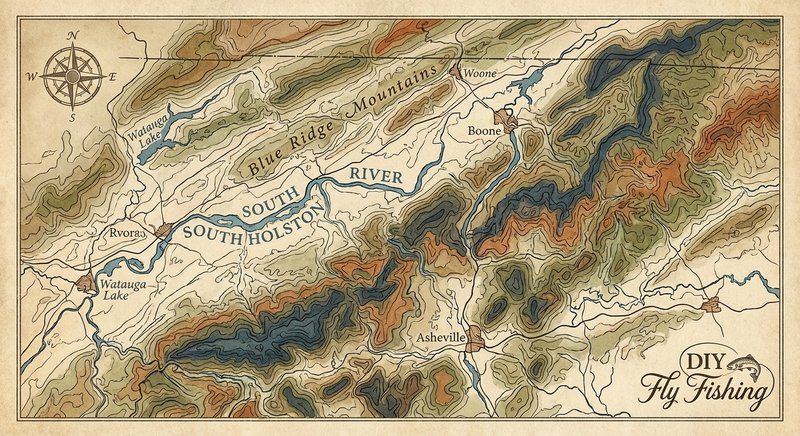
South Holston River
Fly fishing in North Carolina · Intermediate · Best seasons: Spring, Summer, Fall, Winter
Target Species
Brown Trout, Rainbow Trout
About This Water
World-class tailwater fishery with trophy brown trout. Famous sulphur hatches.
Fishing Recommendations
It is important to clarify a key geographic distinction: While the world-famous "SoHo" tailwater is located in Tennessee, the South Fork of the Holston River begins its journey in the Blue Ridge Mountains of North Carolina (Watauga County).
Fishing the South Holston in North Carolina offers a completely different experience than the Tennessee tailwater. Here, you are fishing a high-gradient, freestone mountain stream rather than a massive, regulated river.
🎣 Location Overview
The South Fork Holston in North Carolina is a classic Appalachian freestone river. Located primarily in Watauga County near Boone and Deep Gap, the river flows through a mix of private farmland and dense rhododendron forests before crossing into Virginia and eventually Tennessee.
What makes it special: Unlike the wide-open flats of the Tennessee tailwater, the NC section is intimate. It features "pocket water," tumbling riffles, and deep, dark pools carved into bedrock. It offers a sense of solitude and a "wild" feel that the crowded tailwater lacks. Anglers love it for its technical challenges, the beauty of the surrounding Blue Ridge Mountains, and the chance to catch hefty fish in relatively small water.
🐟 Target Species & Behavior
The South Fork Holston in NC is home to both Rainbow and Brown Trout.
- Rainbow Trout: These are the primary residents of the swifter water. They tend to hold in the "heavy" water—the heads of pools, bubbly riffles, and behind submerged boulders. They are opportunistic and will often rise to a well-presented dry fly even when no hatch is present.
- Brown Trout: The "kings" of the deeper pools and undercut banks. The South Fork is known for holding surprisingly large Brown Trout for its size. These fish are more nocturnal and predatory. They hold in slower, deeper water during the day and move into the shallows to hunt during low-light conditions.
- Behavior: Because this is a freestone river, the fish are highly dependent on water temperature and rainfall. In the summer, they seek oxygenated water in the riffles; in the winter, they stack up in the deepest, slowest holes.
📅 Best Times to Fish
- Optimal Seasons: Spring (Late March – June) is the gold standard. This coincides with major insect hatches and optimal water temperatures (50–60°F). Fall (October – November) is the second peak, as Brown Trout become aggressive before their spawn and the foliage is spectacular.
- Best Time of Day: In Spring and Fall, midday (10 AM – 4 PM) is best as the sun warms the water. In the heat of Summer, focus strictly on "dawn and dusk" to avoid stressing fish in warmer water.
- Prime Conditions: A "falling and clearing" river after a light rain is the absolute best time to hunt for trophy Browns.
🪰 Recommended Flies & Techniques
Top Fly Patterns
- Dry Flies:
- Spring: Parachute Adams (#14-18), Quill Gordon (#12-14), Elk Hair Caddis (#14-16).
- Summer: Yellow Stimulators (#12-16), Terrestrials like Foam Beetles and Dave’s Hoppers (#10-14).
- Nymphs:
- Pheasant Tail Nymphs (#16-20), Frenchies (#14-18), and Girdle Bugs (Pat’s Rubber Legs) in coffee/black (#8-12).
- Streamers:
- Wooly Buggers (Olive or Black), Pine Squirrel Leeches, and small Sparkle Minnows.
Effective Techniques
- Tight-Line Nymphing: This is the most effective way to fish the pocket water. By ditching the indicator, you can get your flies into the deep slots between rocks where trout hide.
- Dry-Dropper: A high-visibility dry fly (like a Stimulator) with a small Pheasant Tail dropped 18-24 inches below is the "bread and butter" technique for the NC South Holston.
- Streamer Stripping: On overcast days or when the water is slightly stained, swinging a streamer through the tail-outs of pools can trigger violent strikes from large Browns.
💡 Pro Tips & Local Knowledge
- The "Boone" Factor: Because this water is close to Boone, NC, the public access points can get pressured. The further you are willing to hike away from the bridge crossings, the better the fishing gets.
- Watch the Temperature: In July and August, the South Fork can get warm. If the water hits 68°F, stop fishing to protect the trout. Local guides often head to higher elevation feeder streams during these months.
- Stealth is Key: Because the water is often crystal clear, your approach matters. Wear drab clothing, stay low, and try not to splash. Upstream presentations are mandatory to avoid being seen by the fish.
- The "Secret" Winter Bite: Don't overlook January and February. While it’s cold, the river stays ice-free. Slow-rolling a heavy nymph through the deepest pools can produce the biggest fish of the year.
⚠️ Important Information
- Access: Much of the South Fork in NC flows through private property. Always respect "Posted" signs. Public access is available at various bridge crossings and through sections of the Pisgah National Forest.
- Regulations: The South Fork Holston is managed by the North Carolina Wildlife Resources Commission (NCWRC). Check the current regulations map, as different stretches may fall under "Hatchery Supported," "Wild Trout," or "Delayed Harvest" designations.
- Permits: You must have a valid North Carolina Inland Fishing License with a Trout Signoff.
- Safety: The rocks in the South Fork are notoriously slippery (covered in "didymo" or rock snot). Felt-soled boots or studs are highly recommended. Always keep an eye on the weather; being a freestone stream, it can rise rapidly during a mountain thunderstorm.
Bug Hatches & Matching Flies
| Hatch | Type | Peak months | Time of day | Hook sizes | Matching flies |
|---|---|---|---|---|---|
| Sulphurs Ephemerella invaria / dorothea | mayfly | May, June, July, August | Afternoon/Evening | #14-20 | Split Case Sulphur #16-18, Comparadun Sulphur #16-20, Sulphur Puff #18-20 |
| Blue Winged Olives (BWO) Baetis | mayfly | February, March, October, November | Late Morning/Afternoon | #18-22 | RS2 #20-22, Parachute BWO #18-22, Pheasant Tail #18-20 |
| Midges Chironomidae | midge | December, January, February | All Day | #18-26 | Zebra Midge #18-24, Griffith's Gnat #20-24, Morgan's Midge #20-22 |
| Black Caddis (Grannom) Brachycentrus | caddis | April | Morning/Afternoon | #14-16 | Holy Grail #14-16, Elk Hair Caddis (Black) #14-16, Deep Blue Sparkle Pupa #16 |
| Cress Bugs / Sowbugs Lirceus lineatus | crustacean | March, April, May, September, October | All Day | #14-18 | Ray Charles #16-18, Soft Hackle Sowbug #14-16, Scud #14-18 |
| Crane Flies Tipulidae | other | August, September | Morning/Evening | #10-14 | Daddy Long Legs #10-12, Crane Fly Larva #10-12, Killer Bug #12 |
| Tricos Tricorythodes | mayfly | July, August, September | Early Morning | #22-26 | Trico Spinner #22-24, Sunken Trico #24-26, Drowned Trico Spinner #22-24 |
| Terrestrials Formicidae / Coleoptera | terrestrial | July, August, September | Midday/Afternoon | #12-18 | Black Foam Ant #16-18, beetle #14-16, Cricket #12-14 |