South Holston River
Fly fishing in Tennessee · Intermediate · Best seasons: Spring, Summer, Fall, Winter
Target Species
Brown Trout, Rainbow Trout
About This Water
World-class tailwater with trophy brown trout. Famous sulphur hatches make it a premier dry fly destination.
Fishing Recommendations
Welcome to the South Holston River (the "SoHo") in Northeast Tennessee. As a guide, I consider this one of the finest tailwaters in the United States. It is a biological anomaly in the Southeast, offering cold, nutrient-rich water that supports a massive population of wild brown trout.
Here is your comprehensive guide to fishing the South Holston.
🎣 Location Overview
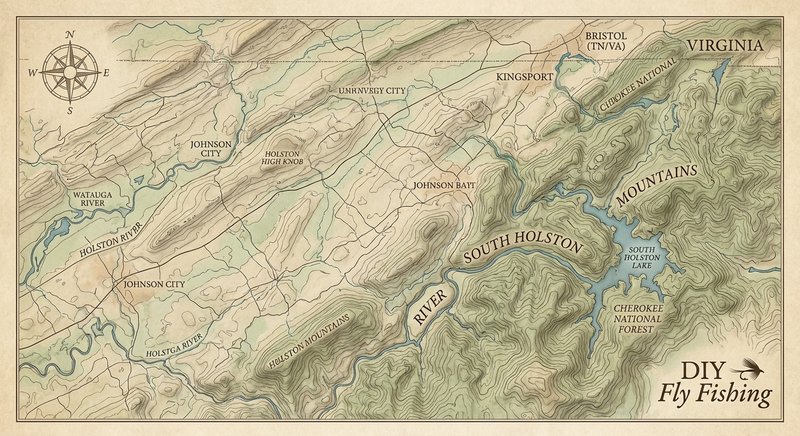
The South Holston River flows from the South Holston Dam near Bristol, TN. Because it is a bottom-release tailwater managed by the Tennessee Valley Authority (TVA), the water stays a consistent 45–55°F year-round.
What makes it special is the biomass. The riverbed is covered in aquatic vegetation (often referred to as "the grass"), which acts as a nursery for an incredible density of insects. Unlike many Southern rivers that rely on stocking, the South Holston has a prolific wild brown trout population that reproduces naturally in the gravel shoals. The river offers about 14 miles of prime trout water, characterized by long, glassy pools, technical riffles, and heavy "sulfur" hatches that are legendary among dry fly enthusiasts.
🐟 Target Species & Behavior
- Brown Trout: The crown jewel of the SoHo. Roughly 80–85% of the browns here are wild. They are notoriously "educated" and selective. During hatches, they sit high in the water column; during non-hatch periods, they tuck into the deep ledge rock and thick vegetation.
- Rainbow Trout: These are primarily stocked, though some wild "bows" exist. They tend to hold in the faster, oxygenated "bubbly" water and are generally less selective than the browns.
- Behavior: Due to the clear water and high fishing pressure, these fish are "leader shy." They will often inspect a fly for several feet before committing. Accuracy and a drag-free drift are more important here than anywhere else in the region.
📅 Best Times to Fish
The SoHo is a true 365-day fishery, but each season offers a different experience:
- Spring (March – May): Excellent nymphing and the start of the Blue Winged Olive (BWO) hatches. As May approaches, the first Sulfurs begin to appear.
- Summer (June – August): The Prime Season. This is when the world-famous Sulfur hatch occurs. Massive clouds of yellow mayflies bring every fish in the river to the surface. It is the best time for dry fly fishing, often occurring daily between 11:00 AM and 4:00 PM.
- Fall (September – November): Great terrestrial fishing (beetles/ants). In November, the brown trout begin their spawn. Note: Large sections of the upper river close to fishing during this time to protect spawning beds (redds).
- Winter (December – February): The "secret" season. Midges and BWOs dominate. While it’s cold, the fishing can be spectacular for those who enjoy technical midge fishing and solitude.
🪰 Recommended Flies & Techniques
Dry Fly Fishing
This is the SoHo's claim to fame. You must have "match the hatch" patterns.
- Sulfurs: CDC Comparaduns, Puff Daddys, and Sparkle Duns (Sizes 16–20).
- Blue Winged Olives: BWO Parachutes and RS2s (Sizes 18–22).
- Midges: Griffith’s Gnats and Zebra Midges (Sizes 20–24).
Nymphing
When the fish aren't rising, they are eating scuds and sowbugs in the vegetation.
- Patterns: Ray Charles (Grey/Tan), Pheasant Tails (Size 18–20), Scuds (Pink/Orange), and the "Split Case" Sulfur nymph.
- Technique: Use a "Long and Light" leader. 12-foot leaders tapering to 6X or 7X fluorocarbon are standard. Use small, yarn-style indicators to avoid spooking fish in the glassy pools.
Streamers
- Patterns: Black or Olive Wooly Buggers, Sparkle Minnows.
- Technique: Best during high-water generation (boat fishing). Strip aggressively near the banks for the "trophy" browns.
💡 Pro Tips & Local Knowledge
- The "SoHo Twitch": Sometimes, a perfectly dead-drifted dry fly is ignored. A micro-twitch of the rod tip to make the fly "shiver" like a struggling insect can trigger a strike from a wary brown.
- Mind the Pulse: The river level changes based on the TVA generation schedule. Check the TVA Lake Info App religiously. One generator means the river is boat-only for most; zero generators means it is a wade-fisherman's paradise.
- The "Big Springs" Stretch: This is a famous section of the river. It holds massive fish but is extremely technical. If you can catch a fish here, you can catch a fish anywhere in the world.
- Stealth is Key: Because the water is so clear, wear earthy tones (greens/tans) and avoid splashing. If you see a fish rising, stay 30 feet back and cast from a kneeling position if possible.
⚠️ Important Information
Access Points
- Emmett Bridge: Good for wading during low water.
- Big Springs: Excellent public access with long stretches of wadeable water.
- Rockhold / Beidleman: Popular spots for drift boat launches and some wading.
Regulations & Permits
- License: You need a Tennessee Fishing License with a Trout Hatchery Procedure (Type 022) supplement.
- Spawning Closures: From November 1 to January 31, certain sections (usually from the dam down to Hickory Tree bridge) are closed to all fishing to protect spawning wild browns. Check the TWRA website for exact boundary markers.
- Catch & Release: While there are creel limits, the local culture is strictly Catch & Release for wild brown trout to maintain the world-class status of the river.
Special Considerations
- The "Didymo" (Rock Snot): This non-toxic algae is present in the river. Always wash your boots and waders with a bleach solution or specialized cleaner after fishing to prevent spreading it to other watersheds.
Bug Hatches & Matching Flies
| Hatch | Type | Peak months | Time of day | Hook sizes | Matching flies |
|---|---|---|---|---|---|
| Sulphur Ephemerella invaria / dorothea | mayfly | May, June, July, August | Afternoon/Evening | #16-20 | Split Case Sulphur #16-18, Puff Daddy #18-20, CDC Comparadun #16-20, Hi-Vis Sulphur Spinner #16-20 |
| Blue Winged Olive (BWO) Baetis | mayfly | October, November, February, March | Midday | #18-24 | RS2 #20-24, Pheasant Tail #18-22, CDC BWO Thorax #20-22 |
| Midge Chironomidae | midge | December, January, February | Morning/All Day | #20-26 | Zebra Midge #20-24, Morgan's Midge #22-26, Griffith's Gnat #20-24 |
| Black Fly Simulium | midge | April, May, June | Morning/Afternoon | #22-28 | Black Fly Larva #22-24, Cluster Midge #20-22 |
| Grannom Caddis Brachycentrus | caddis | April, May | Morning/Afternoon | #14-18 | Elk Hair Caddis #14-16, Holy Grail #16-18, Deep Sparkle Pupa #16-18 |
| Crane Fly Tipulidae | midge | August, September, October | Afternoon | #10-14 | Daddy Long Legs #10-12, Crane Fly Larva #10-12 |
| Terrestrials (Beetles/Ants) Coleoptera / Formicidae | terrestrial | July, August, September | All Day | #12-18 | Foam Beetle #14-16, Cinnamon Ant #16-18, Chernobyl Ant #12-14 |
| Light Cahill Stenacron / Stenonema | mayfly | June, July | Evening | #12-14 | Light Cahill #12-14, Gold Ribbed Hare's Ear #12-14 |