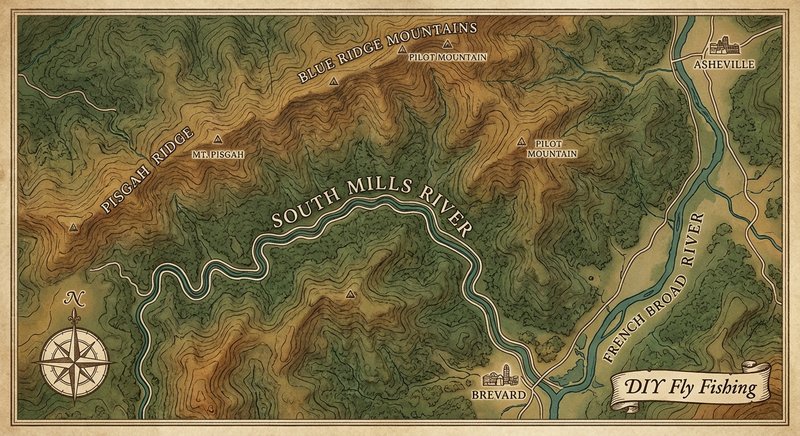
South Mills River
Fly fishing in North Carolina · Intermediate · Best seasons: Spring, Summer, Fall
Target Species
Brown Trout, Rainbow Trout, Brook Trout
About This Water
Remote stream with excellent wild trout. Beautiful Pisgah Forest setting.
Fishing Recommendations
Welcome to one of the crown jewels of the Pisgah National Forest. As a guide, I consider the South Mills River to be the "wilder sibling" of the nearby Davidson River. While the Davidson is famous for its technical, educated fish, the South Mills offers a more rugged, remote, and traditional Appalachian fly fishing experience.
Here is your comprehensive guide to tackling the South Mills River.
🎣 Location Overview
The South Mills River is a classic freestone stream located near Brevard and Asheville, North Carolina. What makes this river special is its remoteness. Unlike many roadside streams in Western North Carolina (WNC), much of the South Mills requires a hike to access, which naturally thins out the crowds.
The river is characterized by large boulders, deep plunge pools, and long, glassy tailouts. It flows through a lush canopy of rhododendron and hemlock, keeping the water cooler than many other valley streams. It feels "ancient"—you are fishing in the heart of the Cradle of Forestry, and the lack of road noise makes it a meditative experience for the backcountry angler.
🐟 Target Species & Behavior
The South Mills is primarily a Wild Rainbow and Brown Trout fishery, though you will find Brook Trout in the higher-elevation headwaters and tiny feeder tributaries.
- Wild Rainbows: These are the most common residents. They are opportunistic but extremely "spooky." They tend to hold in the "bubble line" at the head of pools and in oxygenated riffles.
- Wild Browns: The "ghosts" of the South Mills. These fish grow surprisingly large for a freestone stream. They prefer deep undercut banks, the dark shadows beneath overhanging rhododendrons, and the very bottom of the deepest pools.
- Behavior: Because the water is often gin-clear, these fish have excellent vision. They are highly sensitive to "shadow flash" (your rod or line casting a shadow) and heavy wading vibrations.
📅 Best Times to Fish
- Spring (March – May): Prime Time. This is the window for the best hatches. Water temperatures rise into the 50s, and fish become very active.
- Summer (June – August): Excellent for "dry-dropper" fishing. However, focus on the early morning (6:00 AM – 10:00 AM) or late evening. If water temperatures exceed 68°F, give the fish a break and head to higher elevations.
- Fall (September – November): A spectacular time to be on the water. The Brown Trout become aggressive as they prepare to spawn. The low, clear water of autumn requires the ultimate stealth.
🪰 Recommended Flies & Techniques
Top Fly Patterns
- Dry Flies:
- Yellow Stimulator (Size 12-16): Imitates the Yellow Sallies and Golden Stoneflies common here.
- Parachute Adams (Size 14-20): The ultimate "searching" pattern.
- Elk Hair Caddis (Tan or Olive, Size 14-18).
- Nymphs:
- Pheasant Tail (Size 16-20): A staple for South Mills trout.
- Frenchie (Size 14-18): Great for high-visibility attraction in riffles.
- Girdle Bug / Pat’s Rubber Legs (Size 8-12): Effective after a rain when the water has some color.
- Terrestrials (Summer):
- Greenie Weenie: A local WNC secret that imitates the inchworms that fall from the canopy.
- Dave's Hopper: For the tailouts of pools in late summer.
Techniques
- The Dry-Dropper: This is the most effective way to cover South Mills water. Use a buoyant dry (like a Stimulator) and hang a small Pheasant Tail 18-24 inches below it.
- Stealth Nymphing: In deep pools, use a long leader (9ft to 12ft) to avoid spooking fish with your fly line. 6X tippet is often necessary during low water.
- Streamer Stripping: On overcast days or when the water is slightly stained, a small olive Wooly Bugger swung through deep holes can entice a trophy Brown.
💡 Pro Tips & Local Knowledge
- The "Two-Mile Rule": Most casual anglers fish within the first half-mile of the Turkey Pen Gap trailhead. If you hike 2+ miles in, the fishing pressure drops significantly, and the fish become much less wary.
- The "Low and Slow" Approach: Do not walk right up to the bank. Stay low, use the boulders as cover, and cast from a distance. If you can see the fish, they have likely already seen you.
- Watch the Gauges: The South Mills can rise quickly after a heavy rain. Check the USGS gauge (Look for "South Mills River near Pink Beds"). You want stable or slightly falling flows for the best success.
- The "Pink Beds" Area: The upper section (Pink Beds) is flatter and more meadow-like. It’s great for beginners, but the lower section through the gorge (Turkey Pen) holds the more challenging and rewarding wild fish.
⚠️ Important Information
Access Information
- Turkey Pen Gap Trailhead: Located off Highway 280 between Brevard and Asheville. This is the primary access point for the lower, wilder sections. Be prepared for a steep hike down (and a grueling hike back up!).
- Pink Beds: Located off Hwy 276 near the Cradle of Forestry. This offers easier walking and gentler water.
Regulations
- Wild Trout Waters: Much of the South Mills is designated as "Wild Trout Waters." This means:
- Artificial Lures Only (Single hook).
- Catch and Release is highly encouraged, though there are specific size and creel limits if you choose to keep fish (Check NCWRC current regulations).
- License: You must have a valid North Carolina Fishing License with a Trout privilege.
Special Considerations
- Bears & Wildlife: This is active Black Bear country. Carry out all trash and be "bear aware."
- Wading Safety: The rocks in the South Mills are notoriously "snotty" (slippery). Felt-soled boots or studs are highly recommended.
- Cell Service: Virtually non-existent once you leave the trailhead. Tell someone where you are going and when you expect to be back.
Tight lines, and enjoy the solitude of the South Mills!
Bug Hatches & Matching Flies
| Hatch | Type | Peak months | Time of day | Hook sizes | Matching flies |
|---|---|---|---|---|---|
| Quill Gordon Epeorus pleuralis | mayfly | March, April | Midday | #12-14 | Quill Gordon Dry #12-14, Quill Gordon Nymph #12-14 |
| Blue-Winged Olive Baetis spp. | mayfly | March, April, October, November | Afternoon | #18-22 | RS2 #20-22, Parachute BWO #18-22, Pheasant Tail Nymph #18-20 |
| March Brown Maccaffertium vicarium | mayfly | April, May | Afternoon | #10-14 | March Brown Dry #10-12, Gold Ribbed Hare's Ear #10-14 |
| Yellow Sally Isoperla spp. | stonefly | May, June, July | Late Afternoon/Evening | #14-16 | Yellow Stimulator #14-16, Little Yellow Sloan #14-16 |
| Light Cahill Stenacron interpunctatum | mayfly | June, July, August | Evening | #12-16 | Light Cahill #12-16, Light Cahill Wet #14 |
| Cinnamon Caddis Hydropsyche spp. | caddis | May, June, September | Evening | #14-18 | Elk Hair Caddis (Tan/Cinnamon) #14-18, Pupa-X #16-18 |
| Golden Stonefly Acroneuria carolinensis | stonefly | June, July | Morning/Evening | #8-12 | Pat's Rubber Leg #8-12, Golden Stone Dry #10-12 |
| Green Sedge Rhyacophila spp. | caddis | April, May, June | All Day | #12-16 | Green Weenie #12-14, LaFontaine's Deep Sparkle Pupa #14-16 |
| Terrestrials (Ants/Beetles) Formicidae / Coleoptera | terrestrial | July, August, September | Midday | #12-18 | Parachute Ant #14-18, Foam Beetle #12-16 |