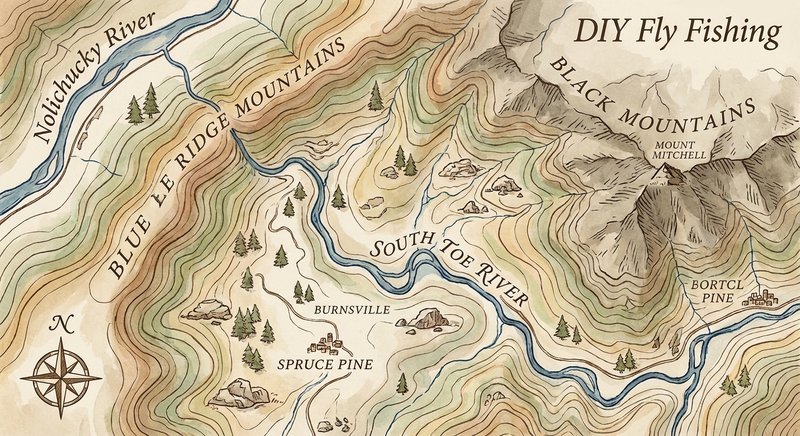
South Toe River
Fly fishing in North Carolina · Beginner · Best seasons: Spring, Fall, Winter
Target Species
Brown Trout, Rainbow Trout
About This Water
Delayed harvest water below Mount Mitchell. Excellent year-round fishing.
Fishing Recommendations
As an expert guide who has spent many cold mornings and golden evenings in the shadow of Mount Mitchell, I can tell you that the South Toe River is one of the crown jewels of North Carolina fly fishing. It offers a rare combination of rugged high-gradient mountain water and accessible, productive valley stretches.
Here is your comprehensive guide to fishing the South Toe.
🎣 Location Overview
The South Toe River originates on the slopes of the Black Mountains, home to Mount Mitchell (the highest peak east of the Mississippi). This high-elevation birth ensures the water stays colder and more oxygenated than many other Southern Appalachian streams.
The river is a classic freestone stream. In its upper reaches, it is characterized by plunging waterfalls, tight rhododendron-choked banks, and deep "blue" pools. As it flows toward Burnsville, it widens into a medium-sized river with massive boulders, long riffles, and classic pocket water. What makes it special is the scenery; you are fishing in one of the most biodiverse and topographically dramatic regions in the United States.
🐟 Target Species & Behavior
The South Toe offers two distinct experiences based on where you are:
- Wild Rainbow and Brown Trout: Found primarily in the upper reaches (above Black Mountain Campground). These fish are "opportunistic." They don't have the luxury of being picky because the water is nutrient-poor. They hold in the "cushion" in front of rocks or in the tail-outs of pools during hatches.
- Stocked/Holdover Fish: In the "Hatchery Supported" and "Delayed Harvest" sections, you will find larger Rainbows and Browns. These fish tend to congregate in the deeper, slower pools and require a bit more weight on your rig to reach them.
- Behavior: In the clear water of the South Toe, trout are incredibly spooky. If they see your silhouette or a splashy line, the pool is "done" for thirty minutes. Stealth is as important as fly choice.
📅 Best Times to Fish
- Spring (March – May): This is the pinnacle. The Quill Gordon and March Brown hatches in late March/April bring the big wild fish to the surface.
- Fall (October – November): The Brown trout become aggressive as they prepare to spawn. The water is often low and crystal clear, and the fall colors against the Black Mountains are world-class.
- Winter (December – February): Focus on the "Delayed Harvest" sections. Fish the warmest part of the day (11:00 AM – 3:00 PM). Midges and small nymphs are the rule.
- Summer Note: While I recommend Spring/Fall/Winter, the South Toe stays cooler than most NC rivers in July. If you must fish summer, go high into the headwaters where the canopy provides shade.
🪰 Recommended Flies & Techniques
Top Fly Patterns
- Dry Flies: Parachute Adams (#14-18), Yellow Stimulator (#12-16) for the Yellow Sally hatch, and Elk Hair Caddis (Tan/Olive).
- Nymphs: Pheasant Tail (#14-20), Frenchie (#14-18), and Pat’s Rubber Legs (Stonefly) in black or coffee.
- Streamers: Wooly Buggers in Olive or Black, and small sculpin patterns like the Muddler Minnow.
Techniques
- Dry-Dropper: This is the most effective way to cover the South Toe. Use a high-visibility dry (like a Stimulator) with a 24-inch dropper to a Pheasant Tail nymph.
- Tight-Line Nymphing: In the boulder-heavy pocket water, ditch the indicator. A Euro-style or tight-line approach allows you to get nymphs deep into the small pockets behind rocks where the big Browns sit.
- Presentation: Always cast upstream. Use the "reach cast" to avoid drag, as the South Toe has complex micro-currents.
💡 Pro Tips & Local Knowledge
- The "Stealth" Approach: Wear drab colors (greens and browns). Avoid white fly lines if possible. Before you cast, stand 10 feet back from the bank and observe. Many anglers walk right past the fish sitting in the shallow "thin" water at the tail of the pool.
- Focus on the Pocket Water: Everyone wants to fish the big, beautiful pools near the bridges. The pros fish the "junk water"—the small pockets between the big pools. A 2-foot wide pocket behind a rock can hold a 14-inch wild Rainbow.
- The Carolina Hemlocks Stretch: This is a popular area, but if you walk half a mile upstream or downstream from the campground, the fishing pressure drops off significantly.
⚠️ Important Information
Access Information
- Upper River: Access via Black Mountain Campground (off NC Hwy 80). This is Wild Trout water.
- Middle River: Carolina Hemlocks Recreation Area provides great access to Hatchery Supported and deep-hole water.
- Lower River: There are various pull-offs along Hwy 80, but be mindful of private property signs.
Regulations
The South Toe has multiple designations, and they change as you move downstream:
- Wild Trout Water: Barbless hooks and single-hook artificials only.
- Hatchery Supported: Closed in March; open for harvest in season.
- Delayed Harvest: (Check latest NCWRC maps as stretches can change) Catch and release only from Oct 1 to early June.
- Note: Always carry a valid NC Fishing License with a Trout privilege.
Special Considerations
- Wading Safety: The South Toe is notorious for slippery rocks. The "Toe" in the name might as well stand for "Toe-stubbing." I highly recommend felt-soled boots with aluminum studs and a wading staff.
- Wildlife: This is bear country. Keep food locked in your vehicle and be aware of your surroundings.
Bug Hatches & Matching Flies
| Hatch | Type | Peak months | Time of day | Hook sizes | Matching flies |
|---|---|---|---|---|---|
| Quill Gordon Epeorus pleuralis | mayfly | March, April | Midday | #12-14 | Quill Gordon Dry #12-14, Quill Gordon Wet #12-14 |
| Blue-Winged Olive (BWO) Baetis spp. | mayfly | March, April, October, November | Afternoon | #18-22 | RS2 #20-22, Parachute Adams #18-22, Pheasant Tail Nymph #18-20 |
| March Brown Maccaffertium vicarium | mayfly | April, May | Afternoon | #10-14 | March Brown Dry #10-12, Hare's Ear Nymph #10-14 |
| Sulphur Ephemerella invaria/dorothea | mayfly | May, June | Evening | #14-18 | Sulphur Parachute #14-18, CDC Sulphur Emerger #16-18 |
| Yellow Sally Isoperla spp. | stonefly | May, June, July | Afternoon/Evening | #14-16 | Yellow Stimulator #14-16, Yellow Sally Nymph #14-16 |
| Light Cahill Stenonema/Stenacron spp. | mayfly | June, July | Evening | #12-16 | Light Cahill Dry #12-16 |
| Tan Caddis Hydropsyche spp. | caddis | April, May, June, September | Morning/Evening | #14-18 | Elk Hair Caddis #14-18, Holy Grail Caddis #14-16 |
| Isonychia (Slate Drake) Isonychia bicolor | mayfly | June, September, October | Afternoon | #10-12 | Isonychia Parachute #10-12, Prince Nymph #10-14 |
| Ants and Beetles Formicidae / Coleoptera | terrestrial | July, August, September | All Day | #12-18 | Chernobyl Ant #12-14, Black Foam Beetle #14-18 |