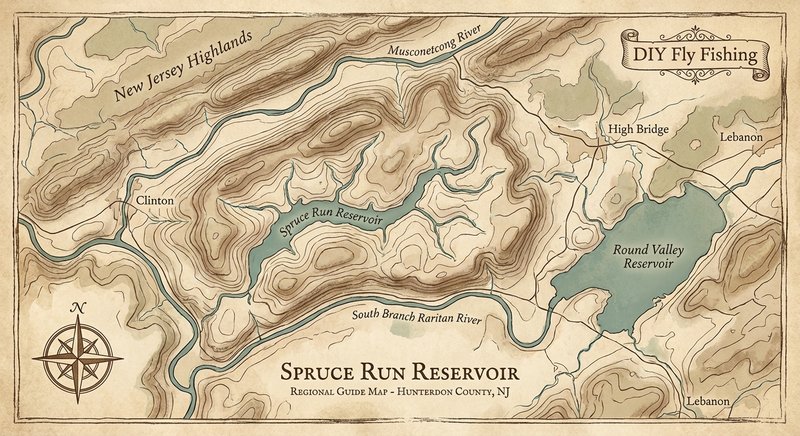
Spruce Run Reservoir
Fly fishing in New Jersey · beginner · Best seasons: spring, fall, winter
Target Species
Brown Trout, Rainbow Trout, Lake Trout
About This Water
Hunterdon County impoundment with excellent trout fishing. Stocked heavily with spring holdover potential.
Fishing Recommendations
Spruce Run Reservoir, located in Clinton, Hunterdon County, is one of New Jersey’s premier multi-species fisheries. While many anglers associate this 1,290-acre impoundment with Hybrid Striped Bass and Northern Pike, it offers a unique and challenging opportunity for fly anglers targeting salmonids, particularly during the cooler months.
Unlike its neighbor, Round Valley Reservoir (which is ultra-deep and gin-clear), Spruce Run is relatively shallow with more "stained" water. This makes the fish slightly less spooky but requires a more tactical approach to finding where they hold.
🎣 Location Overview
Spruce Run is characterized by its rolling shoreline, submerged points, and three primary inflows: Mulhockaway Creek, Spruce Run Creek, and Willoughby Brook.
What makes it special is the "reservoir-run" dynamic. During the spring and fall, trout move from the main body of the reservoir toward these tributaries to feed or seek thermal refuge. For the fly angler, this creates a "mini-Great Lakes" experience where you are often casting into the "slack" where moving water meets the still reservoir. The water is more fertile than many NJ reservoirs, leading to a robust baitfish population (Alewives) that grows heavy-shouldered trout.
🐟 Target Species & Behavior
- Rainbow Trout: These are the most common targets, frequently stocked by the NJ Division of Fish & Wildlife. They tend to cruise the upper 10 feet of the water column along rocky shorelines and the dam face.
- Brown Trout: The "glamour" fish of Spruce Run. These are often holdovers that have grown large feeding on alewives. They are structure-oriented and light-sensitive, often holding deep during the day and moving into the shallows to hunt at dawn, dusk, and during overcast rainy days.
- Lake Trout: While less common here than in Round Valley, "Lakers" are present. They are depth-dependent. For a fly angler to have a shot at a Laker, you must fish in the late fall or very early spring when the water temperature is uniform (below 55°F), allowing them to move into casting range near the boat ramps or the dam.
📅 Best Times to Fish
- Spring (Late March – May): This is the peak. As the ice melts and the tributaries swell with rain, trout congregate at the mouths of the Mulhockaway and Spruce Run Creeks.
- Fall (October – November): As water temperatures drop, trout move back into the shallows. This is the best time for "trophy" Browns who are looking to bulk up before winter.
- Winter (December – Early March): If the reservoir remains ice-free, slow-stripping streamers near the dam or deep-pumping nymphs under an indicator can produce.
- Prime Window: Low-light conditions are mandatory. The hour before sunrise and the 90 minutes after sunset are when the big Browns move into the 3–5 foot depth range to hunt baitfish.
🪰 Recommended Flies & Techniques
1. The Alewife Mimic (Streamers)
The primary forage is the Alewife. You need flies with flash and profile.
- Patterns: White or Silver Zonkers, Game Changers (small), Clouser Minnows (White/Chartreuse), and Black Ghosts.
- Technique: Use a 6 or 7-weight rod with an intermediate sinking line. Cast parallel to the shoreline or across the mouths of the creeks. Use a "strip-strip-pause" retrieve to mimic a wounded baitfish.
2. The Tributary Washout (Nymphing)
After a rain event, the creeks wash worms, scuds, and stoneflies into the reservoir.
- Patterns: San Juan Worms (Red/Pink), Egg Patterns, and Bead-head Prince Nymphs (Size 12-14).
- Technique: Use a long leader (12ft+) with a strike indicator. Fish the "seam" where the creek current dies into the reservoir.
3. The "Midnight Scavenger" (Large Dries/Surface)
- Patterns: Muddler Minnows or Gurglers.
- Technique: On very calm, dark nights in the fall, waking a Muddler Minnow across the surface can trigger explosive strikes from aggressive Brown Trout.
💡 Pro Tips & Local Knowledge
- Focus on the "Points": Look for points of land that jut into the water. These act as "natural corrals" where trout trap schools of alewives. The windward side (where the wind is blowing into the shore) is usually better as it pushes the baitfish and plankton toward the bank.
- The Mulhockaway Mouth: This is the "Holy Grail" spot at Spruce Run. Park at the Union 702 lot and hike down. When the water level is low, you can see the old creek channel—fish the edges of that drop-off.
- Wading Caution: The bottom of Spruce Run can be extremely silty and "mucky" in some areas, while very rocky in others. Use a wading staff and be careful of sudden drop-offs near the creek channels.
- Temperature Matters: Invest in a pocket thermometer. If the surface temp hits 70°F, stop fishing for trout; they will head for the deep "dead zone" where oxygen is low, and catching them causes high mortality.
⚠️ Important Information
- Access: The primary access is via Spruce Run Recreation Area (Van Syckles Rd). There are also multiple parking pull-offs on Route 606 and near the Clinton Wildlife Management Area.
- Regulations: NJ Trout Stamp is required. Be aware that Spruce Run is part of the "Trout Stocked Waters" program, but also check specific regulations for the tributaries (Mulhockaway is often subject to different rules/seasons).
- Boating: If you have a float tube or kayak, you have a massive advantage. However, be extremely wary of the wind; Spruce Run is notorious for kicking up dangerous whitecaps very quickly.
- Clean Your Gear: To prevent the spread of invasive species like Didymo (Rock Snot) or New Zealand Mud Snails, always dry your boots and gear completely before moving to another watershed.
Guide’s Final Word: Spruce Run is a "quality over quantity" trout fishery for the fly fisher. You may go several trips with nothing to show, but when you hook up, it is often a 20-inch+ holdover Brown that will put your reel deep into the backing.
Bug Hatches & Matching Flies
| Hatch | Type | Peak months | Time of day | Hook sizes | Matching flies |
|---|---|---|---|---|---|
| Chironomids Chironomidae | midge | March, April | All Day | #18-24 | Zebra Midge #18-22, Griffith's Gnat #20-24, Chironocone #18-20 |
| Blue-Winged Olive Baetis | mayfly | April, May, September, October | Midday | #18-22 | RS2 #20-22, BWO Sparkle Dun #18-22, Pheasant Tail Nymph #18-20 |
| Grannom Caddis Brachycentrus | caddis | April, May | Afternoon | #14-16 | LaFontaine's Deep Sparkle Pupa #14-16, Elk Hair Caddis (Olive) #14-16 |
| Sulphurs Ephemerella invaria | mayfly | May, June | Evening | #14-18 | Sulphur Parachute #14-18, Sulphur Emerger #16-18, Split Case Sulphur #16 |
| Light Cahill Stenacron canadense | mayfly | June, July | Evening | #12-14 | Light Cahill #12-14, Gold Ribbed Hare's Ear #12-14 |
| Tan Caddis Hydropsyche | caddis | May, June, July, August | Evening/Night | #14-18 | X-Caddis (Tan) #14-16, Holy Grail #16-18 |
| Trico Tricorythodes | mayfly | July, August, September | Early Morning | #22-26 | Trico Spinner #22-24, Trico Drowned Spinner #24 |
| Terrestrials Formicidae / Coleoptera | terrestrial | July, August, September | All Day | #12-18 | Black Foam Ant #16-18, Japanese Beetle #12-14, Chernobyl Ant #10-12 |