Squannacook River
Fly fishing in Massachusetts · Intermediate · Best seasons: Spring, Summer, Fall
Target Species
Brown Trout, Brook Trout
About This Water
Middlesex County stream with wild brown trout. Townsend area fishing.
Fishing Recommendations
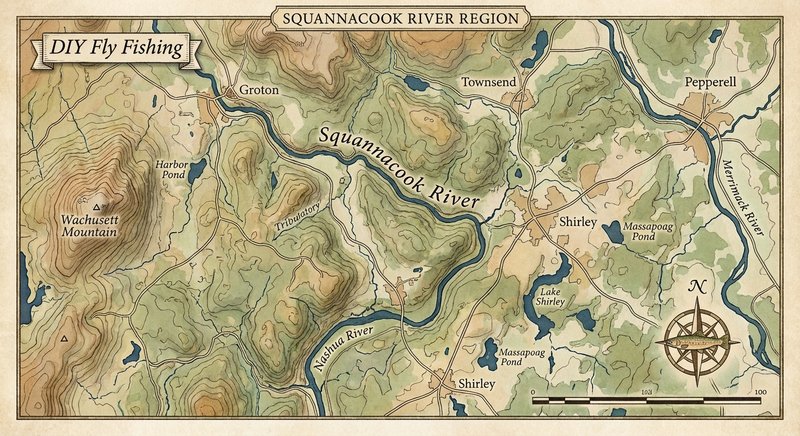
The Squannacook River is one of the most cherished cold-water resources in Eastern Massachusetts. Flowing through the towns of Townsend, Groton, and Shirley, it offers a surprisingly wild, "upcountry" feel despite being less than an hour from Boston. As a designated Wild and Scenic River, it provides a mix of classic pool-and-riffle water, slow meandering bends, and dense canopy cover that keeps the water cool and the trout happy.
🎣 Location Overview
The "Squanney," as locals call it, is a classic freestone river characterized by tea-colored (tannic) water. This acidity comes from the surrounding wetlands, but don't let the dark water fool you—it is highly productive.
What makes it special is the diversity of the water. The upper reaches in Townsend are tighter and more technical, resembling a mountain stream, while the lower sections open up into deeper runs and large pools. Most of the river is bordered by the Squannacook River Wildlife Management Area, ensuring that the banks remain forested and the fishing experience feels secluded.
🐟 Target Species & Behavior
- Brown Trout: These are the kings of the Squannacook. While the state stocks a significant number of Browns, the river holds over-wintered fish that become wary and dark-colored in the tannic water. They tend to hold in deep undercut banks, under fallen timber, and at the tail-outs of pools during evening hatches.
- Brook Trout: You will find both stocked Brookies and a modest population of wild, native fish in the smaller tributaries and the extreme upper reaches. They are opportunistic feeders but very "spooky."
- Behavior: Due to the dark water, trout here often rely on vibration and silhouette. They are less likely to move long distances for a small fly, so accuracy and "putting it on their nose" is key.
📅 Best Times to Fish
- Spring (April – June): This is the prime window. As soon as the spring runoff subsides, the insect activity explodes. May is arguably the best month for dry fly action.
- Summer (July – August): The Squannacook holds its temperature better than the nearby Nashua River, but it can still get low and warm. Focus on the early mornings or "the witching hour" (sunset). Look for shaded areas and oxygenated pocket water.
- Fall (September – October): A secondary peak. The water cools, and the Brown trout become aggressive as they prepare for spawning. The foliage makes this a visually stunning time to be on the water.
- Time of Day: In the spring, 10:00 AM to 4:00 PM is best. In the summer, shift to 5:00 AM–9:00 AM or 7:00 PM–Dark.
🪰 Recommended Flies & Techniques
Dry Flies
- Hendrickson (April/May): The first major hatch. Size 12-14.
- Light Cahill (June): Essential for the evening "white fly" activity. Size 14-16.
- Elk Hair Caddis: A staple year-round. Tan or olive, sizes 14-18.
- Terrestrials (Summer): Ant and Beetle patterns are lethal under the overhanging hemlocks.
Nymphs
- Pheasant Tail & Hare’s Ear: The gold standards. Size 14-18.
- Prince Nymph: The flash helps in the tannic water.
- Squirmy Worms/Mop Flies: Very effective after a rain when the water gets murky.
Streamers
- Woolly Bugger: Black or Olive. The dark water makes black silhouettes very visible to trout.
- Muddler Minnow: Great for imitating the small sculpins found in the riffles.
Technique Tip:
Because of the heavy bank vegetation, Roll Casting is a mandatory skill here. Practice your short-game; many fish are caught within 20 feet of the angler.
💡 Pro Tips & Local Knowledge
- The "Townsend State Forest" Stretch: This is the most scenic area. It requires a bit of hiking, which thins out the crowds. Focus on the pocket water behind large boulders.
- Watch the Gauges: The Squannacook can rise quickly after a storm. Check the USGS gauge at Bertozzi Wildlife Management Area. Anything between 100–200 cfs is "ideal" wading. Over 300 cfs can be dangerous and difficult to fish.
- The "Shadow" Approach: Because the water is dark, trout often hold in shallower water than you’d expect, especially under low-hanging branches. Approach the bank slowly; if you can see the fish, they have likely already seen you.
- Stealth: Use 5x or 6x fluorocarbon tippet. Despite the dark water, these fish see a lot of lures and can be leader-shy.
⚠️ Important Information
- Access:
- Vinton Pond Rd / West Townsend: Good for smaller water and Brookies.
- Harbor Pond Dam: A popular stocking point and easy access.
- Bertozzi WMA: Excellent trail access and plenty of room to spread out.
- Regulations:
- A Massachusetts freshwater fishing license is required.
- Standard statewide regulations apply (usually a 3-fish limit, no minimum length), but many local anglers practice 100% Catch and Release to preserve the fishery.
- Wading Safety: The bottom is a mix of sand and slippery "bowling ball" rocks. Felt soles or studs are highly recommended.
- Ticks: The surrounding brush is prime tick habitat. Use Permethrin on your gear and do a thorough check after your session.
Guide’s Final Word: The Squannacook is a "thinking man's" river. It rewards patience, stealth, and those willing to walk a half-mile away from the bridges. Tight lines!
Bug Hatches & Matching Flies
| Hatch | Type | Peak months | Time of day | Hook sizes | Matching flies |
|---|---|---|---|---|---|
| Hendrickson Ephemerella subvaria | mayfly | April, May | Afternoon | #12-14 | Red Quill #12-14, Hendrickson Emerger #12-14, Pheasant Tail #12-14 |
| Blue-Winged Olive Baetis spp. | mayfly | April, May, September, October | Late Morning/Afternoon | #18-22 | BWO Sparkle Dun #18-22, RS2 #20-22, WD-40 #18-20 |
| Tan Caddis Hydropsyche | caddis | May, June, July | Evening | #14-18 | Elk Hair Caddis #14-16, LaFontaine's Deep Sparkle Pupa #14-16, Holy Grail #14-18 |
| Sulphur Ephemerella dorothea | mayfly | May, June | Evening | #16-18 | Sulphur Parachute #16-18, Sulphur Cripple #16-18, Hare's Ear #16-18 |
| March Brown Maccaffertium vicarium | mayfly | May, June | Afternoon | #10-12 | March Brown Dry #10-12, March Brown Wet Fly #10-12, Gold Ribbed Hare's Ear #10-12 |
| Light Cahill Stenonema ithaca | mayfly | June, July | Evening | #14-16 | Light Cahill Dry #14-16, Cahill Wet Fly #14-16 |
| Early Brown Stonefly Strophopteryx fasciata | stonefly | March, April | Afternoon | #14-16 | Early Brown Stone #14-16, Pats Rubber Legs #12-14 |
| Terrestrials (Ants/Beetles) Formicidae / Coleoptera | terrestrial | July, August, September | All Day | #14-20 | Black Foam Ant #16-20, Cinnamon Ant #14-18, Crowe Beetle #14-16 |