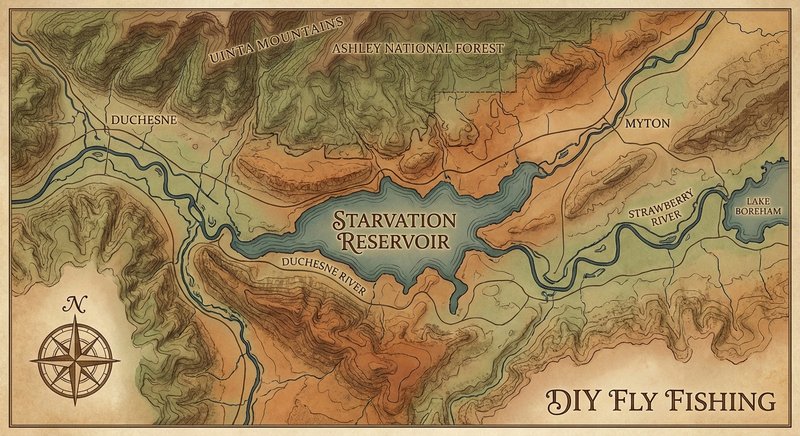
Starvation Reservoir
Fly fishing in Utah · Beginner · Best seasons: Spring, Summer, Fall
Target Species
Walleye, Smallmouth Bass, Rainbow Trout
About This Water
Uinta Basin reservoir with excellent walleye fishing. Also bass and trout.
Fishing Recommendations
Starvation Reservoir (located within Fred Hayes State Park) is one of Utah’s premier high-desert fisheries. While many fly anglers overlook reservoirs in favor of the nearby Green or Strawberry Rivers, Starvation offers a unique, world-class opportunity for those looking to target trophy-class Walleye and aggressive Smallmouth Bass on the fly.
Here is your comprehensive guide to fly fishing Starvation Reservoir.
🎣 Location Overview
Located just outside Duchesne, Utah, Starvation Reservoir is a sprawling, 3,300-acre impoundment of the Strawberry River. It is characterized by its stark contrast: deep, sapphire-blue water set against rugged, orange sandstone cliffs and sagebrush flats.
What makes Starvation special is its water clarity and its trophy potential. Unlike many murky walleye fisheries, the clarity here allows for sight-fishing opportunities for Smallmouth and makes it an ideal environment for fly anglers using streamers. It is a "big water" experience that requires strategy, but the rewards are some of the hardest-fighting fish in the state.
🐟 Target Species & Behavior
Walleye
Starvation is legendary for Walleye. While traditionally a gear-fisher's prize, they are highly susceptible to flies during low-light transitions.
- Behavior: They are light-sensitive predators. During the day, they hold deep (20–40 feet) near submerged rock piles or drop-offs.
- Fly Target: At dawn, dusk, and on overcast days, they move into the shallows (3–10 feet) to hunt Yellow Perch and crawfish.
Smallmouth Bass
The "workhorse" of the reservoir for fly anglers. These fish are prolific and incredibly aggressive.
- Behavior: They hug the rocky shorelines, submerged boulders, and cliff faces.
- Feeding: They focus heavily on crawfish and juvenile Yellow Perch.
Rainbow Trout
Though often overshadowed by the warm-water species, the reservoir is stocked regularly.
- Behavior: In the heat of summer, they stay deep near the dam or the old river channel. In spring and fall, they can be found cruising the surface near the Strawberry River inlet.
📅 Best Times to Fish
Spring (April – June)
- The Window: This is the prime time for Walleye. As water temperatures hit the low 50s, Walleye move into very shallow water to spawn.
- Conditions: Look for "Walleye Chop"—a slight breeze that breaks the surface tension, making the fish less spooky in the shallows.
Summer (July – August)
- The Window: Peak Smallmouth season.
- Time of Day: First light until about 10:00 AM is magic for topwater. As the sun gets high, transition to deep-sinking lines along cliff faces.
Fall (September – October)
- The Window: The "Fall Feed." As temperatures drop, all three species move shallow to bulk up for winter.
- Conditions: This is arguably the best time for Rainbow Trout and trophy Smallmouth near the rocky points.
🪰 Recommended Flies & Techniques
For Walleye (The "Night Shift")
- Patterns: Size 2–4 Clouser Minnows (Chartreuse/White or Orange/Firetiger), Game Changers (Perch colors), and large Bunny Leeches.
- Technique: Use an Intermediate or Type 3 Sinking line. Cast toward the shore and use a slow, "strip-strip-pause" retrieve. The hit almost always happens on the pause.
For Smallmouth Bass (The "Cliff Hangers")
- Patterns: Topwater: Boogle Bugs or Foam Poppers in black or orange. Sub-surface: Near-Nuff Craws, Meat Whistles, and Woolly Buggers (Olive or Rusty Brown).
- Technique: Cast tight to the sandstone walls. Let the fly sink along the ledge. For topwater, fish the coves early in the morning with a "pop-and-stop" rhythm.
For Rainbow Trout
- Patterns: Balanced Leeches under an indicator, or Soft Hackles and Renegades if they are rising in the evening.
- Technique: Focus on the Strawberry River inlet at the west end of the reservoir.
💡 Pro Tips & Local Knowledge
- The "Perch Connection": Yellow Perch are the primary forage. If you aren't sure what color to fish, choose Gold, Orange, and Chartreuse. Any fly that mimics a 3-inch perch will get eaten.
- Focus on "The Knolls": The area known as "The Knolls" features underwater humps and islands. This is a magnet for Walleye. If you have a float tube or kayak, this is the place to be at sunset.
- The Strawberry Inlet: The far western end where the Strawberry River enters is a high-protein zone. In the spring, this area holds massive concentrations of fish.
- Wind is your Friend (and Enemy): A dead-calm surface makes Walleye very difficult to catch on a fly. A slight ripple "blurs" their vision of you and your fly line, making them more confident strikers. However, beware of the afternoon winds—they can whip up dangerous waves quickly.
⚠️ Important Information
- Access: Fred Hayes State Park at Starvation offers excellent boat ramps and developed camping. Rabbit Gulch on the north side offers more primitive access and is great for shore-based fly anglers.
- Regulations: Always check the current Utah Fishing Guidebook. There are specific limits on Walleye (only one over 24 inches may be kept) to protect the trophy class.
- Equipment: A 6-weight or 7-weight rod is recommended. You need the backbone to throw weighted streamers and to fight the frequent afternoon winds.
- Permits: A standard Utah Fishing License is required. If entering through the State Park, a daily vehicle fee applies.
Guide’s Final Word: Starvation is a "quality over quantity" fishery for the fly angler. Spend your time working the rocky transitions where the sandstone meets the deep water, and don't be afraid to fish well into the dark for a shot at a wall-hanger Walleye.
Bug Hatches & Matching Flies
| Hatch | Type | Peak months | Time of day | Hook sizes | Matching flies |
|---|---|---|---|---|---|
| Chironomids (Midges) Chironomidae | midge | April, May, September, October | All Day | #12-22 | Zebra Midge #16-20, Ice Cream Cone #12-16, Griffith's Gnat #18-22 |
| Callibaetis (Speckled Duns) Callibaetis ferrugineus | mayfly | June, July, August | Late Morning/Afternoon | #12-16 | Callibaetis Spinner #14-16, Hare's Ear Nymph #14-16, Parachute Adams #14-16 |
| Damselfly Enallagma | terrestrial | June, July | Morning/Afternoon | #10-14 | Marabou Damsel Nymph #10-12, Adult Damsel #12-14 |
| Dragonfly Anisoptera | terrestrial | July, August | Afternoon | #4-8 | Dragon Nymph #6-10, Woolly Bugger (Olive) #4-8 |
| Scud Gammarus | midge | March, April, November | All Day | #12-18 | Ray Charles #14-18, Orange Scud #12-16 |
| Caddis Trichoptera | caddis | July, August | Evening | #14-18 | Elk Hair Caddis #14-18, LaFontaine's Sparkle Pupa #14-16 |
| Grasshopper Acrididae | terrestrial | August, September | Afternoon | #6-12 | Morrish Hopper #8-12, Joe's Hopper #10-12 |
| Crayfish Orconectes | terrestrial | May, June, July | Evening/Night | #2-8 | Clouser Minnow #2-6, Near Nuff Crawdad #4-8 |