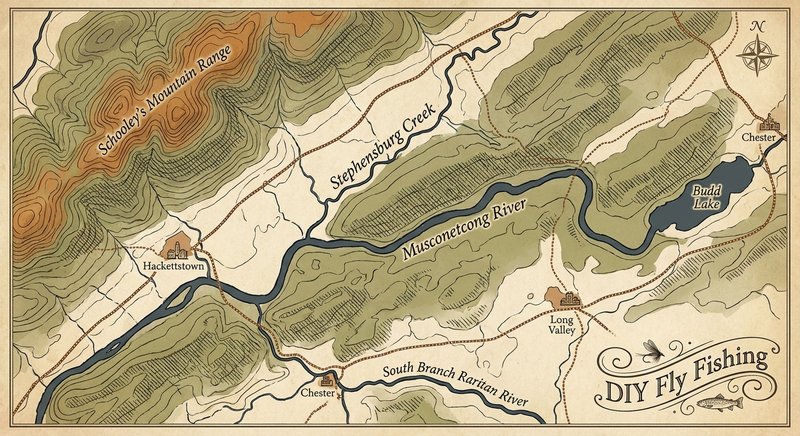
Stephensburg Creek
Fly fishing in New Jersey · intermediate · Best seasons: spring, summer, fall
Target Species
Brown Trout
About This Water
Warren County spring creek with wild brown trout. Limestone influence creates excellent hatches.
Fishing Recommendations
Stephensburg Creek is one of New Jersey’s hidden gems. While many anglers flock to the larger, more famous Musconetcong River nearby, the "Stephensburg" offers a more intimate, technical, and rewarding experience for the fly fisher looking for wild fish in a classic limestone-influenced setting.
Here is your comprehensive guide to fly fishing Stephensburg Creek, New Jersey.
🎣 Location Overview
Stephensburg Creek is a primary tributary to the Musconetcong River, located near the border of Morris and Warren Counties. What makes this creek special is its wild trout heritage. Unlike many NJ streams that rely heavily on stocking, the Stephensburg is a cold, spring-fed nursery that supports a self-sustaining population of wild Brown Trout.
The water characteristics are classic "small stream": undercut banks, tight corridors of overhanging willow and alder, and a mix of shallow riffles and deep, silty pools. Because it is limestone-influenced, the water stays cooler and more nutrient-rich than other freestone streams in the region, allowing trout to thrive even during the warmer months.
🐟 Target Species & Behavior
The primary prize here is the Wild Brown Trout. You may occasionally find a stray Rainbow Trout that has migrated up from the Musconetcong, but the resident population is dominated by buttery, red-spotted Browns.
- Behavior: These fish are notoriously "spooky." Because the water is often clear and the creek is narrow, they are highly sensitive to overhead movement and heavy footsteps.
- Holding Patterns: Look for them tight against the undercut banks or tucked under log jams. In the heat of summer, they will move into the faster, oxygenated "heads" of the pools.
- Feeding: They are opportunistic but selective. Due to the limestone influence, Scuds and Cressbugs are a staple year-round.
📅 Best Times to Fish
Spring (April – June)
The prime window. This coincides with the major Delaware Valley hatches.
- Optimal Months: May is the "Golden Month" for Sulphurs and Hendricksons.
- Time of Day: Late afternoon into the evening "spinner fall" is when the largest fish lose their caution.
Summer (July – August)
While other NJ streams get too warm, the Stephensburg stays remarkably cool.
- Strategy: Focus on terrestrial patterns (ants and beetles).
- Time of Day: Early morning (dawn) is best. Once the sun hits the water, the fish move deep into cover.
Fall (September – November)
A beautiful time to fish as the Brown Trout prepare for the spawn and become more aggressive.
- Optimal Months: October.
- Time of Day: Mid-day as the water warms slightly.
- Note: Please avoid stepping on "redds" (clean gravel spawning beds) in late November.
🪰 Recommended Flies & Techniques
Top Fly Patterns
- Nymphs:
- Zebra Midge (#18-22) - Essential for picky wild fish.
- Scud/Cressbug (#14-18) - Olive or gray; fish these deep in the slow runs.
- Pheasant Tail (#16-20) - A classic that mimics many local mayflies.
- Dry Flies:
- CDC Sulphur (#16-18) - The CDC wings provide a realistic profile for clear water.
- Elk Hair Caddis (#14-18) - Great for skating across riffles.
- Black Ant/Cinnamon Ant (#16-20) - Deadly in the summer under overhanging branches.
- Streamers:
- Woolly Bugger (Black or Olive, #10-12) - Best used after a rain when the water has a slight "stain" to it.
Presentation Tips
- The Stealth Approach: Approach pools from downstream. Stay low—sometimes literally on your knees—to avoid casting a shadow.
- Short Game: You will rarely make a cast longer than 20 feet. Accuracy is more important than distance.
- Light Tackle: A 2-weight or 3-weight rod (7’ to 8’ length) is perfect. Use 6X or 7X fluorocarbon tippet to avoid breaking off on the wary wild trout.
💡 Pro Tips & Local Knowledge
- The Confluence: The stretch where Stephensburg Creek meets the Musconetcong River is a "big fish" transition zone. Larger Browns often move from the big river into the creek to seek thermal refuge or to spawn.
- "Dapping": In the most overgrown sections, don't even try to cast. Use a technique called "dapping"—simply poke your rod through the brush and drop the fly on the surface.
- Watch the Rain: Because the creek is small, it clears much faster than the Musconetcong. If the big river is blown out and muddy after a storm, the Stephensburg might be fishable within 12–24 hours.
⚠️ Important Information
- Access: Much of the creek runs through private land or small bridge crossings. Always look for "Posted" signs. Public access is generally available near the Stephens State Park area and various bridge rights-of-way along Stephensburg Road.
- Regulations: Stephensburg Creek is subject to New Jersey's Wild Trout Stream regulations in certain sections. This often means specific creel limits or Catch and Release only. Always check the current NJ Fish & Wildlife Digest before heading out.
- Wading: The bottom can be very silty in the slower sections. Move slowly to avoid kicking up mud clouds that will alert every fish downstream of your presence.
Final Guide Advice: Respect these wild fish. They are a finite resource. Handle them with wet hands, keep them in the water, and they’ll be there for the next angler to test their skills against.
Bug Hatches & Matching Flies
| Hatch | Type | Peak months | Time of day | Hook sizes | Matching flies |
|---|---|---|---|---|---|
| Blue-Winged Olive (BWO) Baetis | mayfly | March, April, September, October | Midday | #18-22 | RS2 #20-22, Parachute BWO #18-20, Pheasant Tail Nymph #18-20 |
| Hendrickson Ephemerella subvaria | mayfly | April, May | Afternoon | #12-14 | Red Quill #12-14, Hendrickson Emerger #14, Gold Ribbed Hare's Ear #12-14 |
| Sulphur Ephemerella dorothea | mayfly | May, June | Evening | #14-18 | Sulphur Parachute #16-18, Comparadun Sulphur #14-16, Pheasant Tail #16 |
| Grannom Caddis Brachycentrus | caddis | April | Morning/Afternoon | #14-16 | LaFontaine's Deep Pupa #14-16, Elk Hair Caddis (Dark) #14-16, Peacock Caddis #16 |
| Trico Tricorythodes | mayfly | July, August, September | Early Morning | #22-26 | Trico Spinner #22-24, Sunken Trico Spinner #22-24, Griffith's Gnat #22 |
| Tan Caddis Hydropsyche | caddis | May, June, July, August | Evening/Night | #14-18 | Tan Elk Hair Caddis #14-18, Hydropsyche Larva #14-16, X-Caddis #16 |
| Light Cahill Stenacron interpunctatum | mayfly | June, July | Evening | #12-14 | Light Cahill #12-14, Cream Usual #14, Gold Ribbed Hare's Ear (Light) #14 |
| Terrestrials Formicidae / Coleoptera | terrestrial | July, August, September | All Day | #12-18 | Cinnamon Ant #16-18, Foam Beetle #14-16, Dave's Hopper #12 |