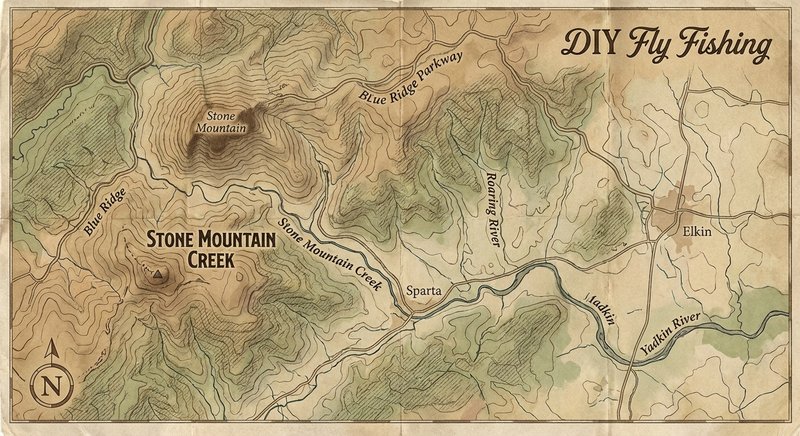
Stone Mountain Creek
Fly fishing in North Carolina · Intermediate · Best seasons: Spring, Summer, Fall
Target Species
Brown Trout, Rainbow Trout
About This Water
Stream in Stone Mountain State Park with wild trout. Beautiful waterfall scenery.
Fishing Recommendations
Stone Mountain Creek, located within the iconic Stone Mountain State Park in North Carolina, is a crown jewel of the Blue Ridge Mountains. As a guide, I consider this one of the most aesthetically pleasing places to cast a fly in the Southeast. Whether you are fishing the "meadows" with the massive granite dome as your backdrop or hiking into the steep gradients near the falls, it offers a quintessential Appalachian fly fishing experience.
🎣 Location Overview
Stone Mountain Creek is primarily managed as Delayed Harvest (DH) water from the park boundary upstream to the base of Stone Mountain Falls. This means it receives heavy stockings of high-quality fish throughout the fall and spring.
The water is a classic freestone stream. In the lower "Meadow" section, the creek meanders through open fields, offering rare, unobstructed backcasting room—a luxury in North Carolina. As you move upstream toward the falls, the terrain becomes more rugged with large boulders, plunge pools, and tighter canopy cover. The water is exceptionally clear, making stealth and presentation paramount, especially as the season progresses.
🐟 Target Species & Behavior
The creek is home to Rainbow Trout and Brown Trout, with the occasional Brookie moving down from the high-gradient headwaters.
- Rainbow Trout: These are the most common in the DH section. They tend to hold in the swifter "riffle" water and at the heads of pools. They are opportunistic feeders but can become "tippet shy" after seeing a few hundred flies.
- Brown Trout: The Browns here—especially the holdovers—are more secretive. Look for them in the undercut banks in the meadow section or in the deep, dark shadows of the boulders near the falls. They are more likely to move for a streamer during low-light conditions or after a light rain.
- Wild Fish: If you hike above the falls into the "Wild Trout" designated water, the fish are smaller (5–9 inches) but incredibly beautiful and far more skittish.
📅 Best Times to Fish
- Spring (March – May): This is the Prime Window. The Delayed Harvest is in full swing, and the insect life is waking up. Expect heavy hatches of Quill Gordons and Hendricksons in early spring, followed by March Browns.
- Fall (October – November): The scenery is world-class. The DH season begins in October, meaning the creek is freshly stocked. The cooler temperatures make the trout aggressive.
- Summer (June – August): The lower meadow section can get warm; if the water temp hits 70°F, please stop fishing to protect the trout. During summer, your best bet is to fish early (dawn to 10 AM) or hike to the higher elevations above the falls where the water remains cooler.
- Best Time of Day: During DH season, mid-morning is excellent as the sun warms the water slightly. In the heat of summer, stick to the "golden hours" of dawn and dusk.
🪰 Recommended Flies & Techniques
Top Fly Patterns
- Nymphs:
- The "Junk" (Early Season/High Water): Mop Flies (Chartreuse), Squirmy Wormies (Pink/Red), and Egg patterns.
- Natural Patterns: Frenchie (#14-18), Pheasant Tail (#16-20), and Girdle Bugs (Black/Rubber legs).
- Dry Flies:
- Attractors: Royal Wulff, Stimulators (Orange or Yellow #12-16).
- Match the Hatch: Parachute Adams (#16-20), Elk Hair Caddis (Tan #14-16), and Blue Winged Olives (#18-22).
- Streamers:
- Woolly Buggers (Olive or Black), Pine Squirrel Leeches.
Effective Techniques
- Tight-Line Nymphing: In the plunge pools and boulder runs, a Euro-style or tight-line nymphing rig is deadly. It allows you to get flies deep into the pockets where stocked fish congregate.
- Dry-Dropper: This is the "bread and butter" for the meadow section. Use a buoyant Stimulator as your indicator and hang a small Pheasant Tail or Hare’s Ear 18–24 inches below it.
- The "Long Leader" Approach: Because the water is so clear, use a 9ft to 12ft leader tapered to 5X or 6X fluorocarbon tippet to avoid spooking fish.
💡 Pro Tips & Local Knowledge
- The Meadow "Trap": Most anglers stop at the first easy-access bridge in the meadow. It gets pounded. If you walk just 15 minutes upstream toward the falls, the fishing pressure drops significantly and the fish are less "educated."
- The Falls Section: The water directly below Stone Mountain Falls is highly oxygenated and holds fish even when the lower sections get sluggish. It’s a steep hike, but worth the effort.
- Sneak Up on Them: In the flat water of the meadows, trout can see you from a long way off. Crouch down, wear earthy colors, and avoid "lining" the fish (casting your fly line directly over their heads).
- After the Rain: If the water has a slight "stain" (tea color) after a rain, switch immediately to a black Woolly Bugger or a large stonefly nymph. This is when the biggest Browns in the system come out to hunt.
⚠️ Important Information
- Regulations: Stone Mountain Creek is primarily Delayed Harvest (Catch and Release only, Single Hook Artificial Lures only) from October 1st through the first Saturday in June. After that, it opens to harvest. Always check the NC Wildlife Resources Commission (NCWRC) website for current dates.
- Permits: You need a standard North Carolina Fishing License PLUS a "Trout Privilege" (Trout Stamp).
- Access: The park has ample parking near the "Lower Trailhead" and the "Stone Mountain Falls" parking lots. Access is very easy via well-maintained gravel trails.
- Park Hours: Be mindful that the park gates close at a specific time (usually dusk). Don’t get your vehicle locked in!
- Wading Safety: While the meadow is easy walking, the rocks near the falls are notoriously slick (granite + moss). Felt-soled boots or studs are highly recommended.
Bug Hatches & Matching Flies
| Hatch | Type | Peak months | Time of day | Hook sizes | Matching flies |
|---|---|---|---|---|---|
| Quill Gordon Epeorus pleuralis | mayfly | March, April | Mid-day | #12-14 | Quill Gordon Dry #12-14, Quill Gordon Nymph #12-14 |
| Blue-Winged Olive (BWO) Baetis | mayfly | March, April, October, November | Afternoon | #18-22 | Parachute BWO #18-20, RS2 #20-22, Pheasant Tail Nymph #18-22 |
| Yellow Sally Isoperla | stonefly | May, June, July | Late Afternoon/Evening | #14-16 | Yellow Stimulator #14-16, Yellow Sally Stone Nymph #14-16 |
| March Brown Maccaffertium vicarium | mayfly | April, May | Mid-day/Afternoon | #10-14 | March Brown Dry #12-14, Hare's Ear Nymph #10-14 |
| Tan Caddis Hydropsyche | caddis | April, May, June | Morning/Evening | #14-18 | Elk Hair Caddis (Tan) #14-16, Holy Grail #14-16, Pupa-Leanza #16-18 |
| Light Cahill Stenacron / Stenonema | mayfly | June, July | Evening | #12-14 | Light Cahill Dry #12-14, Cream Midge #20-22 |
| Terrestrials (Ants & Beetles) Formicidae / Coleoptera | terrestrial | July, August, September | All Day | #12-18 | Black Foam Ant #16-18, Coffee's Sparkle Beetle #14-16 |
| Midges Chironomidae | midge | December, January, February | Late Morning | #20-24 | Zebra Midge #18-22, Griffith's Gnat #20-24 |
| Giant Black Stonefly Pteronarcys dorsata | stonefly | April, May | Night/Early Morning | #4-8 | Pat's Rubber Legs #6-10, Girdle Bug #6-10 |