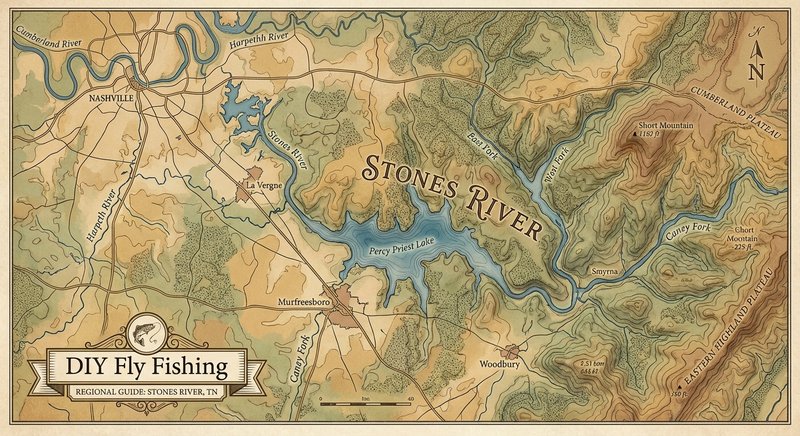
Stones River
Fly fishing in Tennessee · Beginner · Best seasons: Spring, Summer, Fall
Target Species
Smallmouth Bass, Largemouth Bass
About This Water
Middle Tennessee river near Murfreesboro. Smallmouth and largemouth bass fishing.
Fishing Recommendations
The Stones River is one of Middle Tennessee’s true gems. Flowing through the heart of Rutherford and Davidson counties, it offers a diverse range of water—from the limestone-bottomed wading stretches of the West Fork to the big-water tailrace below Percy Priest Dam. For the fly angler, it is a premier Smallmouth Bass destination that combines Southern hospitality with technical, rewarding fishing.
🎣 Location Overview
The Stones River is characterized by its three distinct forks (East, West, and Middle) that eventually converge and flow into Percy Priest Lake, continuing as a tailwater below the dam.
What makes this river special is its limestone geology. The alkaline nature of the water supports a massive biomass of crustaceans and baitfish, leading to high growth rates for bass. You’ll find classic "pool-and-drop" morphology: long, slow pools separated by shallow, rocky riffles. Whether you are wading the Greenway in Murfreesboro or floating the tailwater in Nashville, the river offers a mix of urban accessibility and surprisingly wild scenery.
🐟 Target Species & Behavior
Smallmouth Bass (The Primary Target)
Smallmouths are the kings of the Stones. They are extremely structure-oriented here.
- Behavior: They hold in the "seams" where fast water meets slow water. In the heat of summer, they move into the oxygenated riffles; in spring and fall, they patrol the ledge rock and submerged timber.
- Feeding: Their diet consists heavily of crawfish, hellgrammites, and clupeids (shad/shiners).
Largemouth Bass
Found primarily in the slower, deeper "slack water" sections and around heavy woody debris (downed trees).
- Behavior: Less likely to be in the current than Smallmouth. Look for them in the "backwater" pockets and deep holes during the heat of the day.
📅 Best Times to Fish
- Spring (April – June): This is prime time. As water temperatures hit the 55–60°F mark, bass become highly aggressive pre-spawn.
- Summer (July – August): The "Topwater Window." While the midday sun can be brutal, the early morning and late evening provide world-class surface action.
- Fall (September – early November): As the water cools, bass feed heavily to bulk up for winter. This is the best time for trophy-sized fish on large streamers.
- Optimal Conditions: Look for a "falling and clearing" river. After a rain, once the water turns from "chocolate milk" to a "emerald green" tint, the fishing is lights-out.
🪰 Recommended Flies & Techniques
Topwater (The Most Fun)
- Patterns: BoogleBugs (Poppers) in yellow or green, Todd’s Wiggle Minnow, and Foam Gurglers.
- Technique: Cast tight to the bank or logs. Let the rings disappear before moving the fly. Give it two sharp "pops," then let it sit.
Sub-surface (The Most Effective)
- Patterns:
- Clouser Minnow: Chartreuse/White or Olive/White (the gold standard here).
- Near Nuff Craw: In rust or brown to mimic the river's abundant crayfish.
- Gamechanger/Murdich Minnow: To mimic injured shad in the tailwater.
- Pat’s Rubber Legs: A stonefly/hellgrammite imitation that works wonders in the riffles.
- Technique: Use a "strip-strip-pause" retrieve. Often, the bass will hit on the pause as the fly sinks.
💡 Pro Tips & Local Knowledge
- The "Splat" Factor: When fishing topwater, don't be afraid to let the fly hit the water hard. The "splat" mimics a terrestrial (like a cicada or grasshopper) falling in and can trigger an immediate reactionary strike.
- Wading the West Fork: Use the Murfreesboro Greenway system. Access points like Manson Pike or Thompson Lane allow you to hike in and find water that doesn't see boat traffic.
- The Tailwater Secret: Below J. Percy Priest Dam, the water is colder. You can actually find holdover Trout here in the spring, but the Smallmouth in this section grow huge on a steady diet of shad pushed through the turbines.
- Shadow Lines: In the summer, Smallmouth will hug the shadow lines created by high bluffs or overhanging trees. If a spot is in the direct, high-noon sun, move on.
⚠️ Important Information
- TVA Releases: If fishing the Stones River Tailwater (below the dam), always check the TVA Lake Info app for the generation schedule. When they turn on the generators, the water rises rapidly and can be life-threatening for waders.
- Access:
- West Fork: Thompson Lane Trailhead, Old Fort Park, and Barfield Crescent Park.
- Main Stem: Kohl’s Trailhead or the Stones River Boat Ramp near the dam.
- Regulations: A standard Tennessee Fishing License is required. Be sure to check the TN Wildlife Resources Agency (TWRA) guide for specific "slotted" size limits on Smallmouth Bass, as regulations can vary by specific river sections to protect the trophy population.
- Gear: A 6-weight or 7-weight fast-action rod is ideal. You need the backbone to throw wind-resistant poppers and to pull a 4lb Smallmouth away from a submerged log.
Bug Hatches & Matching Flies
| Hatch | Type | Peak months | Time of day | Hook sizes | Matching flies |
|---|---|---|---|---|---|
| Midges Chironomidae | midge | January, February, March, December | All Day | #18-24 | Zebra Midge #18-22, Griffith's Gnat #20-22, Top Secret Midge #20-24 |
| Blue Winged Olives Baetis | mayfly | March, April, October, November | Late Morning/Afternoon | #18-22 | RS2 #20-22, Parachute Adams #18-22, Pheasant Tail Nymph #18-20 |
| Sulphurs Ephemerella invaria | mayfly | May, June | Evening | #14-18 | Sulphur Parachute #14-18, CDC Sulphur Emerger #16-18, Split Case Sulphur #16-18 |
| Tan Caddis Hydropsyche | caddis | May, June, July, August | Late Afternoon/Evening | #14-18 | Elk Hair Caddis #14-16, Holy Grail Caddis #16-18, LaFontaine's Deep Sparkle Pupa #14-16 |
| White Fly Ephoron leukon | mayfly | August, September | Dusk/Night | #12-14 | White Wulff #12-14, Ephoron Spinner #12-14 |
| Yellow Sallies Isoperla | stonefly | May, June, July | Afternoon/Evening | #14-16 | Yellow Sally Stone #14-16, Iron Lotus #16 |
| Terrestrials Formicidae/Coleoptera | terrestrial | July, August, September | All Day | #10-18 | Black Foam Ant #16-18, Chernobyl Ant #10-12, Beatles #14-16 |
| Damselflies Calopteryx | terrestrial | June, July, August | Midday | #10-14 | Marabou Damsel #12-14, Adult Damsel #10-12 |