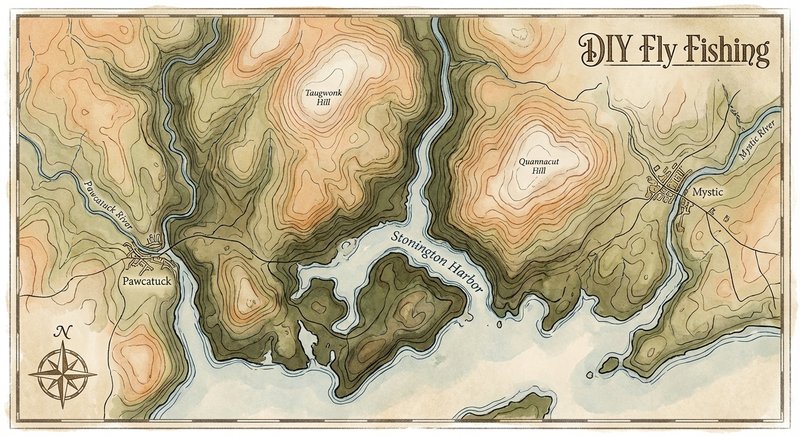
Stonington Harbor
Fly fishing in Connecticut · Intermediate · Best seasons: Summer, Fall
Target Species
Striped Bass, False Albacore, Bonito
About This Water
Eastern CT harbor with diverse saltwater fishing. Watch Hill area.
Fishing Recommendations
Stonington Harbor, located in the southeastern corner of Connecticut, is widely considered the "crown jewel" of the Nutmeg State’s saltwater fly fishing scene. Positioned at the confluence of Fishers Island Sound and the Atlantic, it offers a unique blend of rocky structure, deep channels, and nearby sand flats.
As your guide, here is the comprehensive breakdown for fishing these storied waters.
🎣 Location Overview
Stonington Harbor is the last port before the Rhode Island border, making it a strategic "jumping-off point" for some of the finest light-tackle fishing in the Northeast. What makes this area special is the proximity to deep water. Unlike the shallow mudflats of the western Sound, Stonington features high-salinity, crystal-clear water pushed in by the tides from the Atlantic.
The harbor is protected by massive granite breakwalls, which act as a magnet for baitfish and predators. Within a ten-minute boat ride, you have access to the rocky reefs of Fishers Island, the sandy points of Napatree (RI), and the legendary currents of "The Race." It is a dynamic, high-energy environment that rewards technical fly casters.
🐟 Target Species & Behavior
- Striped Bass: The bread and butter of the region. During the summer, they transition from the shallow flats to the cooler, deeper structure of the breakwalls and reefs. In the fall, they congregate in massive schools for the "migration," feeding aggressively on the surface.
- False Albacore (Albies): The "Holy Grail" of Northeast fly fishing. These pelagic speedsters arrive in September. They don't have teeth or scales; they are pure muscle. They feed in chaotic "blitzes," moving at 40 mph, requiring fast casts and faster retrieves.
- Bonito: The Albies' cousins, usually arriving a few weeks earlier (August). They are slightly more "sneaky" than Albies, often popping up for a few seconds before diving deep. They are excellent table fare but even better sport on a 9-weight.
📅 Best Times to Fish
- Summer (July – August): Focus on the "low light" windows. Dawn and dusk are essential for Striped Bass. This is also when Atlantic Bonito make their first appearance around the outer walls and reefs.
- Fall (September – October): This is prime time. The "Fall Blitz" occurs as cooling water temperatures trigger baitfish to move out of the estuaries. September is the peak for False Albacore.
- Tides: In Stonington, moving water is mandatory. The best fishing usually occurs during the middle two hours of an incoming tide, which brings clear, cool ocean water into the harbor.
- Wind: A light Southwest wind is the "local favorite" as it pushes bait against the Connecticut shoreline.
🪰 Recommended Flies & Techniques
The Patterns
- For Albies/Bonito: You must "Match the Hatch." The primary bait is the Bay Anchovy (Rain Bait).
- Epoxy/Surf Candies: Size 2 to 4, slim profile, translucent.
- Mushmouths: Great for mimicking larger silversides.
- Albie Snax (Fly version): White or pink.
- For Striped Bass:
- Clouser Minnow: Chartreuse/White is the local standard.
- Gurglers: For thrilling topwater action at sunrise.
- Hollow Fleyes: For a larger profile when the "bunker" (Menhaden) are present.
The Techniques
- The "Two-Handed Strip": For Albies and Bonito, a standard strip is often too slow. Tuck the rod under your arm and use both hands to recover line as fast as possible.
- Blind Casting Structure: When fish aren't showing on the surface, cast Clousers or weighted streamers against the rocks of the Stonington Breakwater and let them sink 5–10 feet before beginning a rhythmic strip.
- The "Pause": For Striped Bass, a sudden pause in your retrieve often triggers a strike from a trailing fish.
💡 Pro Tips & Local Knowledge
- The Breakwalls: The Stonington outer breakwall is a consistent producer. Fish the "tips" of the wall where the current creates eddies. Bait gets trapped here, and bass wait in ambush.
- Don't "Run and Gun": When Albies are blitzing, inexperienced boaters race their engines toward the fish, which puts the school down. Cut your engine well up-drift and let the wind/tide carry you into the feeding zone.
- Watch the Birds: Common Terns are your best scouts. If you see them hovering and dipping, the "Hardtails" (Albies/Bonito) are likely pushing bait to the surface.
- Napatree Point: Just east of the harbor is Napatree. The "Slew" between the point and the rocks is a highway for migrating fish. It is a world-class spot for wading fly anglers.
⚠️ Important Information
- Licensing: You need a Connecticut Marine Waters Fishing License. If you drift across the border into Rhode Island waters (which happens often near Napatree), ensure you check reciprocity laws; generally, a CT license is recognized in RI for marine waters, but always verify current regulations.
- Access:
- Boat Launch: The Stonington Town Boat Launch (at the end of High Street) is excellent but can be crowded.
- Shore Access: Limited in the harbor itself, but DuBois Beach offers some casting opportunities in the off-season.
- Regulations: Striped Bass have a "slot limit" (currently 28" to less than 31" in many areas, but check the CT DEEP website for the most current emergency updates).
- Safety: The waters around Stonington can be treacherous. Watch out for "Wicopesset Passage"—it has standing waves during a heavy tide and can swamp small skiffs.
Guide’s Final Word: Bring a 9-weight rod with a cold-water intermediate sinking line. It’s the versatile "workhorse" for this area. And remember: if the Albies are refusing your fly, go smaller and strip faster!
Bug Hatches & Matching Flies
| Hatch | Type | Peak months | Time of day | Hook sizes | Matching flies |
|---|---|---|---|---|---|
| Cinder Worm Nereis limbata | midge | May, June | Late Afternoon/Evening | #10-14 | V-Rib Cinder Worm #12, Gurgler (Red/Pink) #10-12, Page's Cinder Worm #12 |
| Blue Winged Olive Baetis | mayfly | April, May, September, October | Midday | #18-22 | RS2 #20, BWO Parachute #18-22, WD-40 #20 |
| Salt Marsh Midge Chironomidae | midge | May, June, July, August | Dawn/Dusk | #20-24 | Zebra Midge #20-22, Griffith's Gnat #20-24 |
| Flying Ants Formicidae | terrestrial | August, September | Afternoon | #16-20 | Fur Ant #18, Chernobyl Ant #14-16 |
| Cinnamon Caddis Hydropsyche | caddis | June, July | Evening | #14-16 | Elk Hair Caddis #14-16, Pupa Emerger #16 |
| Grass Shrimp Palaemonetes | terrestrial | June, July, August | Anytime | #4-8 | Bob's Banger (Shrimp) #6, Glass Shrimp #8 |
| March Brown Maccaffertium vicarium | mayfly | May | Afternoon | #12-14 | March Brown Wet #12, Traditional March Brown #14 |
| Japanese Beetle Popillia japonica | terrestrial | July, August | Midday | #12-14 | Foam Beetle #12-14 |