Stony Brook
Fly fishing in New Jersey · beginner · Best seasons: spring
Target Species
Rainbow Trout, Brown Trout
About This Water
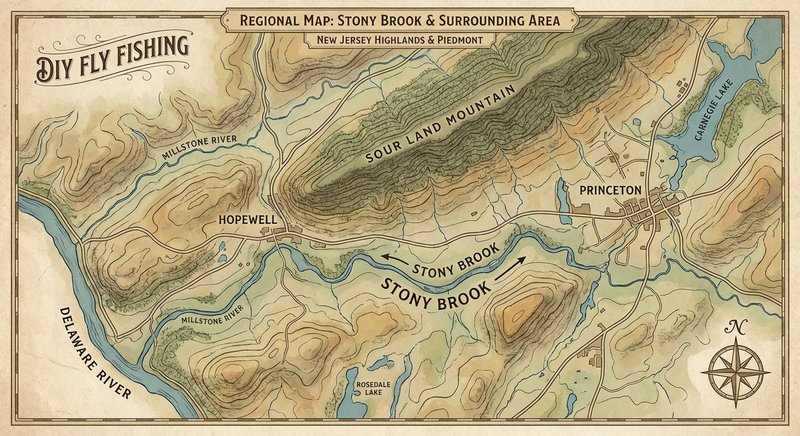
Mercer County stream near Princeton. Stocked trout with easy access through preserves.
Fishing Recommendations
As an expert guide who has spent years navigating the nuances of Mid-Atlantic waters, I can tell you that Stony Brook in Mercer County is a unique gem in New Jersey’s trout portfolio. While it lacks the rugged mountainous feel of the Musconetcong or the Ken Lockwood Gorge, it offers a classic, low-gradient Piedmont stream experience that is incredibly productive during the spring months.
Here is your comprehensive guide to fly fishing the Stony Brook.
🎣 Location Overview
Stony Brook flows through the heart of historic Princeton and Hopewell, winding through a mixture of suburban backyards, preserved forests, and boulder-strewn parks.
What makes it special is its Piedmont character. Unlike the limestone-influenced streams to the north, the Stony is a "freestone-style" stream with a bed of shale and gravel. It is relatively wide for a Central Jersey stream, offering plenty of room for backcasts. Anglers love it because it provides a "big water" feel in a suburban setting, with deep pools, long glides, and technical riffles that hold fish well after the initial stocking rush.
🐟 Target Species & Behavior
The primary targets here are Rainbow Trout and Brown Trout.
- Rainbow Trout: These are the primary residents following the state's heavy spring stocking program. They tend to hold in the faster oxygenated water at the heads of pools or in the middle of riffles. They are opportunistic and will often chase a swinging nymph or streamer.
- Brown Trout: While most are stocked, there are occasional "holdovers" that survive mild winters in the deeper, cooler holes. Browns here are more cautious; they prefer "structure"—undercut banks, submerged logs, or the dark shadows beneath the many stone bridges that cross the brook.
- Feeding Behavior: In the spring, fish are active as the water warms from the 40s into the 50s (Fahrenheit). They feed heavily on aquatic insects (caddis and stones) but are also highly responsive to "junk flies" (eggs and mops) shortly after being stocked.
📅 Best Times to Fish
- Optimal Months: April and May are the "Golden Era" for Stony Brook. By mid-June, water temperatures often rise above 70°F, which can be lethal for trout; fishing should cease once temps hit 68°F.
- Best Times of Day:
- Early Spring (April): Late morning to mid-afternoon (10 AM – 3 PM) when the sun warms the water and triggers insect activity.
- Late Spring (May): Early morning and the "Magic Hour" just before dusk when the hatches are most prolific.
- Prime Conditions: 2–3 days after a rain event. The Stony can get muddy quickly due to the clay/shale soil. You want the water to be "trout green"—slightly stained but with at least 2 feet of visibility.
🪰 Recommended Flies & Techniques
The Stony Brook requires a versatile fly box.
Top Fly Patterns
- Nymphs:
- Bead Head Pheasant Tail (#14-18): A staple for mimicking the stream's natural mayfly nymphs.
- Zebra Midge (#18-22): Essential for those clear-water, pressured days.
- Sexy Walt’s Worm (#14-16): Highly effective in the shale-bottomed riffles.
- Dries:
- Elk Hair Caddis (#14-16): The most consistent hatch on the brook.
- Adams Parachute (#14-18): A great general attractor for Mayfly hatches.
- Attractors/Streamers:
- Woolly Bugger (Black or Olive, #8-10): Best for high water or targeting larger Browns.
- Egg Patterns & Mop Flies: Controversial to some, but undeniably effective for recently stocked fish in April.
Effective Techniques
- Indicator Nymphing: The most productive method. Use a light indicator and enough split shot to get the fly near the bottom shale.
- The "Tights-Line" Swing: In the riffles, swinging a pair of wet flies or small streamers can trigger aggressive strikes from Rainbows.
- Dry-Dropper: In May, running a buoyant Elk Hair Caddis with a small Pheasant Tail dropped 18 inches below is deadly in the shallower glides.
💡 Pro Tips & Local Knowledge
- The "Princeton Stretch": Focus on the water within Pillar to Post (off Rosedale Rd) and the stretches near the Updike Farm. These areas have better gradients and more oxygenated water.
- Find the Deep Shale Ledges: The Stony Brook has unique underwater shale shelves. Trout will tuck directly under these ledges. If you aren't bouncing your fly off the rock, you're missing the fish.
- Stealth Matters: Because the banks are often flat, your silhouette is easily visible to the fish. Wear earthy tones and wade slowly.
- Bridge Pools: Every bridge over the Stony Brook (especially the historic stone arches) creates a massive scour hole. These are the "community holes" but they hold fish all season. If a spot looks too deep to wade, fish the edges.
⚠️ Important Information
- Access: Great access is found at Rosedale Park and Karsers Pond/Stony Brook Park. There are also several pull-offs along Blackwell Road and Rosedale Road.
- Regulations: Stony Brook is managed under Statewide General Regulations. You must have a valid NJ Fishing License and a Trout Stamp.
- Stocking Schedule: The NJ Division of Fish & Wildlife stocks this water weekly in April. Check their official schedule to avoid the "truck-chasing" crowds if you prefer solitude, or to find fresh fish if you are taking a beginner.
- Special Consideration: Respect private property. While much of the brook is bordered by parkland, some stretches run through private estates. If it’s posted, stay in the water or move on.
Guide’s Final Word: The Stony Brook is the perfect "after-work" stream. It’s accessible, friendly to wade, and during a warm May evening when the caddis are dancing, it’s as beautiful as any water in the Northeast. Tight lines!
Bug Hatches & Matching Flies
| Hatch | Type | Peak months | Time of day | Hook sizes | Matching flies |
|---|---|---|---|---|---|
| Blue Winged Olive Baetis | mayfly | March, April, October, November | Late Morning/Afternoon | #18-22 | RS2 #18-22, BWO Sparkle Dun #18-20, Pheasant Tail Nymph #18-20 |
| Early Brown Stonefly Taeniopteryx | stonefly | February, March | Afternoon | #12-16 | Early Brown Stone Nymph #12-14, Stimulator #14-16 |
| Hendrickson Ephemerella subvaria | mayfly | April | Afternoon | #12-14 | Red Quill #12-14, Hendrickson Emerger #12-14, Gold Ribbed Hare's Ear #12-14 |
| Sulphur Ephemerella invaria | mayfly | May, June | Evening | #14-18 | Sulphur Parachute #14-18, CDC Sulphur Emerger #16-18, Pheasant Tail #14-16 |
| Tan Caddis Hydropsyche | caddis | April, May, June | Morning/Evening | #14-18 | Elk Hair Caddis #14-16, Pupa #14-18, Soft Hackle #14-16 |
| Light Cahill Stenacron interpunctatum | mayfly | June, July | Evening | #12-14 | Light Cahill Dry #12-14, Light Cahill Wet #12-14 |
| Midges Chironomidae | midge | January, February, March, December | All Day | #20-26 | Zebra Midge #20-22, Griffith's Gnat #20-24 |
| Terrestrials Formicidae/Coleoptera | terrestrial | July, August, September | All Day | #12-18 | Black Foam Ant #14-18, Crowe Beetle #12-16 |