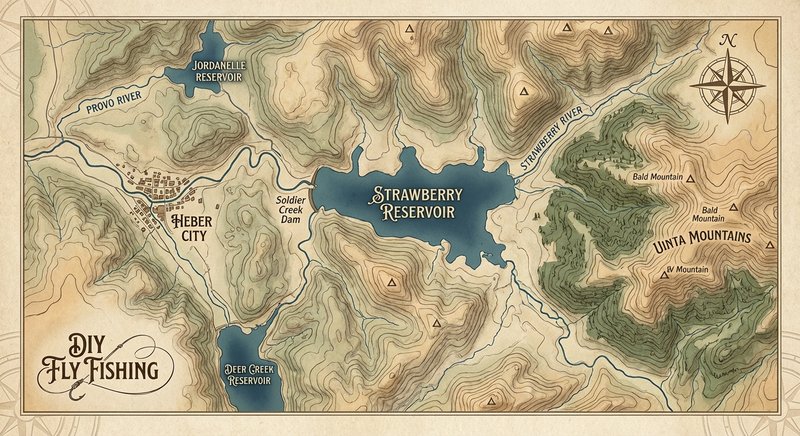
Strawberry Reservoir
Fly fishing in Utah · Beginner · Best seasons: Spring, Summer, Fall
Target Species
Cutthroat Trout, Rainbow Trout, Kokanee Salmon
About This Water
Premier stillwater fishery with trophy cutthroat. Utah's most popular trout lake.
Fishing Recommendations
Welcome to the "Berry." As an expert guide, I can tell you that Strawberry Reservoir is arguably the crown jewel of Utah’s stillwater fisheries. Located at roughly 7,600 feet in the Wasatch Mountains, it is a high-altitude "trout factory" famous for producing trophy-sized fish and incredible catch rates.
Here is your comprehensive guide to fly fishing Strawberry Reservoir.
🎣 Location Overview
Strawberry Reservoir is a massive impoundment characterized by two distinct areas: the Strawberry Basin (shallower, more weed beds, classic flats) and the Soldier Creek Basin (deeper, steeper shorelines, colder water).
What makes it special is its biological productivity. The "Strawberry Valley Project" restored this water in the 1990s, and today it operates as a finely tuned ecosystem. It is a "heavy" water, meaning it is rich in scuds, damselflies, and chironomids, which allows fish to grow at a staggering rate—often 1 to 2 inches per month during the summer.
🐟 Target Species & Behavior
- Bear Lake Cutthroat Trout: The stars of the show. They were introduced to control the invasive Utah Chub. They are aggressive predators. Large "cuts" (20-25 inches) often cruise the shallows looking for smaller fish or cruise weed edges for damselflies.
- Rainbow Trout: These are sterile (triploid) fish designed to grow big and fast without interbreeding with the cutthroats. They are hard-fighting and often found in the top 10–15 feet of the water column.
- Kokanee Salmon: These landlocked sockeye salmon spend most of their time in the deep, open water of the Soldier Creek side. They are filter feeders but become highly aggressive (and turn bright red) during their fall spawning run.
📅 Best Times to Fish
- Spring (Ice-out to Late June): This is prime time. As the ice recedes (usually May), fish congregate in the shallows where the water warms first. Chironomid hatches are massive.
- Summer (July - August): Fish move slightly deeper or toward oxygen-rich areas. Morning and evening are best. This is "Callibaetis" and terrestrial season (ants/beetles).
- Fall (September - November): The "Second Spring." As water temps drop, big Cutthroats return to the shallows to gorge before winter. The Kokanee turn red and move toward the tributaries and the ladders.
- Prime Windows: Low light is your friend. 30 minutes before sunrise until 10:00 AM is often more productive than the entire rest of the day.
🪰 Recommended Flies & Techniques
Top Fly Patterns
- Chironomids (Midges): Ice Cream Cone, Zebra Midge (Red or Black), and any "Chironobunny" in sizes 12–18.
- Scuds/Sowbugs: Strawberry is crawling with scuds. Use Olive, Gray, or Pink (size 12–16).
- Leeches & Streamers: Balanced Leeches (Black/Red or Olive), Pine Squirrel Leeches, and Woolly Buggers. For big Cutthroats, try a white streamer to mimic a small chub.
- Dry Flies: Parachute Adams (size 14–18), Carpenter Ants (size 12), and Foam Beetles.
Effective Techniques
- Indicator Nymphing: The most effective way to fish the Berry. Use a long leader (12–18 feet) and hang a chironomid or scud 12–18 inches off the bottom.
- The "Slow Crawl": Use an intermediate sinking line with a leech or damselfly nymph. Cast, let it sink to the weed tops, and use a very slow, rhythmic "figure-eight" retrieve.
- The Naked Side-Pressure: In the fall, strip large streamers near rocky points for aggressive Cutthroats.
💡 Pro Tips & Local Knowledge
- The Float Tube Advantage: While you can fish from the shore, a float tube or kick boat is the ultimate tool here. It allows you to stay 30 feet off the weed line and cast back toward the shore, which is where the fish cruise.
- Watch the Wind: Strawberry is notorious for sudden, dangerous winds. If you see whitecaps forming, get off the water immediately. The "Strawberry Breeze" usually kicks in around 11:00 AM.
- The "Ladder" and "Renegade": These are famous spots. The Ladder (near the fish trap) is great in the spring. Renegade offers great access to flats where big rainbows cruise.
- Color Transition: If the bite dies on olive leeches, switch to something with dark red or purple. The fish here have a known affinity for those hues, especially on cloudy days.
⚠️ Important Information
- Special Regulations: Crucial! You must know the slot limit. As of current regulations: You must immediately release all Cutthroat Trout between 15 and 22 inches. You may keep two Cutthroats under 15 inches and one over 22 inches. (Always check the current Utah Fishing Guidebook before heading out).
- No Live Bait: Only artificial flies and lures are allowed.
- Aquatic Invasive Species (AIS): You must decontaminate your boat/float tube to prevent the spread of Quagga mussels.
- Access: Main access points are Strawberry Bay Marina, Renegade, Soldier Creek, and Aspen Grove. All have boat ramps and parking, but some require a USFS Day Use fee.
Guide’s Final Word: Bring your 6-weight rod. These fish are strong, and the wind can be stiff. If you hook a 24-inch Bear Lake Cutthroat on a size 16 midge, you're in for the fight of your life!
Bug Hatches & Matching Flies
| Hatch | Type | Peak months | Time of day | Hook sizes | Matching flies |
|---|---|---|---|---|---|
| Chironomids (Midges) Chironomidae | midge | May, June, September | Morning/All Day | #12-20 | Ice Cream Cone #14-18, Zebra Midge #16-20, Griffith's Gnat #18-22 |
| Callibaetis (Speckled Duns) Callibaetis | mayfly | June, July, August | Morning/Midday | #12-16 | Parachute Adams #14-16, Callibaetis Spinner #14-16, Hare's Ear Nymph #12-16 |
| Damselfly Enallagma | terrestrial | June, July | Midday | #10-14 | Marabou Damsel Nymph #10-14, Braided Butt Damsel #12-14 |
| Scuds (Freshwater Shrimp) Gammarus | midge | May, October | All Day | #12-16 | Ray Charles #14-16, Flashback Scud #12-16 |
| Water Boatmen / Backswimmers Corixidae / Notonectidae | midge | September, October | Afternoon | #14-18 | Water Boatman #14-16, Prince Nymph #14-18 |
| Traveling Sedge (Caddis) Hesperophylax | caddis | July, August | Evening | #10-14 | Elk Hair Caddis #10-14, Goddard Caddis #10-12 |
| Leeches Hirudinea | midge | May, June, October | All Day | #8-12 | Balanced Leech #8-12, Woolly Bugger (Olive/Black) #8-12 |
| Terrestrials (Ants and Beetles) Formicidae / Coleoptera | terrestrial | August, September | Afternoon | #12-16 | Chernobyl Ant #10-14, Black Foam Beetle #14-16 |