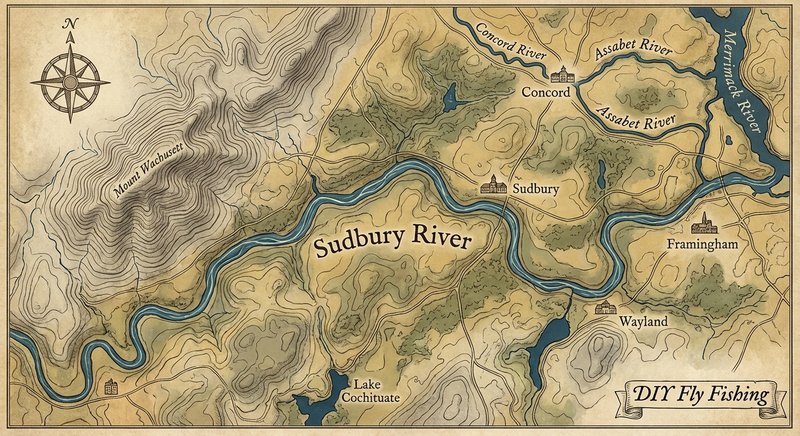
Sudbury River
Fly fishing in Massachusetts · Beginner · Best seasons: Spring, Summer, Fall
Target Species
Largemouth Bass, Pickerel, Carp
About This Water
Middlesex County river with bass fishing. Great Meadows Wildlife Refuge.
Fishing Recommendations
The Sudbury River is one of Massachusetts’ most storied and unique warm-water fisheries. Flowing through the historic MetroWest region and the Great Meadows National Wildlife Refuge, it offers a distinct "blackwater" experience characterized by slow-moving currents, heavy vegetation, and tannin-stained waters.
Here is your comprehensive guide to fly fishing the Sudbury River.
🎣 Location Overview
The Sudbury River is a low-gradient, sluggish river that feels more like a series of interconnected lagoons and wetlands than a traditional flowing stream. It is famous for its extensive lily pad fields, "spatterdock" (yellow water lily), and submerged timber.
What makes it special is the wildness found so close to Boston. Once you paddle a few hundred yards from a bridge, the suburban noise fades, replaced by the calls of herons and the swirl of large predatory fish. Because the river is often choked with weeds and has a soft, silty bottom, it is primarily a boat or kayak fishery. Wading is rare and generally dangerous due to deep mud.
🐟 Target Species & Behavior
Largemouth Bass
The king of the Sudbury. These fish are structure-oriented. They hold tight to the edges of lily pads, under downed trees, and in the "holes" within dense weed mats. They are opportunistic feeders, eating everything from crayfish and bluegill to dragonflies and frogs.
Chain Pickerel
The Sudbury is a "Pickerel Factory." These toothy predators are everywhere. They are highly aggressive and often strike when a bass won't. They prefer the shallower, weedy margins and will slash at anything that flashes or vibrates.
Common Carp
The "Golden Ghost" of the Sudbury. These fish can reach massive sizes (20+ lbs) here. They are highly intelligent and spooky. You’ll find them vacuuming the silty bottom in shallow flats or "clooping" (feeding on the surface) under overhanging mulberry trees or among the seeds of aquatic plants.
📅 Best Times to Fish
- Spring (Late April – June): This is the prime window. As the water warms, Bass move into the shallows to spawn (please avoid fishing active beds). Pre-spawn and post-spawn are explosive for streamers. Carp become active in the shallows as well.
- Summer (July – August): Focus on the "Low Light" windows. The heat makes the fish lethargic during the day. Vegetation is at its peak, requiring weedless patterns.
- Fall (September – October): As the weeds begin to die back, Bass and Pickerel go on a feeding binge to prepare for winter. This is often the best time for trophy-sized fish.
Prime Windows:
- Sunrise/Sunset: Essential during summer for topwater action.
- Overcast Days: The best days for steady streamer action, as the fish feel more secure moving away from heavy cover.
🪰 Recommended Flies & Techniques
Top Patterns
- Topwater: Dahlberg Divers (Frog/Chartreuse), BoogleBugs (Poppers), and Foam Gurglers.
- Streamers: Game Changers (White/Yellow), Woolly Buggers (Black/Olive - weighted), and the Clouser Minnow (for deeper channels).
- Carp Specials: Backstabbers, Carp Bitters, and San Juan Worms (in red or orange).
- Weedless is Key: Always use flies with wire or heavy mono weed guards.
Techniques
- The "Pop and Pause": When using poppers, the pause is more important than the pop. Let the rings disappear before moving the fly again. Bass often strike on the dead still.
- The Strip-Set: Because these fish have hard mouths and you are often fishing near heavy cover, never trout-set (lifting the rod). Point the rod at the fish and pull the line hard to set the hook.
- Carp Stalking: For Carp, you need a stealthy approach. Find feeding fish (look for "mudding" or tails breaking the surface), and place your fly 12 inches in front of their nose. Let it sink and give it the tiniest twitch.
💡 Pro Tips & Local Knowledge
- The "Fairhaven Bay" Stretch: Located between Concord and Lincoln, this wide, lake-like section of the river is a hotspot for large Bass and massive Carp.
- Follow the Mulberries: In late June and July, look for mulberry trees overhanging the water. Carp will congregate underneath to eat the falling fruit. A purple foam berry fly is a local secret.
- Color Selection: Because the water is tea-colored (tannic), Black, Gold, and Chartreuse offer the best visibility. White is excellent on sunny days.
- The Pickerel Tax: Always carry a few wire tippet sections or 30lb+ fluorocarbon bite tippets. Pickerel will slice through standard 10lb mono instantly.
⚠️ Important Information
Access Information
- Route 20 Launch (Wayland): Excellent for kayaks and canoes.
- Sherman’s Bridge (Sudbury/Wayland): A popular spot with a small pull-off for launching.
- Lowell Road (Concord): Provides access to the downstream sections near the confluence with the Assabet.
Regulations & Permits
- A Massachusetts Freshwater Fishing License is required for anyone 15 or older.
- The Sudbury River has consumption advisories due to historical mercury levels from upstream industrial sites. Catch and release is strongly recommended.
Special Considerations
- Ticks & Mosquitoes: The Great Meadows area is notorious for bugs. Bring heavy-duty repellent.
- Water Levels: In mid-summer, the river can get very shallow and choked with weeds. Check USGS gauges for "Sudbury River at Saxonville" to ensure there is enough water to navigate comfortably.
Guide’s Final Word: The Sudbury is a "thinking angler's" river. It rewards patience, accurate casting into tight pockets, and a stealthy approach. Pack a 6-weight or 7-weight rod to handle the weeds, and enjoy the serenity of one of New England's most beautiful marshland rivers.
Bug Hatches & Matching Flies
| Hatch | Type | Peak months | Time of day | Hook sizes | Matching flies |
|---|---|---|---|---|---|
| Hexagenia Hexagenia limbata | mayfly | June, July | Dusk/Night | #6-10 | Hex Paradox #6-8, Burrowing Mayfly Nymph #8-10 |
| White Miller Ephoron leukon | mayfly | August | Late Evening | #12-14 | White Wulff #12-14, White Miller Sparkle Dun #12-14 |
| Trico Tricorythodes | mayfly | July, August, September | Early Morning | #20-24 | Trico Spinner #20-24, RS2 #20-22 |
| Spotted Sedge Hydropsyche | caddis | May, June, July | Evening | #14-18 | Elk Hair Caddis #14-16, LaFontaine's Deep Sparkle Pupa #14-16 |
| Blue-Winged Olive Baetis | mayfly | April, May, September, October | Afternoon | #18-22 | Parachute BWO #18-22, Pheasant Tail #18-20 |
| Light Cahill Stenacron interpunctatum | mayfly | June, July | Evening | #12-14 | Light Cahill #12-14, Gold Ribbed Hare's Ear #12-14 |
| Damselfly Calopteryx | terrestrial | June, July, August | All Day | #10-14 | Adult Damsel #10-12, Marabou Damsel Nymph #12-14 |
| Carpenter Ant Camponotus | terrestrial | July, August, September | Afternoon | #12-16 | Black Foam Ant #14-16, Chernobyl Ant #12 |
| Midges Chironomidae | midge | March, April, November | Morning/Afternoon | #20-26 | Griffith's Gnat #20-22, Zebra Midge #20-24 |