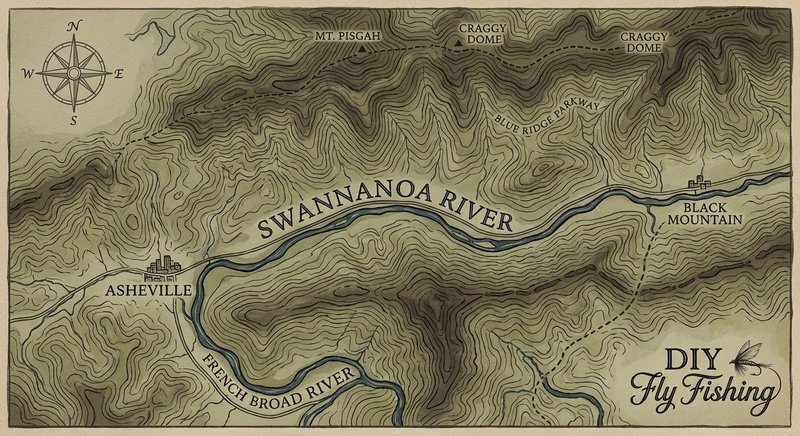
Swannanoa River
Fly fishing in North Carolina · Beginner · Best seasons: Spring, Summer, Fall
Target Species
Brown Trout, Rainbow Trout
About This Water
Urban trout stream through Asheville. Recovering fishery with wild trout.
Fishing Recommendations
The Swannanoa River is one of Western North Carolina’s most accessible and rewarding fly fishing destinations. Flowing from the high peaks of the Black Mountains near Montreat down through the heart of the Swannanoa Valley and into Asheville, it offers a diverse range of water types—from high-gradient "blue line" headwaters to a wide, gentle valley river.
As your guide, here is everything you need to know to find success on the Swannanoa.
🎣 Location Overview
The Swannanoa River is a gem because of its dual personality. Its upper reaches are classic Appalachian freestone waters, while the middle and lower sections near Black Mountain and Asheville are characterized by a "Delayed Harvest" (DH) management strategy.
What makes it special is the accessibility. You can be in a vibrant downtown Asheville brewery one minute and standing in a productive trout pool 15 minutes later. The river features a mix of rocky riffles, deep sediment-bottomed pools, and long glides. Because it flows through a mix of agricultural and suburban lands, it is highly fertile, supporting a robust biomass of aquatic insects.
🐟 Target Species & Behavior
The Swannanoa is primarily a Rainbow and Brown Trout fishery.
- Rainbow Trout: These are the backbone of the Delayed Harvest section. They are generally opportunistic and will hold in the faster oxygenated water at the heads of pools or in riffles.
- Brown Trout: You will find both heavily stocked "bruisers" and smaller, skittish wild browns in the upper tributaries. Large browns in the main stem tend to hug the undercut banks and deep woody debris. They become highly predatory as they grow, often switching to a diet of crayfish and sculpins.
- Behavior: In the DH sections, newly stocked fish can be "dumb" for the first week, but within 14 days, they become highly educated. They will move from the middle of the pools to more natural holding lies (seams and bubble lines) as they acclimate.
📅 Best Times to Fish
Optimal Seasons
- Spring (March – May): This is the "Golden Age" on the Swannanoa. The Delayed Harvest is in full swing, water temperatures are rising into the 50s, and the bug life is explosive.
- Fall (October – November): The DH season restarts in October. The fish are aggressive, the foliage is stunning, and the Brown Trout are looking to bulk up before the spawn.
- Summer (June – August): Focus on the headwaters near Montreat where the water stays cool. The lower river can get too warm for trout health in late July; if the water is over 68°F, give the fish a break.
Best Times of Day
- Spring/Fall: Mid-morning to late afternoon. You want the sun to warm the water slightly to trigger insect activity.
- Summer: First light until 10:30 AM.
🪰 Recommended Flies & Techniques
Top Fly Patterns
- Nymphs:
- Attractors: Sexy Walt’s Worm, Frenchie (Size 14-18), Mop Flies (Chartreuse), and Squirmy Wormies (Red/Pink) for recently stocked fish.
- Natural: Pheasant Tail Nymphs, Bead-head Hare’s Ear, and Girdle Bugs (Pat’s Rubber Legs) in Black/Olive.
- Dry Flies:
- Spring: Yellow Stimulators, Elk Hair Caddis (Tan), and Parachute Adams.
- Summer: Terrestrials! Foam Beetles, Ants, and Dave’s Hopper.
- Streamers:
- Olive or Black Wooly Buggers (Size 6-10), Sparkle Minnows, and Near Nuff Sculpins.
Effective Techniques
- Tight-Line (Euro) Nymphing: This is arguably the most effective way to fish the Swannanoa. The river has many subtle depth changes where a traditional indicator might miss the strike zone.
- Dry-Dropper: Perfect for the riffles. Use a high-floating Stimulator with a small Pheasant Tail dropped 18 inches below it.
- Streamer Stripping: On overcast days or when the water is slightly stained after a rain, strip streamers through the deep bends for the "trophy" Browns.
💡 Pro Tips & Local Knowledge
- The "Warren Wilson" Stretch: The water running through the Warren Wilson College campus is legendary. It features great habitat and is well-maintained. Respect the campus rules and stay within the designated fishing areas.
- Watch the Gauge: The Swannanoa reacts quickly to rain. If the USGS gauge at Swannanoa is spiking, the river will get "chocolate milk" muddy due to urban runoff. However, as it begins to clear (the "green drop"), streamer fishing is lights-out.
- Stealth Matters: Despite being a "city" river, the water can be very clear. Long leaders (9-12ft) and 5X or 6X fluorocarbon tippet are essential for the pressured fish in the DH sections.
- The "Junk" Factor: Don't be a purist on the DH sections. If the hatch isn't happening, a bright Pink Squirmy Wormy or a Mop Fly often out-produces the most technical midge patterns.
⚠️ Important Information
Access Points
- Azalea Park (Asheville): Great for easy access and families.
- Grovestone Road Bridge: A popular entry point for the DH section.
- Veterans Park (Black Mountain): Good for those wanting to fish the upper transition zones.
Regulations & Permits
- License: You must have a valid North Carolina Inland Fishing License. If fishing the DH section, ensure you have the "Trout" privilege.
- Delayed Harvest (DH) Rules: From October 1 until the first Saturday in June, the DH sections are Catch and Release Only and restricted to Single-Hook Artificial Lures only. No bait is allowed during this time.
- Etiquette: This is a popular river. If someone is already in a pool, give them plenty of space. Generally, move upstream as you fish.
Guide’s Final Word: The Swannanoa is the perfect "everyman's" trout stream. It’s forgiving enough for beginners but has enough hidden "big fish" potential to keep a seasoned angler coming back. Tight lines!
Bug Hatches & Matching Flies
| Hatch | Type | Peak months | Time of day | Hook sizes | Matching flies |
|---|---|---|---|---|---|
| Blue Winged Olive Baetis spp. | mayfly | March, April, October, November | Late Morning/Afternoon | #18-22 | Parachute Adams #18-22, RS2 #20-22, Pheasant Tail #18-20 |
| Quill Gordon Epeorus pleuralis | mayfly | March, April | Mid-day | #12-14 | Quill Gordon Dry #12-14, Gold Ribbed Hare's Ear #12-14 |
| March Brown Maccaffertium vicarium | mayfly | April, May | Afternoon | #10-14 | March Brown Western Style #12-14, March Brown Wet Fly #12-14 |
| Light Cahill Stenacron interpunctatum | mayfly | May, June | Evening | #12-16 | Light Cahill #12-16, Cream Usual #14-16 |
| Yellow Sally Isoperla spp. | stonefly | May, June, July | Late Afternoon/Evening | #14-16 | Yellow Stimulator #14-16, Iron Lotus #16 |
| Tan Caddis Hydropsyche spp. | caddis | April, May, September | Morning/Evening | #14-18 | Elk Hair Caddis #14-16, Holy Grail #14-16, Frenchie #14-18 |
| Golden Stonefly Acroneuria carolinensis | stonefly | June, July | Morning/Night | #6-10 | Pat's Rubber Leg #8-10, Golden Stimulator #8-12 |
| Midges Chironomidae | midge | December, January, February | Late Morning | #20-26 | Zebra Midge #20-22, Griffith's Gnat #20-24 |
| Terrestrials Formicidae/Coleoptera | terrestrial | July, August, September | All Day | #12-18 | Black Foam Ant #16-18, Crowe Beetle #14-16 |