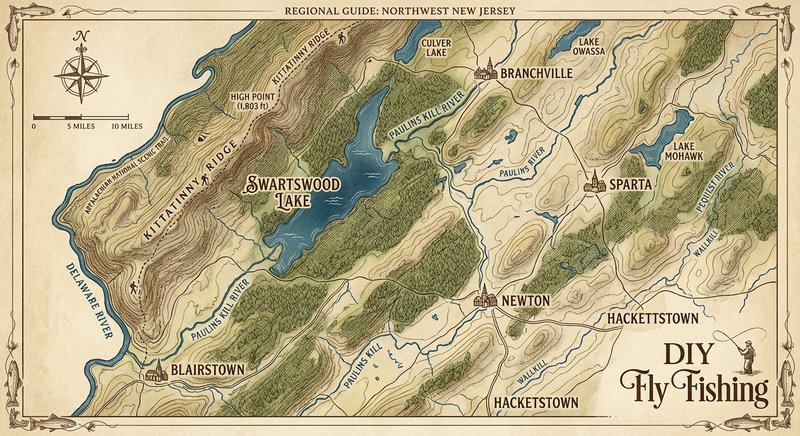
Swartswood Lake
Fly fishing in New Jersey · beginner · Best seasons: spring, fall
Target Species
Rainbow Trout, Brown Trout
About This Water
Sussex County natural lake with trout stocking. Electric motors only for peaceful fishing.
Fishing Recommendations
Welcome to the gateway of trout fishing in Northern New Jersey. As your guide, I’m excited to break down Swartswood Lake. Located in Sussex County, Swartswood is New Jersey's first state park and holds a special place in the hearts of Garden State anglers.
While many associate New Jersey trout fishing with the Musconetcong or the Pequest rivers, Swartswood offers a unique "stillwater" challenge. It is designated as a Trophy Trout Lake, meaning it is managed specifically to provide high-quality trout fishing opportunities in a lake environment.
🎣 Location Overview
Swartswood Lake is a 550-acre glacial lake characterized by its exceptionally clear water and diverse underwater topography. What makes it special for the fly angler is its status as a Trophy Trout Lake. Unlike shallower ponds that warm up too quickly, Swartswood has significant depth (up to 40+ feet) and a "thermocline" that allows trout to survive deeper into the season than in many other NJ waters.
The shoreline is a mix of rocky points, sandy flats, and steep drop-offs. For the fly fisher, this isn't "classic" stream fishing; it requires a transition to lake tactics—focusing on depth control, wind drifts, and understanding where the cold-water springs enter the system.
🐟 Target Species & Behavior
The primary targets here are Rainbow Trout and Brown Trout, heavily stocked by the NJ Division of Fish and Wildlife.
- Rainbow Trout: These are the most active and "willing" participants. In the spring, they cruise the shallow shorelines and sandy points. They are aggressive and will chase streamers or rise to midges and small mayflies.
- Brown Trout: The Browns here are more predatory and elusive. They tend to hold slightly deeper near submerged structures or where the bottom transitions from gravel to muck. If you want a trophy Brown, you’ll need to fish low-light conditions and use larger profiles.
- Behavior: During the spring, trout are "shoreline oriented." As the sun warms the shallows, the insects hatch, and the trout follow. In the fall, as water temperatures drop, they return from the depths to the shallows to feed aggressively before winter.
📅 Best Times to Fish
Optimal Seasons
- Spring (April – Early June): This is the peak. The water is cool, and trout are distributed throughout the water column. This is when they are most accessible to fly anglers.
- Fall (October – November): After the summer heat dissipates, the lake "turns over," and trout become active in the top 10 feet of water again. The fall stocking (usually in October) provides a fresh burst of activity.
Best Times of Day
- First Light: The 90 minutes around sunrise are magical. The water is usually glass-calm, and you can often see trout "dimpling" the surface for midges.
- Evening Twilight: As the sun dips behind the Kittatinny Ridge, a second window of activity occurs, especially for larger Brown Trout.
Prime Conditions
Overcast, slightly breezy days are often better than bluebird skies. A light "chop" on the water breaks up the surface, making the trout less spooky and hiding your leader/tippet.
🪰 Recommended Flies & Techniques
Top Fly Patterns
- Streamers:
- Woolly Buggers (Olive, Black, or White) sizes 6-10. This is the gold standard here.
- Marabou Muddlers to mimic the local baitfish (shiners and small yellow perch).
- Nymphs & Midges:
- Zebra Midges (Red or Black) sizes 18-22.
- Pheasant Tails and Hare’s Ears sizes 14-16.
- Dry Flies:
- Griffith’s Gnat (for midge clusters).
- Adams or Light Cahill (during late spring evenings).
Effective Techniques
- The "Slow Strip": Using an intermediate (slow-sink) fly line is a game changer at Swartswood. Cast toward the shore or points, let it sink for 5-10 seconds, and use a slow, 3-inch rhythmic strip to mimic a swimming nymph or small baitfish.
- Indicator Nymphing: If fishing from a boat or kayak, hang a midge or scud 4-6 feet under a small indicator near the drop-offs. Let the wind move the fly for you.
- Float Tube/Kayak Stealth: Because the water is clear, a stealthy approach in a kayak or float tube allows you to reach the "shelf" where the water drops from 5 feet to 15 feet—this is the prime hunting ground for trout.
💡 Pro Tips & Local Knowledge
- Focus on the State Park Side: The eastern shore (State Park side) has excellent structure and better access. Look for the areas near the boat rentals and the "Seven Arches" area.
- Find the Springs: There are several underwater springs in Swartswood. If you have a fish finder, look for areas where the water temperature is 2-3 degrees cooler in late May; trout will stack up there like cordwood.
- The "Hatch": While not a classic river hatch, Swartswood gets a decent "White Miller" (Mayfly) hatch in late May. If you see white moths fluttering over the water at dusk, tie on a light-colored dry fly.
- Long Leaders: Because the water is exceptionally clear, use a long leader (9-12 feet) and fluorocarbon tippet (5X or 6X) to avoid spooking fish.
⚠️ Important Information
- Access: Swartswood State Park provides ample parking, boat ramps, and restrooms. A small entrance fee may apply during the summer months (though usually free in early spring/late fall).
- Regulations:
- Trophy Trout Lake Rules: You must have a valid NJ Fishing License and a Trout Stamp.
- Check current NJ Fish & Wildlife digests for specific size and creel limits, as Trophy Trout Lakes have more restrictive harvest rules (typically a 12-inch minimum and a reduced creel limit compared to other waters).
- Boating: Electric motors only. This makes it a paradise for fly anglers in canoes, kayaks, or rowboats, as you don't have to contend with large wake-producing gas engines.
- Wading: Shoreline fly fishing is possible in the State Park area, but a kayak or float tube is highly recommended to reach the best water.
Guide’s Final Word: Swartswood is a "thinking man's" trout lake. Don't just cast blindly; watch the water, find the drop-offs, and vary your retrieve until the fish tell you what they want. Tight lines!
Bug Hatches & Matching Flies
| Hatch | Type | Peak months | Time of day | Hook sizes | Matching flies |
|---|---|---|---|---|---|
| Giant Michigan Mayfly (Hex) Hexagenia limbata | mayfly | June, July | Dusk/Night | #6-10 | Hexagenia Spinner #6-8, Hex Nymph #6-10, Burrowing Mayfly Emerger #8 |
| Eastern Green Drake Ephemera guttulata | mayfly | May, June | Evening | #8-12 | Green Drake Paradrake #10-12, Coffin Fly #8-10, Green Drake Wet Fly #10 |
| Blue-Winged Olive (BWO) Baetis | mayfly | April, May, September, October | Afternoon | #18-24 | BWO Sparkle Dun #18-22, Pheasant Tail Nymph #18-20, RS2 #20-22 |
| Damselfly Enallagma / Ischnura | terrestrial | June, July, August | All Day | #10-14 | Marabou Damsel Nymph #10-14, Adult Blue Damselfly #12-14, Damsel Emerger #12 |
| Midges Chironomidae | midge | March, April, October, November | Morning/Evening | #20-28 | Griffith's Gnat #20-24, Zebra Midge #18-22, Palomino Midge #20-24 |
| Gray Drake Siphlonurus | mayfly | May, June | Evening | #12-14 | Gray Drake Spinner #12-14, Hare's Ear Nymph #12-14 |
| Cinnamon Caddis Hydropsyche | caddis | June, July, August | Evening | #14-18 | Elk Hair Caddis #14-16, Pupa-X #16, LaFontaine's Deep Sparkle Pupa #14-18 |
| Terrestrial Ants and Beetles Formicidae / Coleoptera | terrestrial | July, August, September | Mid-day | #12-18 | Black Foam Ant #14-18, Chernobyl Ant #10-12, Crowe Beetle #12-16 |