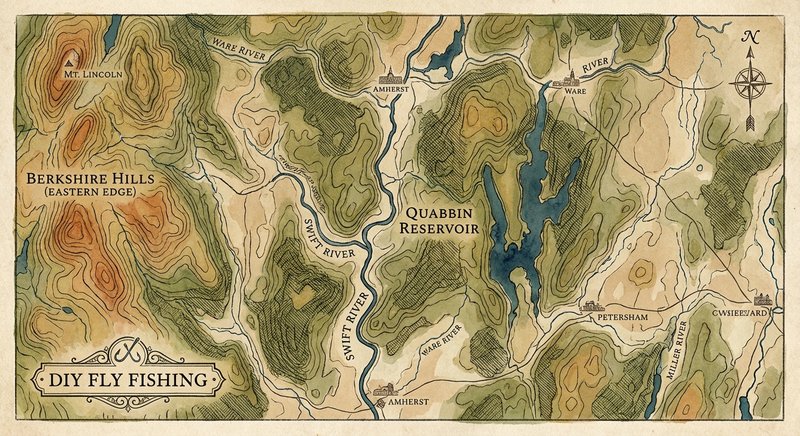
Swift River
Fly fishing in Massachusetts · Intermediate · Best seasons: Spring, Summer, Fall, Winter
Target Species
Brown Trout, Rainbow Trout
About This Water
Quabbin Reservoir tailwater with trophy trout. Year-round catch-and-release fishing.
Fishing Recommendations
The Swift River in Belchertown, Massachusetts, is arguably the most famous and technically demanding tailwater in New England. Flowing from the bottom of the Quabbin Reservoir, it provides a unique "spring creek" experience in the heart of the Northeast.
🎣 Location Overview
The Swift River is a legendary tailwater known for its gin-clear water and consistent year-round temperatures (typically between 40°F and 55°F). Because the water is released from the bottom of the Winsor Dam, the river never freezes in the winter and remains refreshingly cold in the heat of the summer.
What makes it special is the visibility. You can see every pebble, every weed, and every fish on the bottom. However, if you can see the fish, the fish can certainly see you. It is a "technical" river that rewards stealth, light tippets, and microscopic fly patterns.
🐟 Target Species & Behavior
- Rainbow Trout: These are the most abundant. They range from recent stockies to "holdovers" that have survived several seasons and become incredibly wary.
- Brook Trout: The upper stretches (above Route 9) hold a prolific population of wild and holdover Brookies. In the fall, they display stunning spawning colors.
- Brown Trout: Less common than Rainbows but often much larger. The Browns in the Swift are notoriously "smart" and often hold in deeper undercut banks or under low-hanging branches.
Behavior: Swift River trout are "educated." They see hundreds of flies a day. They will often inspect a fly for several seconds before rejecting it. They tend to hold in the main current seams but will move into the shallows during midge hatches.
📅 Best Times to Fish
- Spring (March - May): Excellent fishing as the wild Brookies become active. This is when the first major hatches of Blue Winged Olives (BWOs) occur.
- Summer (June - August): While other Massachusetts rivers become too warm to fish safely, the Swift is at its prime. It acts as a "refrigerator" for trout. This is the best time for terrestrial fishing (ants and beetles).
- Fall (September - November): The Brook Trout spawn. Note: Please do not fish for trout sitting on "redds" (bright gravel spawning beds). The BWO hatches are legendary this time of year.
- Winter (December - February): One of the few places in New England where you can consistently catch trout on dry flies (midges) in 20-degree weather.
- Prime Window: Low-light conditions (dawn and dusk) are best for the larger, more secretive Brown Trout. Mid-day is often best for midge and BWO hatches.
🪰 Recommended Flies & Techniques
Top Fly Patterns
- Midges (#22–#30): Zebra Midges (black, red), Griffith’s Gnat, and the "Sprout" Midge.
- Blue Winged Olives (#18–#24): RS2s, CDC Comparaduns, and Pheasant Tails.
- Scuds and Sowbugs (#16–#20): The river is full of vegetation, making these a primary food source year-round. Use olive or grey.
- Terrestrials (#14–#20): Black Ants, Cinnamon Ants, and small Beetles (summer only).
- Soft Hackles: A Partridge and Orange or a Pheasant Tail soft hackle swung through the "Y-Pool" can be deadly.
Effective Techniques
- Sight Nymphing: Instead of using a bulky bobber, watch the fish. When you see the white of its mouth open or a sudden head shake, set the hook gently.
- Micro-Nymphing: Use 6X or 7X fluorocarbon tippet. If you aren't getting hits, go smaller and lighter.
- Dry Fly: Use a long leader (12–15 feet) to prevent the fly line from spooking the fish in the crystal-clear water.
💡 Pro Tips & Local Knowledge
- The "Y-Pool": This is the most famous spot, located right near the dam. It holds massive amounts of fish but is often crowded. If it’s too busy, walk downstream.
- The Pipe: A few hundred yards below the Y-Pool is "The Pipe." Fish love to congregate in the oxygenated water here.
- Stealth is Mandatory: Wear drab-colored clothing (greens/browns) to blend in with the trees. Avoid splashing. Approach the bank slowly; sometimes the biggest fish are only two feet from the shore.
- The "Swift River Shake": If you see fish rising but they won't take your midge, try a "skittering" motion. Sometimes a tiny bit of movement triggers a strike on this river.
- Check the Bubbles: Look for "foam lines." The trout sit right under the bubbles because that’s where the dead-drifting insects are concentrated.
⚠️ Important Information
- Access: The primary access is off Route 9 in Belchertown. There is a dedicated parking lot for the Winsor Dam area.
- Regulations:
- Above Route 9: Catch and Release ONLY, Artificial Lures/Flies ONLY, Year-round.
- Below Route 9: Different regulations apply depending on the season (some areas allow harvest and bait during specific months). Always check the MassWildlife abstracts.
- Wading: The river is generally easy to wade, but be careful of the "slick" rocks and submerged logs.
- Etiquette: Because the river is small and popular, give other anglers plenty of space. If someone is fishing a pool, it's customary to stay at least 50 feet away.
Bug Hatches & Matching Flies
| Hatch | Type | Peak months | Time of day | Hook sizes | Matching flies |
|---|---|---|---|---|---|
| Midges Chironomidae | midge | January, February, March, April, May, June, July, August, September, October, November, December | All Day | #20-32 | Zebra Midge #20-24, Griffith's Gnat #20-26, WD-40 #22-26 |
| Blue-Winged Olive Baetis | mayfly | April, May, September, October, November | Late Morning/Afternoon | #18-24 | RS2 #20-24, BWO Parachute #18-22, Pheasant Tail Nymph #18-22 |
| Scud Gammarus | crustacean | March, April, May, June, October, November | All Day | #14-20 | Ray Charles #16-20, Orange Scud #14-18, Pink Scud #16-20 |
| Sulphur Ephemerella invaria/dorothea | mayfly | May, June, July | Evening | #16-20 | Sulphur Parachute #16-20, CDC Sulphur Emerger #18-20, Pheasant Tail #16-18 |
| Black Ant Formicidae | terrestrial | June, July, August, September | All Day | #16-22 | Black Foam Ant #18-22, Cinnamon Ant #16-20, Fur Ant #18-22 |
| Little Black Caddis Chimarra | caddis | April, May | Morning/Afternoon | #18-22 | Elk Hair Caddis (Black) #18-20, Z-Lon Midge/Caddis Larva #18-22, CDC Caddis Emerger #18-20 |
| Trico Tricorythodes | mayfly | July, August, September | Early Morning | #22-26 | Trico Spinner #22-26, Trico Parachute #22-24, Sunken Trico Spinner #22-26 |
| Sowbug Isopoda | crustacean | March, April, May, September, October | All Day | #16-20 | Soft Hackle Sowbug #16-20, Scud/Sowbug Hybrid #18-20 |