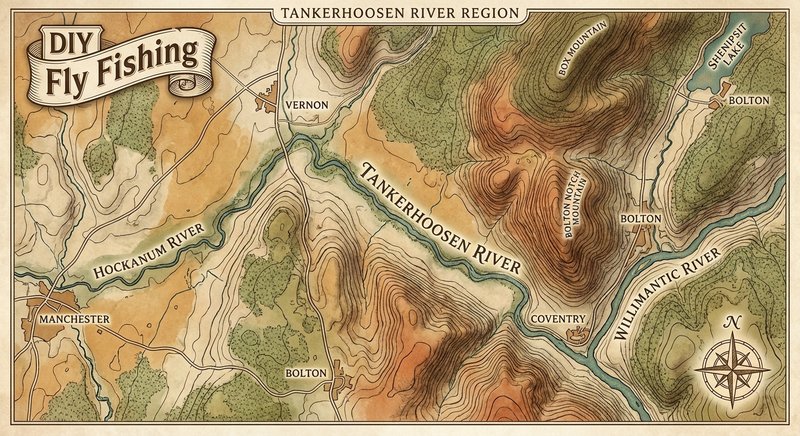
Tankerhoosen River
Fly fishing in Connecticut · Beginner · Best seasons: Spring, Summer, Fall
Target Species
Brown Trout, Brook Trout
About This Water
Tolland County stream with wild trout. Vernon area fishing.
Fishing Recommendations
Welcome to one of Connecticut’s true hidden gems. As your guide, I’m excited to walk you through the Tankerhoosen River. Located in Vernon, CT, this is a quintessential small-stream New England experience. While many anglers flock to the Farmington or the Housatonic, the "Tank" offers a more intimate, technical, and rewarding experience for those who value wild fish over stocked size.
🎣 Location Overview
The Tankerhoosen River is a small but mighty tributary of the Hockanum River. What makes it special is the Belding Wild Trout Management Area (WTMA). This section is one of the few places in southern New England where you can consistently find self-sustaining populations of wild trout in a suburban landscape.
The river is characterized by classic "pocket water," deep hemlock-shaded pools, and undercut banks. It feels much more remote than it is. The water stays remarkably cold throughout the year thanks to numerous springs and the shaded canopy of the Belding Wildlife Management Area and Valley Falls Park. It is a technical stream—overhanging branches and tight quarters mean you’ll need to bring your "A-game" casting.
🐟 Target Species & Behavior
The Tankerhoosen is a "Class 1" Wild Trout Management Area, meaning it is managed specifically for wild fish.
- Wild Brown Trout: These are the kings of the river. They are incredibly wary and possess brilliant gold-and-red spotting. They hold in the "dark spots"—under logs, deep in the shadows of undercut banks, and at the very head of pools where oxygen is highest.
- Wild Brook Trout: Usually found further upstream or in the smaller feeder trickles. They are opportunistic feeders but very easily spooked.
- Stocked Fish: While the WTMA is wild-centric, the sections outside the Class 1 area (closer to the confluence with the Hockanum) receive state stockings of Browns and Rainbows.
Behavior: Because the water is clear and relatively shallow, these fish have high "predator awareness." If they see your shadow or a splashy line, the pool is done for the hour.
📅 Best Times to Fish
- Spring (April – June): This is prime time. Water levels are at their best, and the insect life is peaking. The Mayfly hatches (Hendricksons and Blue Winged Olives) can bring even the bigger wild browns to the surface.
- Summer (July – August): Unlike many CT rivers that get too warm to fish safely, the Tankerhoosen’s spring-fed sections remain cool. However, use a thermometer; if the water hits 68°F, give the fish a break. Early mornings and late evenings are the only times to be on the water.
- Fall (September – October): A spectacular time to be on the river. The wild Browns become aggressive as they prepare to spawn. The foliage is beautiful, and terrestrial fishing (ants/beetles) remains excellent until the first hard frost.
🪰 Recommended Flies & Techniques
Top Fly Patterns
- Dry Flies:
- Elk Hair Caddis (Tan or Olive, #16-18): A staple for the pocket water.
- Blue Winged Olive (#18-22): Essential for cloudy spring/fall days.
- Parachute Adams (#16-20): The ultimate "prospecting" fly.
- Black Ants and Beetles (#16-18): Lethal in mid-to-late summer.
- Nymphs:
- Pheasant Tail (#16-20): Mimics almost everything in the river.
- Zebra Midge (#18-22): Black or Red, works year-round in the deeper pools.
- Perdigons (#16-18): Great for getting deep quickly in the small, fast chutes.
- Streamers:
- Small Wooly Buggers (Olive or Black, #10-12): Best fished on a "swing and strip" through the larger pools at dusk.
Techniques
- The Bow-and-Arrow Cast: You will use this more than a standard overhead cast. The brush is thick; being able to "shoot" your fly into a tight hole is a vital skill here.
- High-Sticking/Euro Nymphing: Because the current seams are complex and short, keeping as much fly line off the water as possible is key to preventing drag.
- Stealth Approach: Fish from the knees when possible. Always move upstream to stay behind the fish's field of vision.
💡 Pro Tips & Local Knowledge
- The Belding Stretch: Focus your efforts within the Belding Wildlife Management Area. The habitat work done here (adding large woody debris) has created incredible holding water for wild trout.
- Downsize Everything: Use a 2-weight or 3-weight rod if you have one. A 7.5-foot rod is much easier to maneuver than a standard 9-foot rod.
- Light Tippet: These fish are leader-shy. I recommend 6X fluorocarbon for nymphs and 6X nylon for dry flies.
- The "One Cast" Rule: In these small pools, your first cast is your best chance. Don't "warm up" with a bad cast; observe the water for 5 minutes before you ever pull line off the reel.
⚠️ Important Information
- Regulations: The Belding WTMA is Class 1. This means:
- Catch and Release ONLY.
- Barbless hooks ONLY.
- Artificial lures/flies ONLY (No bait).
- Access:
- Valley Falls Park: Ample parking and easy access to the lower sections.
- Belding WMA (Bread and Milk Rd): Limited parking but puts you right in the heart of the wild trout water.
- Permits: A valid Connecticut Fishing License with a Trout & Salmon Stamp is required for all anglers 16 and older.
- Conservation: These wild fish are a fragile resource. Minimize handling, keep them in the water, and ensure your hands are wet before touching them.
The Tankerhoosen is a place for the "thinking angler." It doesn't give up its secrets easily, but landing a buttery-yellow wild Brown in the dappled sunlight of the Belding woods is as good as fly fishing gets in Connecticut. Tight lines!
Bug Hatches & Matching Flies
| Hatch | Type | Peak months | Time of day | Hook sizes | Matching flies |
|---|---|---|---|---|---|
| Blue Winged Olive Baetis | mayfly | April, May, September, October | Midday | #18-24 | RS2 #20-22, Parachute BWO #18-22, Pheasant Tail Nymph #18-24 |
| Little Black Stonefly Capniidae | stonefly | March, April | Midday | #14-18 | Early Girl Stonefly #16-18, Zebra Midge #18-20, Black Copper John #16-18 |
| Hendrickson Ephemerella subvaria | mayfly | April, May | Afternoon | #12-14 | Red Quill #12-14, Hendrickson Emerger #14, Hare's Ear Nymph #12-14 |
| Sulphur Ephemerella dorothea | mayfly | May, June | Evening | #16-18 | CDC Comparadun Sulphur #16-18, Sulphur Parachute #16-18, Pheasant Tail #16-18 |
| Tan Caddis Hydropsyche | caddis | May, June, July | Evening | #14-18 | Elk Hair Caddis #14-16, LaFontaine's Deep Sparkle Pupa #14-18, Holy Grail #16 |
| Light Cahill Stenacron / Stenonema | mayfly | June, July | Evening | #12-14 | Light Cahill Dry #12-14, Gold Ribbed Hare's Ear #12-14 |
| Terrestrials Formicidae / Coleoptera | terrestrial | July, August, September | All Day | #12-20 | Black Foam Ant #16-20, Cricket #12-14, Beetle #14-16 |
| Common Midge Chironomidae | midge | January, February, March, December | Midday | #20-26 | Griffith's Gnat #20-24, Zebra Midge (Red/Black) #20-24, Mercury Midge #22 |