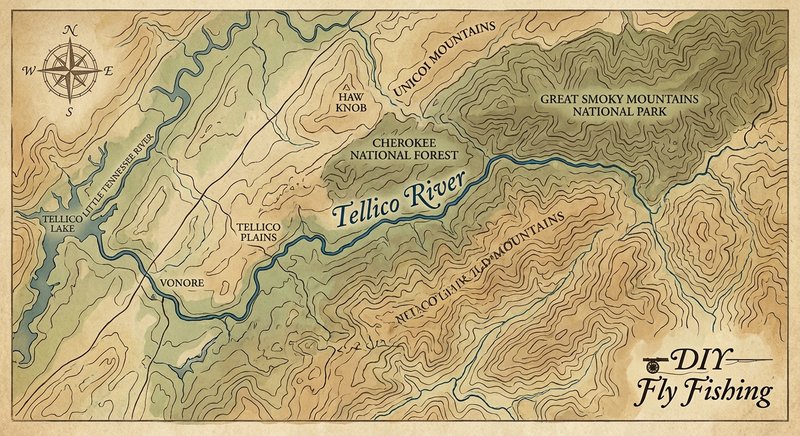
Tellico River
Fly fishing in Tennessee · Intermediate · Best seasons: Spring, Summer, Fall
Target Species
Rainbow Trout, Brown Trout
About This Water
Cherokee National Forest stream with wild trout. Scenic mountain fishing with good access.
Fishing Recommendations
The Tellico River is widely considered the "Crown Jewel" of fly fishing in the Cherokee National Forest of East Tennessee. Known for its rugged beauty, massive boulders, and high-gradient runs, it offers a classic Appalachian freestone experience that caters to both the casual angler and the technical specialist.
🎣 Location Overview
The Tellico River is a large, boulder-strewn freestone river that flows through Monroe County, TN. What makes it special is its accessibility and diversity. The River Road (FS 210) parallels the river for miles, offering easy access to high-quality water.
The river is characterized by "pocket water"—small, deep pools created by large rocks—as well as long, glassy runs and thundering waterfalls (like the famous Bald River Falls at the confluence). It is one of Tennessee’s most productive trout streams due to a combination of heavy state stocking and a healthy population of wild, holdover fish in its upper reaches and tributaries.
🐟 Target Species & Behavior
- Rainbow Trout: These are the primary residents. The lower sections are heavily stocked with "Tellico Slabs," but as you move higher or into the Delayed Harvest sections, you will find holdover fish that have become "river-wise." They typically hold in the oxygenated "bubbles" at the head of pools or in soft pockets behind boulders.
- Brown Trout: While less numerous than Rainbows, the Tellico holds some truly large, wild Browns. They are notoriously shy and light-sensitive. They prefer deep undercuts, dark shadows under overhanging rhododendrons, and the deepest crevices of large pools.
- Diet: The river has excellent aquatic insect life. They feed heavily on Stoneflies (Golden and Giant), Caddis, and Mayflies (Quill Gordons and March Browns). In late summer, terrestrials (ants/beetles) become the primary protein source.
📅 Best Times to Fish
- Spring (March – May): This is the prime window. The Quill Gordon and Hendrickson hatches in March/April bring fish to the surface. Water temperatures are ideal (50–55°F).
- Summer (June – August): Focus on the early morning (6 AM – 10 AM) and late evening. As temperatures rise, head above the Tellico Fish Hatchery or into higher-elevation tributaries like the North River, where the water stays cooler.
- Fall (September – November): This is many guides' favorite time. The Brown trout become aggressive pre-spawn, and the Delayed Harvest (DH) season begins on October 1st, flooding the river with fish and restricting the water to catch-and-release only.
- Optimal Conditions: Overcast days are far superior to bright sunny days on the Tellico, as the trout feel less exposed in the clear water.
🪰 Recommended Flies & Techniques
Top Fly Patterns
- Dry Flies:
- Yellow Stimulator (Size 12-16) – The "Tellico Classic." Mimics Stoneflies and looks like a hopper.
- Parachute Adams (Size 14-20) – The best general attractor.
- Elk Hair Caddis (Size 14-18) – Tan or Olive.
- Nymphs:
- The Tellico Nymph (Size 10-14) – A local pattern with a yellow body and peacock herl. A must-have.
- Pat’s Rubber Legs (Size 8-12) – Essential for high water.
- Pheasant Tail / Prince Nymph (Size 14-18).
- Streamers:
- Black or Olive Woolly Bugger (Size 6-10) – Swing these through deep holes for big Browns.
Effective Techniques
- The Dry-Dropper: This is the most effective way to fish the Tellico. Use a high-floating Stimulator as your "indicator" and hang a Pheasant Tail or Tellico Nymph 18-24 inches below it.
- Pocket Picking: Don't waste time casting into the middle of giant, still pools during the day. Target the "pockets" the size of a hula hoop behind rocks. High-stick your rod to keep your line off the conflicting currents.
- Stealth: The water is crystal clear. Keep a low profile and avoid "lining" the fish (casting your fly line directly over their heads).
💡 Pro Tips & Local Knowledge
- The Hatchery Boundary: Most people fish below the Tellico Fish Hatchery. If you want a more "wild" experience with fewer crowds, drive above the hatchery. The fish are smaller but wild and beautiful, and the scenery is spectacular.
- Fish the "Broken Water": On bright days, trout move into the riffles and broken water where the surface turbulence hides them from predators. Beginners often overlook this shallow, fast water—don't.
- The Tributaries: If the main stem is crowded, duck into the North River or Bald River. These are smaller, tighter "blue line" streams that require shorter rods (7'6" or 8') and stealthy approaches.
- The "Tellico Twitch": When fishing a dry fly in the slower tailouts, give it a tiny micro-twitch to mimic a struggling insect; this often triggers a strike from a wary holdover.
⚠️ Important Information
Regulations & Permits
- Tellico Daily Permit: This is the most important rule. In addition to a standard Tennessee Fishing License (with Trout focal), you MUST purchase a Daily Tellico River Fishing Permit (Type 098). It costs around $7 and is required for the main river and specific tributaries.
- Delayed Harvest (DH): From October 1 through the last day of February, the section from the mouth of Turkey Creek upstream to the River Road Bridge is Catch-and-Release ONLY, and only artificial lures/flies are allowed.
- Closed Days: Historically, the river was closed on Thursdays and Fridays for stocking. While this has changed in some areas, always check the current TWRA (Tennessee Wildlife Resources Agency) guide before your trip.
Safety Considerations
- Slippery Rocks: The Tellico is notorious for "greasy" rocks. Studded wading boots and a wading staff are highly recommended.
- Wildlife: This is black bear country. Keep food locked in your vehicle and be aware of your surroundings, especially when cleaning fish or eating lunch streamside.
- Cell Service: Expect zero cell service once you enter the river corridor. Download your maps for offline use beforehand.
Bug Hatches & Matching Flies
| Hatch | Type | Peak months | Time of day | Hook sizes | Matching flies |
|---|---|---|---|---|---|
| Quill Gordon Epeorus pleuralis | mayfly | March, April | Midday | #12-14 | Quill Gordon Dry #12-14, Quill Gordon Wet #12-14 |
| Blue Winged Olive Baetis | mayfly | February, March, October, November | Midday/Afternoon | #18-22 | Parachute Adams #18-22, Pheasant Tail #18-20 |
| Yellow Sally Isoperla | stonefly | May, June, July | Late Afternoon/Evening | #14-16 | Yellow Sally Stone #14-16, Tellico Nymph #12-16 |
| March Brown Maccaffertium vicarium | mayfly | April, May | Afternoon | #10-14 | March Brown Dry #12-14, Gold Ribbed Hare's Ear #10-14 |
| Golden Stonefly Acroneuria | stonefly | May, June | Evening/Night | #6-10 | Kaufmann's Stone #6-10, Strolis Golden Stone #8-10 |
| Tan Caddis Hydropsyche | caddis | April, May, September | Evening | #14-18 | Elk Hair Caddis #14-18, LaFontaine's Deep Sparkle Pupa #14-16 |
| Light Cahill Stenacron interpunctatum | mayfly | June, July | Evening | #12-16 | Light Cahill Dry #12-16, Cream Variant #14-16 |
| Terrestrials (Ants & Beetles) Formicidae / Coleoptera | terrestrial | July, August, September | All Day | #12-18 | Chernobyl Ant #10-14, Black Foam Beetle #14-18 |
| Giant Black Stonefly Pteronarcys dorsata | stonefly | March, April | Evening | #4-8 | Tellico Nymph #6-12, Girdled Bug #4-10 |