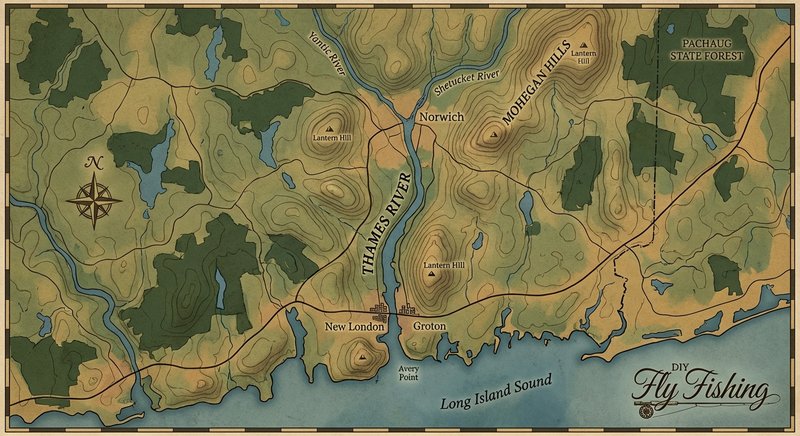
Thames River
Fly fishing in Connecticut · Intermediate · Best seasons: Spring, Summer, Fall
Target Species
Striped Bass, Bluefish, White Perch
About This Water
New London County estuary with striped bass. Near submarine base.
Fishing Recommendations
The Thames River in Eastern Connecticut is one of the most unique fly fishing destinations in the Northeast. Unlike many "rivers," the Thames is actually a short, broad tidal estuary (approximately 15 miles long) formed by the confluence of the Yantic and Shetucket Rivers in Norwich, flowing south into Long Island Sound between New London and Groton.
Because it is deep, brackish, and heavily influenced by the tide, it offers a "big water" experience that holds fish year-round.
🎣 Location Overview
The Thames is a powerhouse of productivity. It features a deep-dredged shipping channel (maintained for the U.S. Navy submarine base) flanked by shallow flats, industrial piers, and rocky shorelines.
What makes it special for fly anglers is the diversity of structure. You can be casting to a rock pile in 3 feet of water one moment and swinging a heavy sink-tip over a 40-foot drop-off the next. It is also famous for its "holdover" population, meaning Striped Bass stay in the river all winter, providing one of the earliest spring fisheries in New England.
🐟 Target Species & Behavior
Striped Bass
- Behavior: In the spring, "holdover" fish wake up in the upper river (Norwich/Montville) while large migratory "cows" enter the mouth in May/June.
- Holdings: Look for bass around bridge pilings (Gold Star Bridge), the edges of the shipping channel, and near the "warm water" discharges if operational. They love "shadow lines" created by industrial lights at night.
- Feed: Atlantic Menhaden (Bunker), Silversides, River Herring (in spring), and Crabs.
Bluefish
- Behavior: These "yellow-eyed devils" arrive in late June and stay through October. They are aggressive, fast-moving, and often found in the lower river (New London to the Mouth).
- Holdings: Look for surface "blitzes" where birds are diving. They often trap bait against the steep channel edges.
- Feed: Anything that moves. They favor Bunker and Squid.
White Perch
- Behavior: Often overlooked but a blast on a 4-weight fly rod. They school heavily in the brackish upper reaches.
- Holdings: Deep holes in the Norwich Harbor area and around the mouths of small freshwater tributaries.
- Feed: Grass shrimp, small minnows, and seaworms.
📅 Best Times to Fish
- Spring (April – June): This is the prime window for the River Herring run. Large bass follow the herring up-river toward Norwich. April is great for schoolies; June is best for trophy-sized fish.
- Summer (July – August): Daytime fishing slows down in the heat. Transition to night fishing or low-light periods (dawn/dusk). This is peak time for Bluefish in the lower harbor.
- Fall (September – November): The "Fall Blitz." Baitfish move out of the marshes and head toward the Sound. Expect aggressive feeding throughout the day as fish fatten up for migration.
- Optimal Window: The outgoing tide is generally preferred, especially in the upper river, as it flushes bait out of the creeks and into the main channel.
🪰 Recommended Flies & Techniques
Top Fly Patterns
- For Stripers:
- Chartreuse/White Clouser Minnow: The gold standard. Gets deep quickly.
- Hollow Fledglings/Bob's Banger: Great for imitating large bunker.
- Gurglers: High-floating foam flies for exciting topwater action at dawn.
- For Bluefish:
- Large Deceivers: Use cheap materials; they will get shredded.
- Poppers: Anything loud and splashy.
- For White Perch:
- Size 6-10 Grass Shrimp patterns: Translucent pink or tan.
- Small Woolly Buggers: In white or silver.
Techniques & Presentation
- The "Thames Countdown": Because the river is deep, you often need an intermediate or fast-sinking line (Type 3 or 5). Cast across the current, let the fly sink for 10–15 seconds, and use a "strip-strip-pause" retrieve.
- Structure Casting: Target the bridge pilings of the I-95 Gold Star Bridge. The eddies created by these pilings are prime ambush spots.
- Light Tackle Perch: Use a 4wt or 5wt rod with a sink-tip line and a slow, short strip near the bottom in Norwich Harbor.
💡 Pro Tips & Local Knowledge
- The "Sub Base" Factor: The U.S. Naval Submarine Base is located on the Groton side. Do not get too close. There are marked security zones that are strictly enforced by armed patrols. Stay well away from any Navy vessels and floating barriers.
- Night Fishing Lights: Many of the industrial piers in New London and Groton have bright lights that shine on the water. These act as "chum lines," attracting bait and bass. Stealthy approaches here can be incredibly productive.
- Norwich Harbor: If you are fishing in early spring, start as far north as you can go in Norwich. The water warms up faster here, and the fish are concentrated.
- The Mouth: For Bluefish and large migratory Stripers, focus on the area between Ledge Light and Fort Trumbull. The current here is very strong; ensure your boat or wading position is secure.
⚠️ Important Information
Access
- Boat: The best way to fish the Thames. Excellent ramps are located at Stoddard Hill State Park (Ledyard) and Fort Trumbull State Park (New London).
- Shore: Limited but available at Fort Trumbull, Stoddard Hill, and the Norwich Harbor walkway.
Regulations
- License: You need a Connecticut Marine Waters Fishing License.
- Striped Bass: CT follows Atlantic States Marine Fisheries Commission (ASMFC) "Slot Limits." Currently, it is usually 1 fish between 28" and 31" (check current year DEEP regulations for updates). Circle hooks are required when using bait, but not for flies.
Safety
- Commercial Traffic: The Thames is a working river. Watch out for ferries, tugboats, and submarines. They have the right of way and create massive wakes.
- Tidal Current: The current near the I-95 bridge can be treacherous for small kayaks. Always check the tide charts and wind direction (a south wind against an outgoing tide creates "square waves").
Bug Hatches & Matching Flies
| Hatch | Type | Peak months | Time of day | Hook sizes | Matching flies |
|---|---|---|---|---|---|
| Blue-Winged Olive Baetis spp. | mayfly | April, May, September, October | Mid-day to Afternoon | #18-22 | BWO Sparkle Dun #18-20, Pheasant Tail Nymph #18-22, RS2 #20-22 |
| Grannom Caddis Brachycentrus | caddis | April, May | Morning/Late Afternoon | #12-16 | Elk Hair Caddis (Olive) #14-16, Pupa-Zilla #14-16, Peacock Caddis #12-14 |
| Hendrickson Ephemerella subvaria | mayfly | April, May | Afternoon | #12-14 | Red Quill #12-14, Hendrickson Emerger #12-14, Gold Ribbed Hare's Ear #12-14 |
| Common Net-Spinner Caddis Hydropsyche | caddis | June, July, August | Evening | #14-18 | Tan Elk Hair Caddis #14-18, LaFontaine's Deep Sparkle Pupa #14-16, Hydropsyche Larva #14-18 |
| Light Cahill Stenonema/Stenacron | mayfly | June, July | Evening | #12-14 | Light Cahill Dry #12-14, Cream Usual #14, Gold Ribbed Hare's Ear (Light) #12-14 |
| Little Winter Stonefly Taeniopteryx/Allocapnia | stonefly | February, March | Mid-day | #16-20 | Black Stonefly Nymph #16-18, Griffith's Gnat #18-20, Copper John (Black) #18 |
| Zebra Midge Chironomidae | midge | January, February, March, December | All Day | #18-24 | Zebra Midge (Black/Silver) #18-22, Palomino Midge #20-24, Mercury Midge #20-22 |
| Terrestrials (Ants/Beetles) Formicidae/Coleoptera | terrestrial | July, August, September | All Day | #12-18 | Black Foam Ant #14-18, Chernobyl Ant #10-14, Crowe Beetle #14-16 |
| Slate Drake Isonychia bicolor | mayfly | June, September | Late Afternoon/Evening | #10-14 | Isonychia Nymph #10-12, Parachute Adams #12-14, Iso Emerger #12-14 |