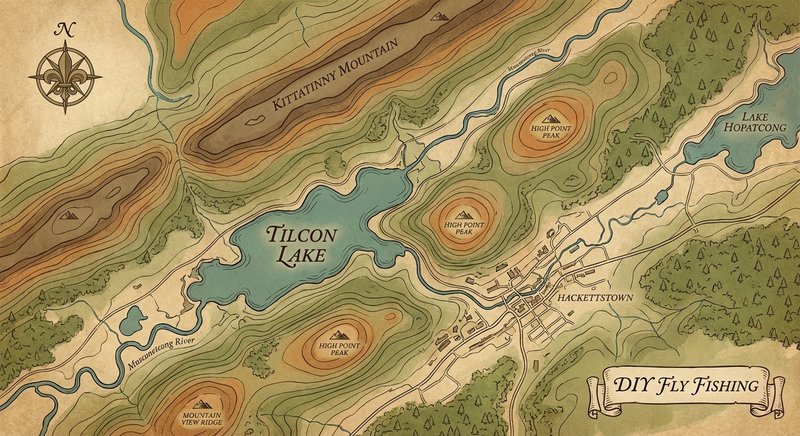
Tilcon Lake
Fly fishing in New Jersey · intermediate · Best seasons: spring, fall, winter
Target Species
Brown Trout, Rainbow Trout
About This Water
Morris County lake with trophy brown trout potential. Deep, clear water supports large fish.
Fishing Recommendations
Welcome to the guide, angler. As an expert in New Jersey’s hidden gems, I can tell you that Tilcon Lake is one of the most unique stillwater fly fishing opportunities in the Garden State. Located within Allamuchy Mountain State Park, this isn't your typical shallow NJ pond.
Tilcon is a former sand and gravel quarry, which gives it characteristics more akin to a glacial lake than a mid-Atlantic reservoir. Here is the breakdown for tackling this deep, clear, and rewarding fishery.
🎣 Location Overview
Tilcon Lake is a 40-acre "Trophy Trout Lake" nestled in the Highlands region. What makes it special is its depth and clarity. Reaching depths of over 40 feet, it stays much cooler than neighboring bodies of water, allowing trout to survive longer into the season.
The water is remarkably clear, often providing 10–15 feet of visibility. Because it is spring-fed and connected to the Musconetcong River system via a small channel, it maintains high dissolved oxygen levels. Anglers love it because it offers a "big water" feel where you can use legitimate stillwater techniques that are usually reserved for the Western US or the UK.
🐟 Target Species & Behavior
The NJ Division of Fish & Wildlife stocks Tilcon heavily with:
- Rainbow Trout: These are your primary targets. They tend to cruise the upper 5–10 feet of the water column during the "shoulder" seasons. They are opportunistic and will often school up near the inflow or along the steep eastern banks.
- Brown Trout: The "wild cards." Tilcon holds some holdover Browns that grow large by feeding on the abundant landlocked alewives (small baitfish). Browns here are notorious for sitting deep along the quarry shelves and coming shallow only during low-light hours or heavy overcast days.
Behavior: Unlike river trout, these fish are "cruisers." They move in circular patterns along the depth contours. If you see a fish rise, it is likely moving; don't cast where it was, cast where it is going.
📅 Best Times to Fish
- Optimal Seasons:
- Spring (April – Early June): The prime window. Fish are high in the water column and aggressive post-stocking.
- Fall (October – November): As water temperatures drop, trout move from the deep "cool zones" back to the shorelines to feed before winter.
- Winter: If the lake isn't frozen, mid-day sun can warm the surface just enough to trigger a midge hatch.
- Best Times of Day:
- First Light & Last Light: Absolutely critical due to the water clarity. In bright sun, the fish retreat to the depths where they are hard to reach with a fly line.
- Overcast/Rainy Days: These are the best days for streamers. The cloud cover gives the trout a sense of security to hunt near the surface.
🪰 Recommended Flies & Techniques
Top Fly Patterns
- Streamers:
- Woolly Buggers (Size 8-12) in Olive, Black, or White (to mimic alewives).
- Zonkers or Muddler Minnows to imitate small baitfish.
- Nymphs/Larvae:
- Zebra Midges (Size 18-22) in Red or Black.
- Scud Patterns (Size 14-16) in Pink or Olive (the lake has a high crustacean population).
- Pheasant Tails (Size 16-18).
- Dry Flies:
- Griffith’s Gnat (Size 20-22) for midge clusters.
- Ants and Beetles (Size 14-16) in late Spring/early Fall near the wooded banks.
Techniques
- The "Slow Strip": Using an intermediate (slow-sink) line, cast a Woolly Bugger toward the shoreline and retrieve it with very slow, 3-inch pulls.
- Static Nymphing: Using a long leader (12–15 feet) and a small indicator, hang a Zebra Midge 4–8 feet deep. This is deadly when the water is calm.
- The "Hang": When stripping streamers, pause for 5 seconds when the fly is right near the bank or the boat. Trout often follow the fly from the deep and strike during the pause.
💡 Pro Tips & Local Knowledge
- The "Canal" Connection: Focus your attention on the western end where the lake connects to the Musconetcong River. There is often a slight movement of water here that concentrates food and fish.
- Stealth and Leader Length: Because the water is so clear, a standard 9-foot leader is often too short. Step up to a 12-foot fluorocarbon leader tapering to 5X or 6X. Fluorocarbon is essential here as it disappears in the clear water.
- The Quarry Shelves: The lake bottom drops off in "steps." If you aren't getting bites, you are likely fishing over the top of the fish. Use a Type 3 or Type 5 sinking line to get your flies down to the 10–15 foot shelves.
- Vessel Advantage: While shore fishing is possible, a kayak, canoe, or float tube is a massive advantage at Tilcon. It allows you to fish the steep eastern cliffs that are inaccessible by foot.
⚠️ Important Information
- Access: Access is via the Allamuchy Mountain State Park parking lots off Waterloo Road. Expect a short walk to the water’s edge.
- Regulations: Tilcon Lake is managed under Trophy Trout Lake regulations.
- Minimum Size: 15 inches.
- Daily Creel Limit: 2 fish.
- Check the current NJ Fish & Wildlife Digest for specific season opening/closing dates, as these can change.
- Safety: The banks can be very steep and slippery. If you are wading, be extremely careful; one step can take you from ankle-deep to ten feet deep instantly. A personal flotation device (PFD) is highly recommended even for shore anglers.
Tight lines, and enjoy the solitude of one of New Jersey's finest trout waters!
Bug Hatches & Matching Flies
| Hatch | Type | Peak months | Time of day | Hook sizes | Matching flies |
|---|---|---|---|---|---|
| Midges Chironomidae | midge | March, April, October, November | All Day | #18-24 | Zebra Midge #18-22, Griffith's Gnat #20-24, Palomino Midge #20-22 |
| Speckled Duns Callibaetis | mayfly | May, June, September | Morning | #14-16 | Callibaetis Spinner #14-16, Hare's Ear Nymph #14-16, Parachute Adams #14-18 |
| Spotted Sedge Hydropsyche | caddis | May, June, July | Evening | #14-18 | Elk Hair Caddis #14-16, LaFontaine's Deep Sparkle Pupa #16-18 |
| White Miller Caenis | mayfly | July, August | Dawn/Dusk | #20-24 | Caenis Spinner #22-24, RS2 #20-22 |
| Tricos Tricorythodes | mayfly | July, August, September | Morning | #20-24 | Trico Spinner #20-24, Pheasant Tail Nymph #20-22 |
| Black Ants Formicidae | terrestrial | July, August, September | Afternoon | #16-20 | Cinnamon Ant #16-18, Black Foam Ant #16-20 |
| Japanese Beetles Popillia japonica | terrestrial | July, August | Afternoon | #12-14 | Foam Beetle #12-14, Japanese Beetle #12 |
| Blue-Winged Olive Baetis | mayfly | April, October | Afternoon | #18-22 | BWO Sparkle Dun #18-20, WD-40 #18-22 |