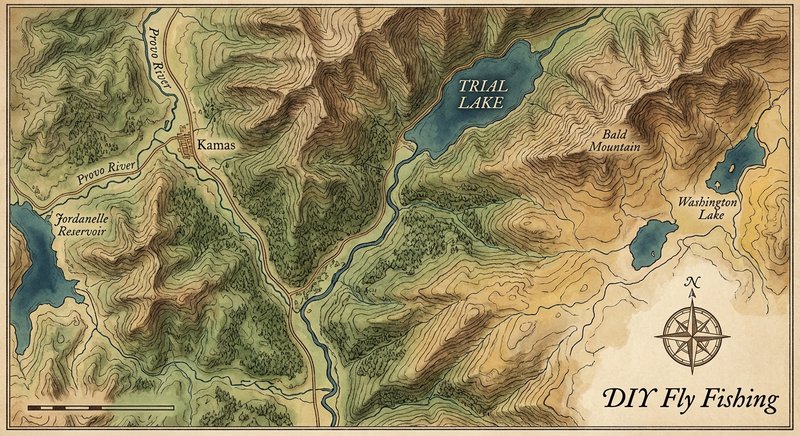
Trial Lake
Fly fishing in Utah · Beginner · Best seasons: Summer, Fall
Target Species
Brook Trout, Rainbow Trout
About This Water
High Uinta lake with excellent brook trout. Popular Mirror Lake Highway destination.
Fishing Recommendations
Welcome to the High Uintas. As your guide, I’m excited to break down Trial Lake, one of the crown jewels of the Mirror Lake Highway. At an elevation of approximately 9,500 feet, this is classic alpine fly fishing: crystal-clear water, thin air, and hungry trout.
Here is your comprehensive guide to fly fishing Trial Lake.
🎣 Location Overview
Trial Lake is a high-elevation reservoir located in the Wasatch-Cache National Forest, about 60 miles east of Salt Lake City. What makes Trial special is its accessibility paired with its staggering beauty. Sitting at the base of Bald Mountain, the scenery is quintessential Utah alpine—pine forests, granite boulders, and wildflower meadows.
The water is remarkably clear, and while it is a popular spot for campers, the lake is large enough that a fly angler can usually find a quiet corner. It is a "managed" fishery, meaning the Utah DWR stocks it regularly, but it also maintains a healthy population of resident brook trout that thrive in the cold, oxygen-rich environment.
🐟 Target Species & Behavior
- Rainbow Trout: These are the primary residents. The DWR stocks them frequently throughout the summer. They tend to cruise the upper water column and are very opportunistic. Look for them "dimpling" the surface during midge hatches.
- Brook Trout: The prize of the Uintas. These fish are more structure-oriented. They hold near the submerged boulders, fallen timber, and the rocky areas near the dam. In the fall, they become aggressively territorial and display brilliant orange bellies.
- Behavior: Because the growing season is short at 9,500 feet, these fish are generally not picky. However, they are easily spooked by heavy footfalls on the bank or thick fly lines landing over their heads.
📅 Best Times to Fish
- The Summer Window (July – August): This is the prime season. The ice usually clears by late June. During these months, the "afternoon monsoon" is common—expect a brief thunderstorm around 2:00 PM. The fishing immediately following these storms can be electric as insects are washed into the lake.
- The Fall Transition (September – early October): This is my favorite time. The crowds vanish, and the Brook Trout move into the shallows to prepare for spawning. The air is crisp, and the fish are eager to bulk up before the lake freezes.
- Prime Windows:
- Morning (6:00 AM – 10:00 AM): Glassy water and active midge hatches.
- Evening (6:00 PM – Dusk): The "Evening Rise" at Trial Lake is famous. The water can look like it's raining because so many fish are rising.
🪰 Recommended Flies & Techniques
Top Patterns
- Dry Flies:
- Parachute Adams (Size 14-18): The gold standard.
- Griffith’s Gnat (Size 18-22): Essential for the midge clusters.
- Black Ants or Foam Beetles (Size 14-16): Deadly in August when wind blows terrestrials off the trees.
- Nymphs/Sub-surface:
- Zebra Midge (Black or Red, Size 18-22): Best under a small indicator.
- Olive Scud (Size 16-18): The Uintas are full of freshwater shrimp (scuds).
- Hare's Ear Nymph (Size 16): A great generalist.
- Streamers:
- Pine Squirrel Leech (Black or Olive): The most effective way to hunt larger Brookies.
- Woolly Bugger (Size 10-12): Thin mint or white/silver to mimic small baitfish.
Techniques
- The Dry-Dropper: Use a high-visibility dry (like a Chubby Chernobyl or a Stimulator) and hang a small Zebra Midge 18 inches below it. This covers two zones of the water column.
- The "Slow Strip": If using a leech or streamer, cast near the rock ledges and use very slow, 2-inch strips. Alpine trout often prefer a slow "crawl" over a fast darting motion.
- Long Leaders: Because the water is gin-clear, use a 9-foot or 12-foot 5X tapered leader to avoid lining the fish.
💡 Pro Tips & Local Knowledge
- Focus on the Inlets: There are small trickles of water that enter the lake on the north and west sides. These inlets bring in cooler, highly oxygenated water and a conveyor belt of food.
- The "Drop-off": Trial Lake has a shelf that stays shallow for about 10–15 feet before dropping into deep blue water. Fish love to patrol right along this edge. Don't stand right on the edge; stay back and cast to the shelf first.
- Bring a Float Tube: If you can, get off the bank. A float tube or kayak allows you to reach the far western shore, which receives much less fishing pressure than the side near the road.
- Watch the Wind: If the wind is blowing toward a specific bank, fish that bank. The wind pushes the "smorgasbord" of surface insects toward that shore, and the trout follow.
⚠️ Important Information
- Access: Trial Lake is located off UT-150 (Mirror Lake Highway). You must purchase a Forest Service Recreation Pass (available at the entrance station or various self-pay kiosks along the highway).
- Regulations: A valid Utah Fishing License is required. Trial Lake falls under general statewide regulations (usually a 4-trout limit), but always check the current Utah Fishing Guidebook for any emergency closures or rule changes.
- Weather Safety: Lightning is a serious threat in the Uintas. If you hear thunder or your graphite rod starts "buzzing," get off the water immediately.
- Altitude: You are at 9,500+ feet. Drink twice as much water as you think you need and wear high-SPF sunscreen; the UV rays are much stronger here.
Guide’s Final Word: Trial Lake is the perfect place to introduce someone to fly fishing or to spend a meditative evening catching beautiful Brookies against a sunset backdrop. Keep your shadow off the water, and you'll have a banner day. Tight lines!
Bug Hatches & Matching Flies
| Hatch | Type | Peak months | Time of day | Hook sizes | Matching flies |
|---|---|---|---|---|---|
| Callibaetis (Speckled Dun) Callibaetis americanus | mayfly | July, August, September | Morning/Afternoon | #12-16 | Parachute Adams #14-16, Callibaetis Spinner #14-16, Hare's Ear Nymph #12-16 |
| Chironomids (Midges) Chironomidae | midge | June, July, August | All Day | #18-24 | Zebra Midge #18-22, Griffith's Gnat #18-22, Ice Midge #20-24 |
| Black Carpenter Ants Camponotus | terrestrial | July, August | Afternoon | #12-16 | Black Foam Ant #12-16, Chernobyl Ant #10-14 |
| Traveling Sedge Hesperophylax | caddis | July, August | Evening | #10-14 | Elk Hair Caddis #10-14, Goddard Caddis #12-14 |
| Spotted Sedge Hydropsyche | caddis | July, August | Evening/Night | #14-18 | Tan Elk Hair Caddis #14-18, Sparkle Pupa #16-18 |
| Mountain Grasshoppers Melanoplus | terrestrial | August, September | Afternoon | #8-12 | Dave's Hopper #10-12, Parachute Hopper #12 |
| Trico Tricorythodes | mayfly | August, September | Morning | #20-24 | Trico Spinner #20-24, RS2 #20-22 |
| Terrestrial Beetles Coleoptera | terrestrial | July, August | Afternoon | #14-18 | Foam Beetle #14-18, Peacock Beetle #16 |