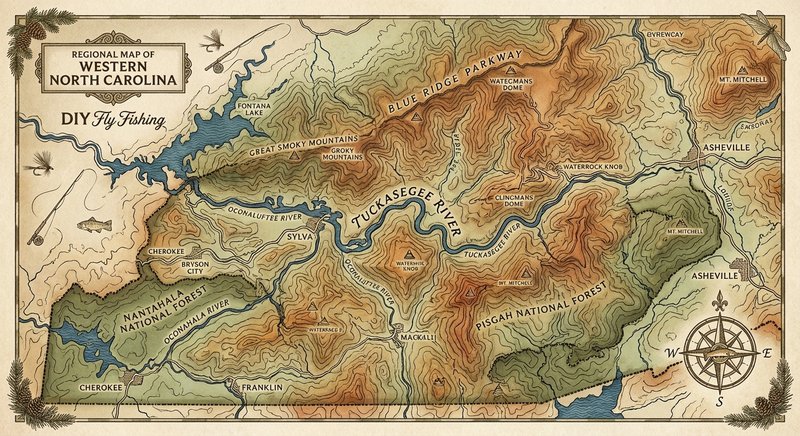
Tuckasegee River
Fly fishing in North Carolina · Beginner · Best seasons: Spring, Fall, Winter
Target Species
Brown Trout, Rainbow Trout
About This Water
Delayed harvest waters near Dillsboro with excellent access. Good winter fishing.
Fishing Recommendations
Welcome to the "Tuck," one of the most productive and beloved fly fishing destinations in the Southeast. As a guide in Western North Carolina, I can tell you that the Tuckasegee River is a crown jewel, specifically the section known as the "Delayed Harvest" (DH) reach. It is famous for its high fish counts, accessibility, and the sheer size of the trout that call these waters home.
🎣 Location Overview
The Tuckasegee River, flowing through Jackson County, is a large, freestone-style tailwater. What makes it special is its versatility; it is one of the widest rivers in the region, making it a "big water" experience that allows for long casts and ample room for wading.
The most famous stretch is the Delayed Harvest section between Dillsboro and Sylva. This 5.5-mile stretch is stocked with nearly 50,000 trout annually, resulting in incredible catch rates. The riverbed is characterized by a mix of large boulders, cobblestone runs, and deep ledge pools. Because it is fed by bottom-release dams upstream (East and West Fork), the water stays cooler longer into the summer and stays warmer in the dead of winter than smaller mountain creeks.
🐟 Target Species & Behavior
- Rainbow Trout: These are the "acrobats" of the Tuck. They tend to hold in faster, oxygenated water—heads of riffles and the "bubble line." They are aggressive feeders and will often move several feet to intercept a fly.
- Brown Trout: The "kings" of the river. Large Browns (20+ inches) are common here. They are more calculated and light-sensitive, often holding in deeper pools or hugging the shadows of large boulders and undercut banks.
- Brook Trout: While you mentioned Browns and Rainbows, the NC Wildlife Resources Commission also stocks thousands of "Brookies" in the DH section. They are generally less cautious and provide great action on dry flies.
Behavior Note: Because of the heavy stocking, these fish are competitive. However, as the season progresses, they become "educated" to standard patterns, requiring more technical presentations.
📅 Best Times to Fish
- Spring (March – May): This is the prime window. The DH season is in full swing, water temperatures are rising into the 50s, and the bugs are moving. April is arguably the best month for dry fly action.
- Fall (October – November): The "Fall Stocking" occurs in early October. This is a favorite for many because of the beautiful foliage and the aggressive nature of Brown Trout preparing to spawn.
- Winter (December – February): Unlike many other rivers, the Tuck fishes exceptionally well in winter. Midges and small nymphs are the ticket. On sunny winter afternoons, you can often find a surprising dry fly bite.
- Time of Day: In the spring/fall, 10:00 AM to 4:00 PM is the "Golden Window" when water temps peak. In the heat of early summer, go early or late.
🪰 Recommended Flies & Techniques
Top Fly Patterns
- Nymphs: Sexy Walt’s Worm (size 12-16), Frenchie (size 14-18), Girdle Bug/Pat’s Rubber Legs (Black/Coffee, size 8-12), and Squirmy Wormies (Red/Pink) for high-water days.
- Dry Flies: Parachute Adams (size 14-18), Elk Hair Caddis (size 14-16), and Yellow Stimulators (during the Mayfly hatches).
- Streamers: Black or Olive Wooly Buggers, and Sparkle Minnows. The Tuck is a world-class streamer river during high water or overcast days.
Effective Techniques
- High-Stick Nymphing: Given the many ledge lines, a tight-line (Euro) or high-stick nymphing approach is lethal here to avoid complex cross-currents.
- Indy Rigging: Using a strike indicator is the most popular method. Fish a "heavy" lead fly (like a Girdle Bug) to get down fast, with a smaller dropper (like a Pheasant Tail) 18 inches behind it.
- The "Swing": At the end of your drift, let your nymphs swing up to the surface. Rainbows often strike at the moment the fly begins to rise.
💡 Pro Tips & Local Knowledge
- Watch the Gauges: The Tuck is a tailwater. You must check the Duke Energy release schedule for the "Tuckasegee - East Fork" and "West Fork." If they are pulling both turbines, the river becomes dangerous to wade and is strictly a drift-boat game.
- The "S" Turns: The section of the river near the Webster bridge (The S-Turns) offers some of the best ledge-line fishing. Focus on the "seams" where fast water meets slow water.
- Size Matters: If the fishing is slow, go smaller. Dropping down to a size 20 Zebra Midge on 6X fluorocarbon tippet often turns a slow day into a "fish every cast" day.
- The Hatch: Look for the Grannom Caddis in April. It can create a feeding frenzy that makes the water look like it’s boiling.
⚠️ Important Information
- Regulations: The Delayed Harvest (DH) section is Catch & Release only (single hook, artificial lures only) from October 1st until the first Saturday in June. After that, it opens to harvest. Always carry a valid NC Fishing License with a Trout "privilege."
- Access: There are several excellent public access points along North River Road between Sylva and Dillsboro. The "Delayed Harvest" signs are clearly posted along the highway.
- Safety: The Tuck is a big river. The rocks are incredibly slick. Studded wading boots and a wading staff are highly recommended. If you see the water level start to rise or see floating debris increase, exit the river immediately—the dam release has reached you.
Tight lines, and enjoy your time on the Tuck! It’s a special place that truly represents the best of Southern Appalachian fly fishing.
Bug Hatches & Matching Flies
| Hatch | Type | Peak months | Time of day | Hook sizes | Matching flies |
|---|---|---|---|---|---|
| Blue Winged Olive Baetis / Pseudocloeon | mayfly | March, April, October, November | Late Morning/Afternoon | #18-22 | RS2 #18-22, Parachute Adams #18-20, Pheasant Tail Nymph #18-20 |
| Quill Gordon Epeorus pleuralis | mayfly | March, April | Midday | #12-14 | Quill Gordon #12-14, Iron Blue Dun #12-14, Gold Ribbed Hare's Ear #12-14 |
| Hendrickson Ephemerella subvaria | mayfly | April, May | Afternoon | #12-14 | Hendrickson Pink Lady #12-14, Red Quill #14, Pheasant Tail #12-14 |
| Golden Stonefly Acroneuria lycorias | stonefly | May, June, July | Morning/Evening | #6-10 | Pats Rubber Legs #6-10, Stimulator (Yellow) #8-12, Golden Stone Nymph #8-10 |
| Grannom Caddis Brachycentrus | caddis | April, May | All Day | #14-16 | Elk Hair Caddis #14-16, Holy Grail #14-16, Peacock Caddis #14-16 |
| Yellow Sally Isoperla | stonefly | May, June, July | Late Afternoon/Evening | #14-16 | Yellow Sally Stone #14-16, Little Yellow Sloan #14-16, Yellow Stimulator #14-16 |
| Midges Chironomidae | midge | December, January, February | Midday | #18-24 | Zebra Midge #18-22, Griffith's Gnat #18-22, Mercury Midge #20-22 |
| Light Cahill Stenonema / Stenacron | mayfly | June, July, August | Evening | #12-16 | Light Cahill #12-16, Cream Variant #14, Hare's Ear (Light) #14-16 |
| Cinnamon Caddis Hydropsyche | caddis | August, September, October | Evening | #14-18 | Cinnamon Elk Hair Caddis #14-16, Soft Hackle Hare's Ear #14-18, Pupa (Tan) #16 |