Uinta River
Fly fishing in Utah · Intermediate · Best seasons: Summer, Fall
Target Species
Cutthroat Trout, Brook Trout
About This Water
High Uinta wilderness stream. Native Colorado River cutthroat in headwaters.
Fishing Recommendations
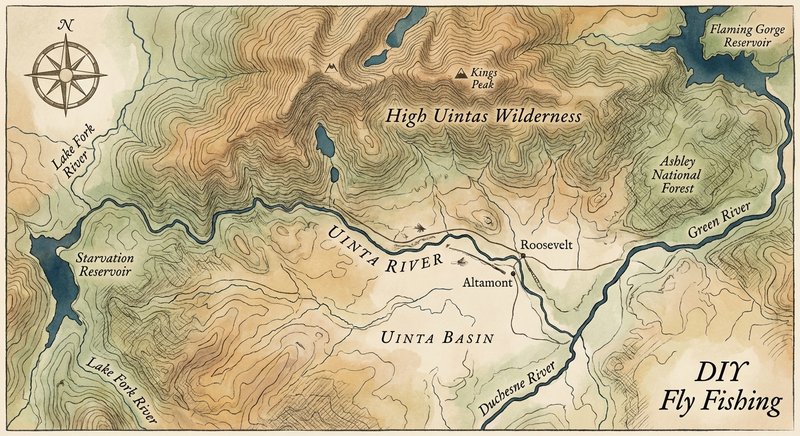
The Uinta River, located on the southern slope of the massive Uinta Mountain Range in northeastern Utah, is a quintessential "high country" freestone stream. Unlike the tailwaters of the Green or the Provo, the Uinta is rugged, remote, and governed entirely by the seasons and snowpack.
As your guide, I’m taking you to a place where the air is thin, the water is gin-clear, and the trout are as wild as the landscape.
🎣 Location Overview
The Uinta River is one of the primary drainages of the High Uintas Wilderness. What makes this water special is its transition from high alpine tundra and boulder-choked canyons to lush meadows.
The river is characterized by "pocket water"—small pockets of calm water created by granite boulders—interspersed with deep, emerald pools and long riffles. It is a high-gradient stream in its upper reaches, meaning the water moves fast. Anglers love it because it offers a true wilderness experience; once you hike a mile or two from the trailhead, you are likely to have miles of world-class trout water entirely to yourself.
🐟 Target Species & Behavior
The Uinta River is a stronghold for native and wild trout.
- Colorado River Cutthroat Trout: These are the gems of the Uintas. They are opportunistic feeders due to the short growing season. Look for them in the "cushion" of water just in front of large boulders or in the slow-moving tails of deep pools.
- Brook Trout: Found in high densities, especially as you move higher into the drainage and its tributaries. They are aggressive and highly competitive. They tend to hold tight to undercut banks and woody debris.
- Behavior: Because the water is nutrient-poor, these fish cannot afford to be picky. However, because the water is exceptionally clear, they are very "spooky." If they see your shadow or a splashy line, the pool is finished for the next hour.
📅 Best Times to Fish
Optimal Seasons
- Summer (July – August): This is the prime window. Runoff in the Uintas can last well into late June. Once the flow stabilizes in July, the dry fly fishing is legendary.
- Fall (September – Early October): My personal favorite. The Brook Trout take on incredible spawning colors (fire-orange bellies), and the Cutthroats become more aggressive before the winter freeze. The cottonwoods and aspens turning gold provide a spectacular backdrop.
Prime Windows
- Time of Day: In the high country, there is no need for an alpine start. The water is cold. Fishing usually picks up around 10:00 AM as the sun hits the water and bugs start moving, and remains excellent until 4:00 PM.
- Conditions: Overcast days are rare but can trigger massive hatches. However, clear, blue-bird days are the norm.
🪰 Recommended Flies & Techniques
Top Fly Patterns
- Attractor Dries: Royal Wulff (#14-16), Humpy (Red or Yellow, #14-16), Stimulator (Orange or Yellow, #12-16).
- Terrestrials: Fat Albert (#10-14), Panty Dropper Hopper (#12), Cinnamon Ants (#16-18), Beetles (#16).
- Nymphs: Prince Nymph (#14-16), Pheasant Tail (flashy versions, #16-18), Zebra Midge (Red, #18-20).
- Streamers: Small Wooly Buggers (Olive or Black, #10-12) for the deeper canyon holes.
Techniques & Presentation
- The Dry-Dropper: This is the most effective way to fish the Uinta. Run a buoyant foam hopper or a Stimulator on top with a 20-inch dropper to a flashy nymph (like a Prince Nymph).
- High-Sticking: Because of the complex currents around boulders, keep as much fly line off the water as possible. Use a short, accurate cast.
- Stealth: Approach pools from downstream (fishing "up") and stay low. Kneeling on the bank can often be the difference between a hookup and a spooked fish.
💡 Pro Tips & Local Knowledge
- The "Bucket" Theory: In pocket water, look for the "bucket"—the deeper, dark spot behind a boulder. Don't just cast into it; cast six inches above it and let the fly drift naturally into the zone.
- Cover Ground: Don't spend 30 minutes in one hole. These fish are opportunistic; if they are there and hungry, they will usually hit within the first five clean drifts. If not, move 20 yards upstream to the next pocket.
- Gear Selection: A 3-weight or 4-weight rod (7'6" to 8'6") is perfect. You don't need long casts, but you do need accuracy and a delicate touch. Use 5X tippet; these fish aren't usually line-shy, but the clarity of the water demands a thinner diameter.
⚠️ Important Information
Access & Permits
- Ute Tribal Lands: CRITICAL. The lower sections of the Uinta River flow through the Uintah and Ouray Indian Reservation. A State of Utah fishing license is NOT valid here. You must purchase a specific Ute Tribal Fishing Permit.
- National Forest/Wilderness: Once you cross the boundary into the Ashley National Forest and the High Uintas Wilderness, a standard Utah State Fishing License is required.
- Trailheads: The most popular access point is the Uinta River Trailhead at the end of Forest Service Road 117 (past Neola, UT).
Regulations
- Always check the current Utah Fishing Guidebook for specific limit changes.
- Catch and Release is highly encouraged for native Colorado River Cutthroats to preserve the genetic integrity of the drainage.
Safety
- Bears: This is Black Bear country. Carry bear spray and store food properly.
- Weather: Afternoon thunderstorms are common and dangerous above the treeline. If you see clouds building, start heading down.
- Elevation: You will be fishing at 8,000 to 10,000+ feet. Stay hydrated to avoid altitude sickness.
Bug Hatches & Matching Flies
| Hatch | Type | Peak months | Time of day | Hook sizes | Matching flies |
|---|---|---|---|---|---|
| Blue Winged Olive Baetis tricaudatus | mayfly | April, May, September, October | Late Morning/Afternoon | #18-22 | RS2 #20-22, Parachute Adams #18-22, BWO CDC Emerger #20-22 |
| Pale Morning Dun Ephemerella excrucians | mayfly | July, August | Late Morning | #14-18 | PMD Sparkle Dun #16-18, Pheasant Tail #14-18, Quigley's PMD Hackle Stacker #16-18 |
| Golden Stonefly Hesperoperla pacifica | stonefly | June, July | All Day | #8-12 | Pat's Rubber Leg #8-12, Rogue River Stone #8-10, Chubby Chernobyl #10-12 |
| Yellow Sally Isoperla | stonefly | July, August | Afternoon/Evening | #14-16 | Yellow Sally Foam Dry #14-16, Iron Lotus (Yellow) #14-16 |
| Mother's Day Caddis Brachycentrus occidentalis | caddis | May, June | Afternoon | #14-16 | Peacock Caddis #14-16, Z-Wing Caddis #14-16 |
| Western Green Drake Drunella doddsii | mayfly | July | Mid-Day/Afternoon | #10-12 | Hairwing Green Drake #10-12, Green Drake Cripple #10-12 |
| Spotted Sedge Hydropsyche | caddis | July, August, September | Evening | #14-18 | Elk Hair Caddis #14-18, LaFontaine Sparkle Pupa #14-16, Bird's Nest #14-18 |
| Grasshoppers Orthoptera | terrestrial | August, September | Late Morning/Afternoon | #10-14 | Parachute Hopper #10-12, Morrish Hopper #12-14 |
| Black Ants Formicidae | terrestrial | July, August | All Day | #14-18 | Cinnamon Ant #16-18, Black Foam Ant #14-16 |
| Midges Chironomidae | midge | March, April, October, November | Morning/Late Afternoon | #20-24 | Zebra Midge #20-24, Griffith's Gnat #20-22 |