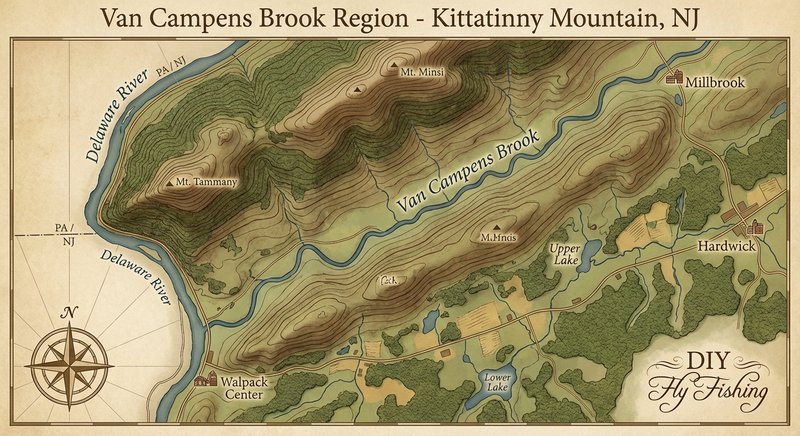
Van Campens Brook
Fly fishing in New Jersey · advanced · Best seasons: spring, fall
Target Species
Brook Trout, Brown Trout
About This Water
Delaware Water Gap tributary with wild brook trout. Small stream requires stealth and precision casting.
Fishing Recommendations
Welcome to one of New Jersey’s most pristine fly fishing gems. As a guide, I often tell clients that Van Campens Brook is the closest you can get to a wild Appalachian mountain stream experience without leaving the Garden State. Located within the Delaware Water Gap National Recreation Area, it offers a rugged, scenic, and technically rewarding experience for those who prefer stealth and wild fish over crowded banks.
🎣 Location Overview
Van Campens Brook is a high-gradient freestone stream that carves its way through a deep, hemlock-shaded ravine. It is widely considered one of the most beautiful streams in the state. Unlike many of New Jersey’s larger, siltier rivers, Van Campens is characterized by crystal-clear water, moss-covered boulders, plunge pools, and short, snappy riffles.
What makes it special is its wild character. While parts of the lower section receive some stocking, the majority of the brook is a dedicated "Wild Trout Stream." It stays significantly cooler than other NJ waters due to the heavy canopy and cold-water springs, making it a critical refuge for native species.
🐟 Target Species & Behavior
- Wild Brook Trout: Found predominantly in the upper reaches and the small feeder tributaries. These are NJ’s only native salmonid. They are vibrant, opportunistic, but incredibly "spooky."
- Wild Brown Trout: These dominate the middle and lower stretches. They are hardier and often larger than the brookies (though a 12-inch fish here is a trophy).
- Behavior: Because this is a nutrient-poor freestone environment, the fish are opportunistic feeders. However, because the water is so clear and the stream is relatively small, their primary defense is flight. If they see your shadow or your fly line landing heavily, the pool is "done" for the next thirty minutes.
📅 Best Times to Fish
- Spring (Mid-April to Early June): This is the prime window. The water levels are usually perfect, and the aquatic insect life is at its peak.
- Fall (Late September to November): My personal favorite. The Brook Trout take on their spectacular spawning colors, and the Brown Trout become aggressive as they prepare to spawn. The foliage in the Delaware Water Gap is world-class during this time.
- Best Time of Day: During the spring, mid-day (10 AM – 3 PM) is best as the water warms slightly. In the heat of late spring or early autumn, stick to the "golden hours"—the first two hours of light and the last two before dark.
- Conditions: Fish it three days after a rain. You want the water "clear but full." Too low, and the fish are impossible to approach; too high, and the pocket water becomes dangerous to wade.
🪰 Recommended Flies & Techniques
Top Fly Patterns
- Dry Flies:
- Elk Hair Caddis (Size 14-18): The staple fly for this water.
- Royal Wulff or Humpy (Size 14-16): High-visibility attractors that float well in turbulent plunge pools.
- Parachute Adams (Size 16-20): For those flat, glassy tail-outs.
- Nymphs:
- Pheasant Tail (Size 16-20): Mimics the small mayflies common here.
- Zebra Midge (Size 18-22): Effective year-round in the deeper pools.
- Streamers:
- Black or Olive Wooly Bugger (Size 10-12): Use these in the larger pools during higher water to entice the bigger resident Browns.
Techniques
- The Dry-Dropper: This is the most effective way to fish Van Campens. Use a buoyant dry fly (like a Stimulator) and hang a small unweighted nymph 12–18 inches below it.
- Bow-and-Arrow Cast: The canopy is tight. You will spend more time doing roll casts and "bow-and-arrow" flicks than traditional overhead casting.
- Stealth Approach: Always fish your way upstream. Approach every pool from behind the fish’s field of vision and stay low—kneeling on the bank is often necessary.
💡 Pro Tips & Local Knowledge
- The "Old Mine Road" Strategy: Access is primarily via Old Mine Road. Don't just fish the pools near the parking pull-offs. The best fishing is found by hiking 15–20 minutes away from the road access points.
- Focus on the Pockets: Beginners often focus on the large, deep pools. Pros know that the most aggressive fish often sit in the "pockets"—small depressions behind boulders or at the very head of a riffle.
- Gear Selection: Leave your 5-weight at home. A 7’6” or 8’ 3-weight rod is the perfect tool for this brook. It allows for delicate presentations and makes a 7-inch Brookie feel like a monster.
- Wading Safety: The rocks in Van Campens are notoriously slippery and "rolly." Felt soles (where legal) or studs are highly recommended.
⚠️ Important Information
- Regulations: Large sections of Van Campens Brook are designated as "Wild Trout Streams." This usually means specific creel limits or Catch and Release only, and artificial lures/flies only. Always check the current NJ Fish & Wildlife Digest before casting.
- Permits: You need a valid New Jersey Fishing License and a Trout Stamp.
- Access: Much of the brook is within the Delaware Water Gap National Recreation Area. Park only in designated pull-outs. Be aware that Old Mine Road can be rough and is occasionally closed in winter/early spring.
- Bears & Wildlife: This is heavy Black Bear country. Make noise while walking to the water, and never leave food in your vehicle in plain sight. Keep a respectful distance from all wildlife.
Guide’s Final Note: Van Campens is a "short game" river. Success isn't measured by the length of your cast, but by the silence of your approach. Tight lines!
Bug Hatches & Matching Flies
| Hatch | Type | Peak months | Time of day | Hook sizes | Matching flies |
|---|---|---|---|---|---|
| Blue-Winged Olive Baetis spp. | mayfly | April, May, September, October | Late Morning/Afternoon | #18-22 | RS2 #18-22, Parachute Blue-Winged Olive #18-20, Pheasant Tail Nymph #18-22 |
| Quill Gordon Epeorus pleuralis | mayfly | April | Midday | #12-14 | Quill Gordon #12-14, Gold Ribbed Hare's Ear #12-14 |
| Hendrickson Ephemerella subvaria | mayfly | April, May | Afternoon | #12-14 | Hendrickson Pink Lady #14, Red Quill #12-14, Hendrickson Wet Fly #12-14 |
| Little Black Stonefly Taeniopteryx spp. | stonefly | March, April | Midday | #14-18 | Early Black Stone #16, Zebra Midge #18-20 |
| Sulfur Ephemerella invaria | mayfly | May, June | Evening | #14-18 | Sulfur Parachute #14-18, Sulfur Emerger #16-18 |
| March Brown Maccaffertium vicarium | mayfly | May, June | Afternoon | #10-14 | March Brown American #10-12, Hare's Ear Nymph #10-12 |
| Tan Caddis Hydropsyche spp. | caddis | May, June | Evening | #14-16 | Elk Hair Caddis (Tan) #14-16, LaFontaine's Deep Sparkle Pupa #14-16 |
| Golden Stonefly Acroneuria spp. | stonefly | June, July | Morning/Evening | #8-12 | Kaufmann's Stone (Golden) #8-12, Stimulator (Yellow) #10-12 |
| Cinnamon Caddis Ceratopsyche spp. | caddis | June, July, August, September | Evening | #16-18 | X-Caddis #16-18, Iris Caddis #16-18 |
| Ants/Beetles Hymenoptera / Coleoptera | terrestrial | July, August, September | All Day | #12-18 | Black Foam Ant #14-18, Crowe Beetle #12-16 |