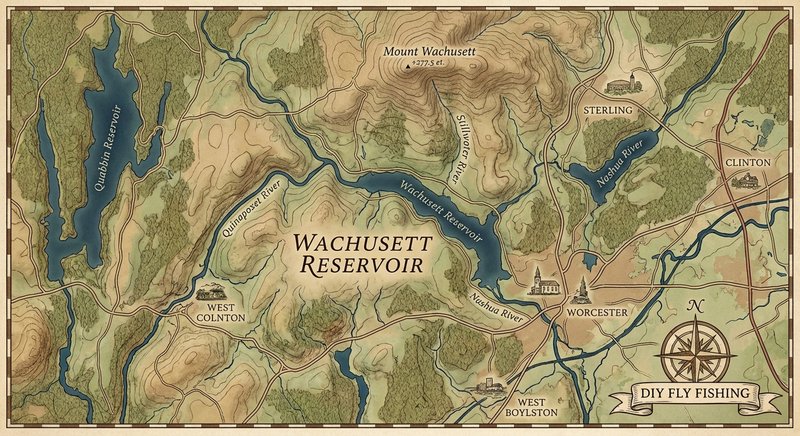
Wachusett Reservoir
Fly fishing in Massachusetts · Intermediate · Best seasons: Spring, Fall
Target Species
Landlocked Salmon, Lake Trout, Brown Trout
About This Water
Worcester County reservoir with landlocked salmon and trout. Shore fishing.
Fishing Recommendations
Wachusett Reservoir is the "Crown Jewel" of Massachusetts freshwater fishing. Located in Central Massachusetts, this 4,000-acre body of water serves as a primary water supply for Boston, which is exactly why the fishing is world-class: no boats are allowed. This is a strictly shore-access fishery, creating a unique challenge for fly anglers who must contend with deep water, rocky points, and long casts.
Here is your guide to tackling "The Rez" with a fly rod.
🎣 Location Overview
Wachusett Reservoir is a massive, deep-water impoundment characterized by crystal-clear water, steep drop-offs, and over 37 miles of shoreline. Because internal combustion engines and even kayaks are prohibited, the fish are less pressured by noise, but they are highly nomadic.
Anglers love Wachusett because it offers a legitimate chance at a "trophy of a lifetime" from the shore. It is one of the few places in Southern New England where you can catch wild-spawning Landlocked Salmon and massive Lake Trout (often exceeding 10-15 lbs) within casting distance of the bank.
🐟 Target Species & Behavior
- Landlocked Salmon: These are the acrobats of the reservoir. In the spring, they follow the smelt (their primary forage) into the shallows as the water warms. In the fall, they congregate near the mouth of the Quinapoxet and Stillwater rivers for their spawning runs. They are aggressive, fast, and prone to leaping.
- Lake Trout (Lakers): Wachusett is famous for its self-sustaining Lake Trout population. Unlike most lakes where you need a downrigger to find them, the cold-water "shelf" at Wachusett brings these monsters into the 10–20 foot depth range in early spring and late fall, putting them within reach of a fast-sinking fly line.
- Brown Trout: Less common than the others but often reaching massive sizes. They are wary and tend to cruise the rocky shorelines and submerged stone walls at dawn and dusk.
📅 Best Times to Fish
Spring (Ice-out through May)
This is the prime window. As soon as the ice melts (usually early April), the "Smelt Run" begins. Forage fish move into the shallows to spawn, and the predators follow.
- Conditions: Overcast, "fishy" days with a slight chop on the water are best. Wind blowing into the shore you are fishing is actually a plus, as it pushes baitfish toward the bank.
Fall (September through October)
The reservoir closes to fishing on November 30th. In late September, as the water cools, salmon and trout move back into the shallows.
- Conditions: Focus on the "River End" (West Boylston area) as fish stage to move into the tributaries.
Time of Day
- First Light: Non-negotiable for the fly angler. The 30 minutes before and after sunrise are when the biggest fish are closest to the shore.
- Evening: The "Magic Hour" before sunset can be excellent for cruising Browns.
🪰 Recommended Flies & Techniques
Top Fly Patterns
- Smelt Imitations (Crucial): The Joe's Smelt, Gray Ghost, and Black Ghost. Size 4-8, long shank.
- Modern Streamers: White or Olive Game Changers (small to medium), Woolly Buggers (White or Olive), and Clouser Minnows (for weight to get deep).
- Egg Patterns: Glo-bugs in orange or pink (primarily for the fall near river mouths).
Techniques & Equipment
- The Setup: A 9-foot, 6-weight or 7-weight rod is the standard. You need the backbone to fight wind and heavy fish.
- Line Choice: This is the most important technical detail. You need two spools:
- Cold Weather/Spring: An intermediate sinking line or a Sink-Tip (Type 3 or 5).
- Late Spring: A fast-sinking integrated line (250-350 grains) to reach the "shelf" where Lakers hold.
- The Retrieve: Start with a "Count Down." Cast, count to 10 or 15, and use erratic, 6-inch strips to mimic a wounded smelt.
💡 Pro Tips & Local Knowledge
- The "Shelf": Use Google Earth before you go. Look for areas where the light blue water (shallow) turns dark blue (deep) very quickly. These "drop-offs" are highways for Lake Trout.
- Wind is your Friend: It’s tempting to fish with the wind at your back for easy casting, but the veterans fish the "windward" shore. The waves stir up nutrients and push smelt into the rocks; the trout are right behind them.
- Gates to Focus On:
- Gate 8: Deep water, classic Laker territory.
- Gate 35 (The Causeway): A legendary spot where the Stillwater River enters. Great for Salmon.
- Gate 19: Offers a mix of rocky points and deeper pockets.
- The "Wachusett Strip": If you see a swirl or a follow, speed up your retrieve. These fish are used to chasing fast-moving smelt; don't let them get a good look at the fly.
⚠️ Important Information
- Regulations: The reservoir is managed by the DCR (Department of Conservation and Recreation).
- Season: Generally opens the first Saturday in April and closes November 30th.
- Hooks: No internal combustion engines. No wading is allowed (this is a water supply rule)—you must stay on the bank.
- Permits: You need a standard Massachusetts Freshwater Fishing License. No additional "reservoir permit" is required, but you must follow all posted DCR signs.
- Ethos: This is a public drinking water supply. Carry out everything you carry in. No "marking" trees or leaving trash.
- Footwear: Wear sturdy hiking boots with good grip. You will be walking miles of shoreline over slippery rocks and steep embankments.
Guide’s Final Word: Wachusett is a game of persistence. You might cast 200 times for one strike, but when that line goes tight, it could be a 5-pound Landlocked Salmon that thinks it's a Tarpon. Bring your heavy sink tip, a box of white streamers, and get there before the sun.
Bug Hatches & Matching Flies
| Hatch | Type | Peak months | Time of day | Hook sizes | Matching flies |
|---|---|---|---|---|---|
| Chironomids (Midges) Chironomidae | midge | April, May, September, October | All Day | #18-24 | Zebra Midge #18-22, Griffith's Gnat #20-24, Chan's Chironomid #12-16 |
| Hendrickson Ephemerella subvaria | mayfly | April, May | Afternoon | #12-14 | Red Quill #12-14, Hendrickson Emerger #12-14, Pheasant Tail #12-14 |
| Hexagenia (Giant Mayfly) Hexagenia limbata | mayfly | June, July | Dusk/Evening | #6-10 | Hexagenia Spinner #6-8, Floating Hex Nymph #8-10, Hexagenia Nymph #6-10 |
| Blue Winged Olive Baetis spp. | mayfly | April, May, September, October | Afternoon | #18-22 | BWO Parachute #18-22, RS2 #20-22, Barr's BWO Emerger #18-20 |
| Sulphurs Ephemerella invaria | mayfly | May, June | Evening | #14-18 | Sulphur Parachute #14-16, Sparkle Dun #16-18, Sulphur Emerger #16-18 |
| Cinnamon Caddis Hydropsyche spp. | caddis | June, July, August | Evening | #14-18 | Elk Hair Caddis (Tan) #14-16, LaFontaine's Deep Sparkle Pupa #14-18, Pupa Emerger #16 |
| Carpenter Ants Camponotus | terrestrial | June, August, September | All Day | #10-16 | Black Foam Ant #12-16, Chernobyl Ant #10-14, Flying Ant #14-16 |
| Flying Ants Formicidae | terrestrial | September, October | Afternoon | #16-20 | Fur Ant (Black/Red) #16-20, Flying Ant #16-18, Hi-Vis Ant #18-20 |