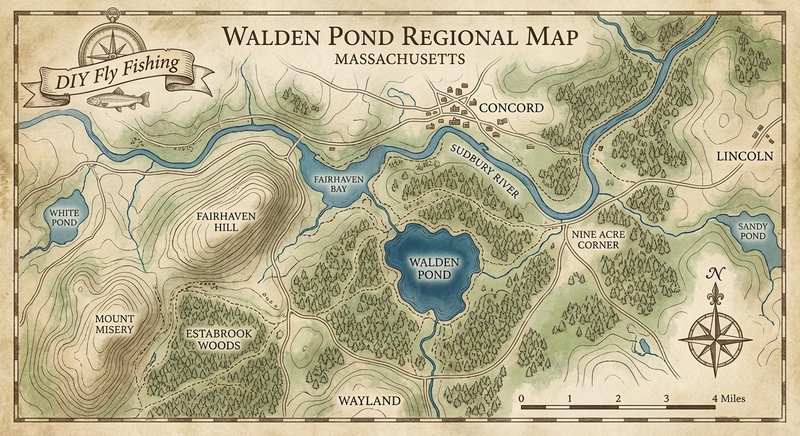
Walden Pond
Fly fishing in Massachusetts · Beginner · Best seasons: Spring, Summer, Fall
Target Species
Largemouth Bass, Pickerel, Perch
About This Water
Historic Concord pond made famous by Thoreau. Bass and panfish.
Fishing Recommendations
Welcome to Walden Pond in Concord, Massachusetts. While globally famous as the site of Henry David Thoreau’s cabin and the birthplace of the American conservation movement, Walden is also a unique and challenging "kettle hole" pond that offers a distinct fly fishing experience.
Unlike many shallow, murky New England ponds, Walden is exceptionally deep (over 100 feet) and boasts gin-clear water. This clarity requires a tactical approach, but the rewards are high-quality fish in a historic setting.
🎣 Location Overview
Walden Pond is a classic glacial kettle hole. Because it has no significant inlets or outlets, the water is filtered through the surrounding sandy soil, resulting in remarkable transparency. For the fly angler, this means two things: you can sight-fish for cruisers, but the fish can also see you from a mile away.
The pond features steep drop-offs, sandy flats, and localized weed beds. While it is heavily stocked with trout, it holds a robust population of "wild" warm-water species that thrive in the oxygenated depths and rocky shorelines. Fishing here feels more like fishing a high-alpine lake than a typical Massachusetts bass pond.
🐟 Target Species & Behavior
Largemouth Bass
Because of the water clarity, Walden’s bass tend to be more nomadic and "educated" than those in smaller, muddier ponds.
- Behavior: They often cruise the edge of the "shelf" (where the shallow sandy bottom drops off into deep blue water).
- Feeding: They focus on young-of-the-year perch, crayfish, and dragonflies. In the summer, they may suspend deep during the day and move into the shallows to hunt under the cover of low light.
Chain Pickerel
These "water wolves" are the primary predators in the weedy sections.
- Behavior: They hide in the lily pads and submerged vegetation, primarily in the shallower coves like Thoreau’s Cove.
- Feeding: They are opportunistic, hitting anything that flashes or vibrates. They are particularly active in the cooler months of spring and fall.
Yellow Perch
Walden holds a massive population of perch, which serve as the primary forage for the bass.
- Behavior: They travel in schools along the bottom. Large "jumbo" perch can be found in 10–15 feet of water.
- Feeding: They focus on midges, scuds, and small minnows.
📅 Best Times to Fish
- Spring (April – June): This is the prime window. As the water warms, bass and pickerel move into the shallows for the spawn. You can sight-fish for large bass on the sandy flats near the boat ramp or the back coves.
- Summer (July – August): The pond becomes very busy with swimmers. Early morning (5:00 AM – 8:00 AM) is the only viable time. Once the sun is high, fish retreat to the deep drop-offs.
- Fall (September – October): As the crowds thin and the water cools, the fish become aggressive again. This is the best time for "topwater" action as bass fatten up for winter.
- Optimal Conditions: Overcast days are your best friend at Walden. The clouds cut the glare and make the fish less "spooky" in the clear water.
🪰 Recommended Flies & Techniques
Top Fly Patterns
- For Bass:
- Gamechanger (White/Olive): Mimics the perch and trout forage.
- Woolly Bugger (Black or Olive, Size 4-8): A universal producer.
- Clouser Minnow (Chartreuse/White): Great for reaching the shelf quickly.
- For Pickerel:
- Dahlberg Diver: For explosive surface strikes near weeds.
- Flashabou Streamers: Anything with high flash to trigger their predatory instinct.
- For Perch:
- Zebra Midges (Size 18-20): Fish these under a small indicator.
- Small Pheasant Tail Nymphs: Effective along the sandy bottoms.
Techniques
- The "Shelf" Strip: Stand on the shallow flat and cast your streamer out over the deep blue drop-off. Let it sink for 10–15 seconds on a sink-tip line, then strip it back up the "hill." Bass often sit right on that edge waiting for prey to emerge from the deep.
- Sight Casting: In the spring, walk the perimeter path quietly. Use polarized sunglasses to spot bass on the beds or cruising. Use a long leader (12ft+) and 4X or 5X fluorocarbon tippet to avoid detection.
- Topwater Popper: In the evenings, fish small poppers around downed timber.
💡 Pro Tips & Local Knowledge
- Stealth is Mandatory: Because the water is so clear, avoid bright-colored fly lines. A clear intermediate sink-tip or a neutral-colored floating line is preferred. Wear earthy tones to blend into the trees.
- The Deep Hole: If you have a float tube or kayak, head to the center-west portion of the pond. While the bass stay closer to the shore, the largest perch often school deep.
- Thoreau’s Cove: This area has more "structure" (fallen logs and weeds) than the main beach area. It is the most consistent spot for Pickerel.
- The "Hatch": Keep an eye out for Hexagenia (Giant Mayflies) in late June. While Walden isn't a classic "dry fly" pond, a large Hex pattern at dusk can produce surprising results from large Bass.
⚠️ Important Information
- Access: Entry is through the Walden Pond State Reservation main entrance on Route 126. There is a daily parking fee ($15 for MA residents, $30 for non-residents). The lot fills up fast in summer—once it's full, they close the park.
- Regulations:
- A Massachusetts freshwater fishing license is required.
- Walden is a "no motors" pond. Electric trolling motors are allowed, but most anglers use kayaks, canoes, or float tubes.
- Lead weights/sinkers are prohibited in MA for all inland waters to protect loons.
- Special Consideration: Walden is a "Sacred Space." Be mindful of the many swimmers and hikers. Avoid casting in the designated swimming beach area. Fly fishing from a kayak or float tube is the best way to escape the crowds and access the best water.
Guide’s Final Word: Walden Pond is a thinking man’s fishery. Don't expect "easy" fish, but do expect a beautiful, meditative experience in the footsteps of Thoreau. Tie your knots well—the bass here have plenty of time to inspect your fly!
Bug Hatches & Matching Flies
| Hatch | Type | Peak months | Time of day | Hook sizes | Matching flies |
|---|---|---|---|---|---|
| Chironomids Chironomidae | midge | March, April, October, November | All day | #18-24 | Zebra Midge #18-22, Griffith's Gnat #20-24, Chromie #18-20 |
| Speckled Dun Callibaetis | mayfly | May, June, September | Morning | #14-16 | Callibaetis Spinner #14-16, Hare's Ear Nymph #14-16, Parachute Adams #14-16 |
| Cinnamon Sedge Limnephilidae | caddis | June, July | Evening | #14-18 | Elk Hair Caddis (Cinnamon) #14-16, Pupa Emerger #16-18, Soft Hackle Hare's Ear #14-16 |
| Angler's Curse Caenis | mayfly | July, August | Early Morning | #22-26 | Caenis Spinner #22-24, Micro Midge #24-26 |
| Terrestrial Ants Formicidae | terrestrial | July, August, September | Afternoon | #16-20 | Black Foam Ant #16-18, Flying Ant #18-20, Cinnamon Ant #16-18 |
| Trico Tricorythodes | mayfly | August, September | Morning | #20-24 | Trico Spinner #20-22, RS2 #20-22 |
| Japanese Beetle Popillia japonica | terrestrial | July, August | Afternoon | #12-14 | Foam Beetle #12-14, Coffee's Sparkle Beetle #14 |
| Micro Caddis Hydroptilidae | caddis | July, August | Evening | #20-24 | CDC Caddis #22-24, Zebra Midge (Green) #20-22 |