Waquoit Bay
Fly fishing in Massachusetts · Intermediate · Best seasons: Summer, Fall
Target Species
Striped Bass, Bluefish, Scup
About This Water
Cape Cod estuary with striped bass and blue crabs. National Estuarine Reserve.
Fishing Recommendations
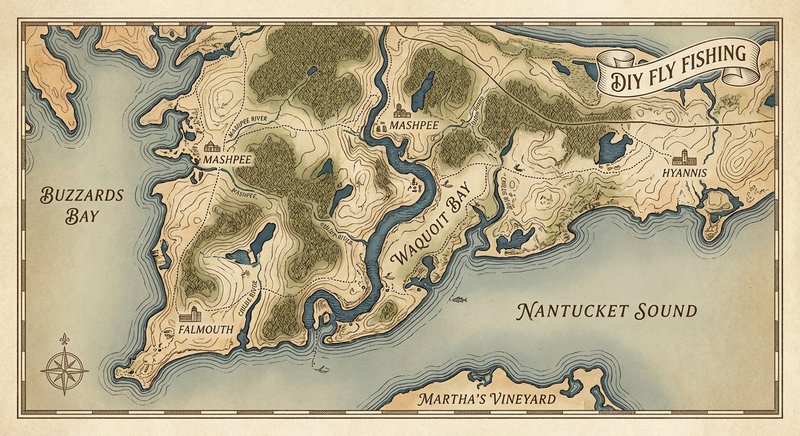
Welcome to Waquoit Bay, one of the crown jewels of Cape Cod’s southern shore. As a guide, I consider this one of the most versatile fly fishing estuaries in Massachusetts. Located between Falmouth and Mashpee, Waquoit is a shallow, sand-bottomed embayment protected by a barrier beach (Washburn Island and Dead Neck). It offers a classic "New England Salt" experience—combining technical sight fishing on sand flats with high-energy blitzes at the inlet.
🎣 Location Overview
Waquoit Bay is a fertile estuary system fed by the Quashnet and Childs Rivers, making it a "biological engine" for the Vineyard Sound. What makes it special is the diversity of habitat: you have expansive shallow flats, salt marshes, deep-water channels, and a high-velocity inlet.
The water is generally clearer than the North Shore marshes, allowing for incredible sight-fishing opportunities on the flats behind Washburn Island. Anglers love it because it provides shelter from heavy winds that often blow out the open sound, and it serves as a massive nursery for baitfish, keeping predators nearby all season long.
🐟 Target Species & Behavior
Striped Bass
The "bread and butter" of the bay.
- Behavior: During the day, they cruise the shallow flats (1–3 feet of water) looking for crabs and shrimp. At night and during tide changes, they move to the "elbows" of the channels and the main inlet to ambush bait.
- Feeding: They focus on silversides, mummichogs (killifish), sand eels, and green crabs.
Bluefish
The "yellow-eyed devils" enter the bay in waves.
- Behavior: Bluefish in Waquoit range from "snappers" (juveniles) to "gators" (10+ lbs). They are aggressive and often reveal themselves through surface "tailing" or explosive blitzes.
- Feeding: They will eat anything that moves, but they particularly love menhaden (bunker) and squid.
Scup (Porgy)
Often overlooked by fly anglers, but pound-for-pound great fighters.
- Behavior: They hold over structure—look for rock piles, dock pilings, or the edges of eelgrass beds.
- Feeding: They have small mouths and focus on tiny crustaceans and marine worms.
📅 Best Times to Fish
Optimal Seasons
- Summer (June–August): This is prime time for sight fishing the flats. The early morning "skinny water" bite is legendary.
- Fall (September–October): The "Fall Run" brings massive schools of migratory stripers and blues as they stage in the bay before heading south. This is when you see the most surface activity.
Best Times of Day
- Low Light: Dawn and dusk are peak for surface activity.
- The "Magic" Window: The last two hours of the falling tide and the first hour of the rising tide. The outgoing tide flushes baitfish from the marshes and the Quashnet River into the main bay—it’s a conveyor belt of food for the fish.
🪰 Recommended Flies & Techniques
Top Fly Patterns
- Clouser Minnow (Chartreuse/White or Tan/White): The universal choice. Use #2 to 2/0 for Bass; go smaller for Scup.
- Mushmouth or Epoxy Silverside: Essential when fish are keyed in on the tiny rain bait in mid-summer.
- Ray’s Fly: A classic local pattern that mimics a sand eel perfectly.
- Gurglers or Bob’s Banger: For topwater action. Use a wire trace if Bluefish are present.
- Crab/Shrimp Patterns: Essential for sight-casting to "cruisers" on the flats.
Techniques
- The Flats: Use a 9-weight rod with a floating line. Wade slowly and look for "shadows" or "nervous water." Long leaders (9–12 ft) are necessary as the fish can be spooky in 2 feet of water.
- The Channels/Inlet: Switch to an intermediate or sink-tip line. Cast across the current, let it sink, and use a fast, erratic strip to mimic a disoriented baitfish being swept out to sea.
- Scup Fishing: Use a weighted #6 or #8 shrimp pattern on a sinking line. Short, jigging strips near the bottom are key.
💡 Pro Tips & Local Knowledge
- The Washburn Island Edge: The eastern side of Washburn Island has a beautiful drop-off. Fish the transition zone where the shallow sand meets the deeper eelgrass.
- The "Quashnet" Mouth: Where the Quashnet River meets the bay is a "cold water refuge." During the heat of August, striped bass will hold here because the river water is significantly cooler than the bay.
- The Stealth Factor: If wading, move like a heron. The sand flats reflect light, and stripers can see your silhouette from a distance. Wear neutral-colored clothing.
- The Night Shift: Some of the largest Bass in Waquoit are caught between 10 PM and 2 AM on black streamers or surface sliders. The bay stays quiet, and the big fish lose their wariness.
⚠️ Important Information
Access
- Waquoit Bay National Estuarine Research Reserve (WBNERR): The visitor center on Route 28 offers parking and access to the upper bay.
- White’s Landing: A popular spot for launching kayaks or small skiffs.
- Washburn Island: Accessible only by boat. This is the "holy grail" for local fly fishers—camping is available by permit, allowing you to fish the prime dawn/dusk windows.
Regulations & Permits
- Saltwater Fishing Permit: A Massachusetts Saltwater Fishing Permit is required for all anglers age 16 and older.
- Striped Bass Regs: Massachusetts has strict "Slot Limit" regulations (currently 28" to less than 31"). Most fly anglers in the bay practice 100% catch and release to protect the fishery.
- Circle Hooks: If you decide to use bait at any point, state law requires the use of non-offset circle hooks.
Special Considerations
- Tidal Currents: The inlet at the south end of the bay (between Dead Neck and South Cape Beach) can have extremely dangerous currents. Do not attempt to wade across the inlet.
- Piping Plovers: Parts of the barrier beaches are often closed to foot traffic in early summer to protect nesting shorebirds. Always respect "Area Closed" signs.
Bug Hatches & Matching Flies
| Hatch | Type | Peak months | Time of day | Hook sizes | Matching flies |
|---|---|---|---|---|---|
| Cinder Worm Nereis limbata | midge | May, June | Evening | #10-14 | V-Rib Cinder Worm #12, Floating Worm #10-12 |
| Blue-Winged Olive Baetis spp. | mayfly | April, May, September, October | Afternoon | #18-22 | RS2 #20, BWO Parachute #18-22 |
| Tan Caddis Hydropsyche | caddis | May, June, July | Evening | #14-16 | Elk Hair Caddis #14-16, Pupa Sparkle #16 |
| Salt Marsh Midge Chironomidae | midge | May, August, September | Morning/Evening | #20-24 | Zebra Midge #20-22, Griffith's Gnat #22 |
| Sulphur Ephemerella invaria | mayfly | June | Evening | #14-16 | Sulphur Parachute #14-16, Pheasant Tail #14-18 |
| Black Carpenter Ant Camponotus pennsylvanicus | terrestrial | June, July, August | Afternoon | #12-16 | Black Foam Ant #14-16 |
| Grass Shrimp Palaemonetes pugio | terrestrial | July, August, September | All Day | #08-12 | Ultra Shrimp #10, Glass Shrimp #12 |
| Salt Marsh Mosquito Ochlerotatus sollicitans | midge | July, August | Evening/Night | #18-22 | Mosquito Larva #20, CDC Mosquito #20 |